
Hunter is one of the most recognisable footwear names in Britain, built on the glossy rubber Wellington boot worn everywhere from country estates to music festivals. The brand carries a royal warrant heritage and a 160 year history.
Hunter was founded in 1856 in Edinburgh as the North British Rubber Company, and its intellectual property is now owned by the American brand management group Authentic Brands Group.
So where are Hunter boots actually made and are they still worth the money in 2026? This guide covers the collapse of the original company, the licensing structure that replaced it, and what buyers report today. Read this first.
Table of Contents
Who Owns Hunter Boots

Hunter Boot Ltd collapsed into administration in June 2023 owing creditors more than 112 million pounds, with a parallel filing in Canada at the end of that month.
Authentic Brands Group acquired the Hunter intellectual property in June 2023 and converted the business into a licensing model rather than a traditional operating company.
Under that structure the Batra Group handles the UK and European business while Marc Fisher Footwear handles the United States, and Fashion Dive reported the terms at the time.
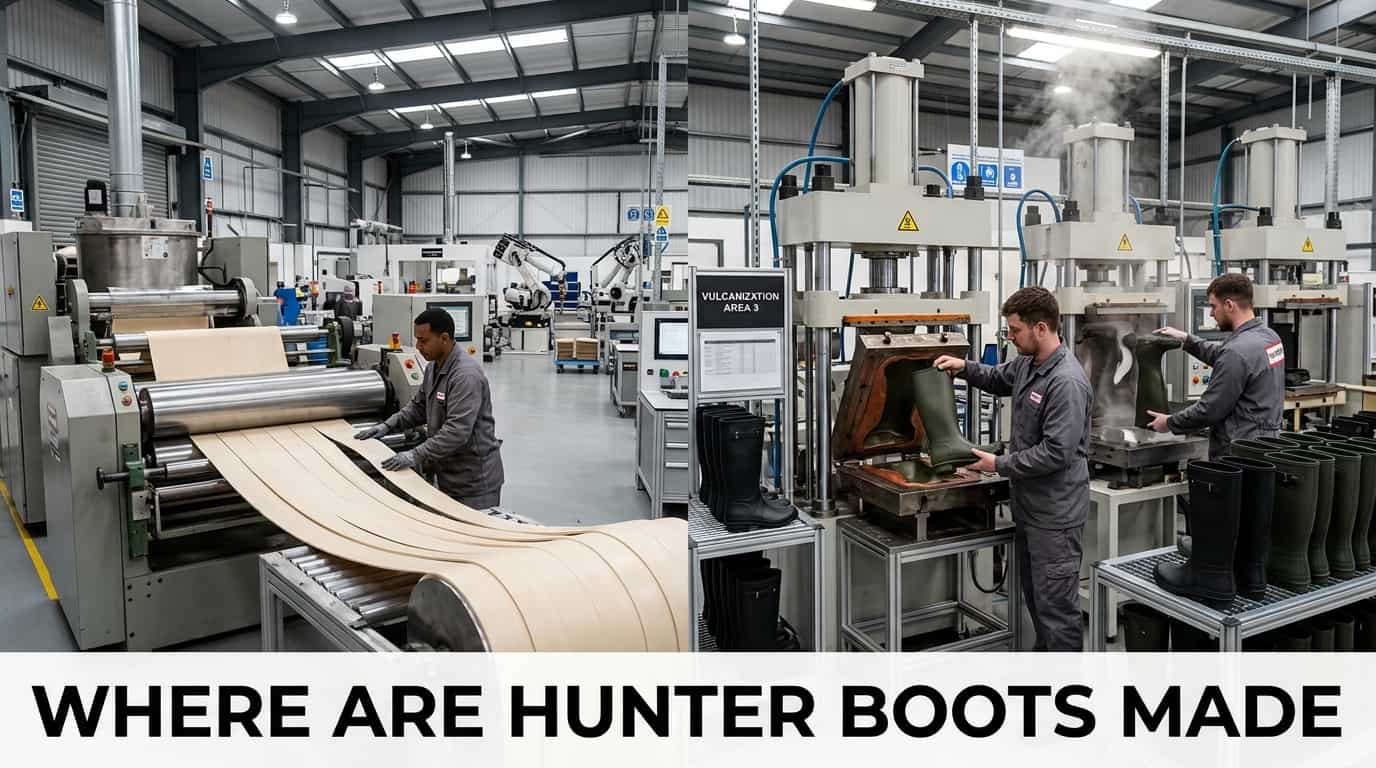
Where Are Hunter Boots Made
Hunter boots are made in China, and have been for many years, despite the strongly British presentation of the brand.
The original green Wellington boots were made in Scotland at the Dumfries factory, but that plant closed in 2008 and production moved offshore, with Wikipedia noting the signature green Wellingtons are now manufactured in China.
The reliance on Chinese production was itself a factor in the collapse, since supply chain disruption and prolonged factory shutdowns hit the company hard during the pandemic years.
A Look At Hunter Boots History
The company began in 1856 when American businessman Henry Lee Norris founded the North British Rubber Company in Edinburgh to produce rubber goods.
The firm supplied trench boots to the British Army during the First World War, and again during the Second World War, which is where the durability reputation originally came from.
The Hunter name and the tall glossy Wellington became a fashion object in the 2000s, helped enormously by festival photography, before the underlying business ran into trouble.
Hunter Boots And The Licensing Model
Since 2023 Hunter has functioned as a licensed brand rather than a single manufacturer, which changes what buyers are actually purchasing.
Different licensees now design, manufacture and distribute Hunter product in different regions, so a boot bought in the United States and one bought in the UK may not come from the same supply chain.
Baozun acquired a 51 percent interest in the Hunter intellectual property for Greater China and Southeast Asia in August 2023, and Fashion Dive covered that agreement in detail.
Hunter Boots Warranty And Customer Support
Hunter offers a limited warranty on manufacturing defects, but the coverage window is short compared with premium footwear brands.
Because the brand now runs through regional licensees, warranty handling depends on where the boots were bought, and customers have reported inconsistent outcomes between territories.
The most common warranty complaint concerns cracking and splitting of the rubber, which the brand has historically treated as wear rather than defect in many cases.
Hunter Compared To Other Boot Brands
Against Aigle and Le Chameau, Hunter loses badly on construction, since those French brands still hand build natural rubber boots that outlast the Hunter Original by years.
Against Muck Boot and Bogs, Hunter is less warm, less practical and less durable, but far more fashion driven, which is the actual point of the brand.
Against genuine heritage outdoor footwear the comparison is unflattering, and buyers wanting boots built for real use are better served by the makers in our Danner boots manufacturing guide.
Hunter competes most directly with other fashion led heritage names that moved offshore, a pattern also visible in our UGG boots guide.
Is Hunter Boot Really Good
Hunter is the rare case where owner sentiment has clearly declined over time, and the criticism is specific rather than vague.
The positives are real, since the boots look excellent, the silhouette is genuinely iconic, and they are completely waterproof and easy to clean when new.
Comfort with thick socks or the branded boot socks is decent, and the tall shaft handles mud, festivals and dog walking exactly as intended.
The dominant complaint is cracking, with a large number of owners reporting splits across the flex point at the ankle within one to three years of light use.
Long term customers repeatedly say the boots are not what they were when Dumfries built them, and the offshore move is the reason most commonly given.
The fair verdict for 2026 is that Hunter is a style purchase rather than a durability purchase, and anyone buying rubber boots for genuine hard outdoor use will get far better value from Le Chameau, Aigle or a dedicated work boot brand.
Hunter Boots Frequently Asked Questions
Where Are Hunter Boots Made
Hunter boots are made in China, and have been since the Scottish Dumfries factory closed in 2008.
Who Owns Hunter Boots
Authentic Brands Group owns the Hunter intellectual property after the original Hunter Boot Ltd fell into administration in June 2023.
Why Do Hunter Boots Crack
Cracking is the most reported Hunter fault and is generally linked to the rubber compound and flex stress at the ankle after the move to offshore production.
Are Hunter Boots Worth The Money
Hunter is worth it in 2026 for style and everyday wet weather use, but Le Chameau and Aigle offer far better durability for serious outdoor work.

I am Jack Neel, a mechanical engineer, researcher, and writer. I created this website to share my knowledge about different brands and products with you. I research the manufacturers behind the brands and provide you with the information you need to make smart buying decisions.