

Goodman HVAC systems are primarily made by Goodman Global Group, Inc., a prominent name in the heating, ventilation, and air conditioning industry.
Goodman is a well-established brand known for manufacturing a wide range of residential and light commercial HVAC products, including air conditioners, furnaces, heat pumps, and indoor air quality solutions.
Goodman Global Group, Inc. itself operates as a subsidiary of Daikin Industries, Ltd., a leading global manufacturer of HVAC systems based in Japan.
Why does knowing the manufacturer and its parent company matter when you are considering a new HVAC system for your home or business?
This article will explore the ownership of Goodman HVAC, its manufacturing processes, product offerings, market reputation, and what this all means for consumers seeking reliable and efficient heating and cooling solutions.
So let’s get started.
Table of Contents
Who Owns the Goodman HVAC Brand?
The Goodman HVAC brand is owned by Goodman Global Group, Inc. This company operates as a wholly-owned subsidiary of Daikin Industries, Ltd.
Daikin Industries, Ltd. is a multinational corporation headquartered in Osaka, Japan. It is one of the world’s largest manufacturers of air conditioning equipment.
Daikin acquired Goodman Global Group, Inc. in 2012. This move significantly expanded Daikin’s presence in the North American HVAC market.
The acquisition combined Goodman’s strong distribution network and focus on value-driven products with Daikin’s advanced technology and global manufacturing capabilities.
This ownership structure allows Goodman to benefit from Daikin’s extensive research and development resources, along with its commitment to quality and innovation in the HVAC sector.
Where Are Goodman HVAC Units Manufactured?
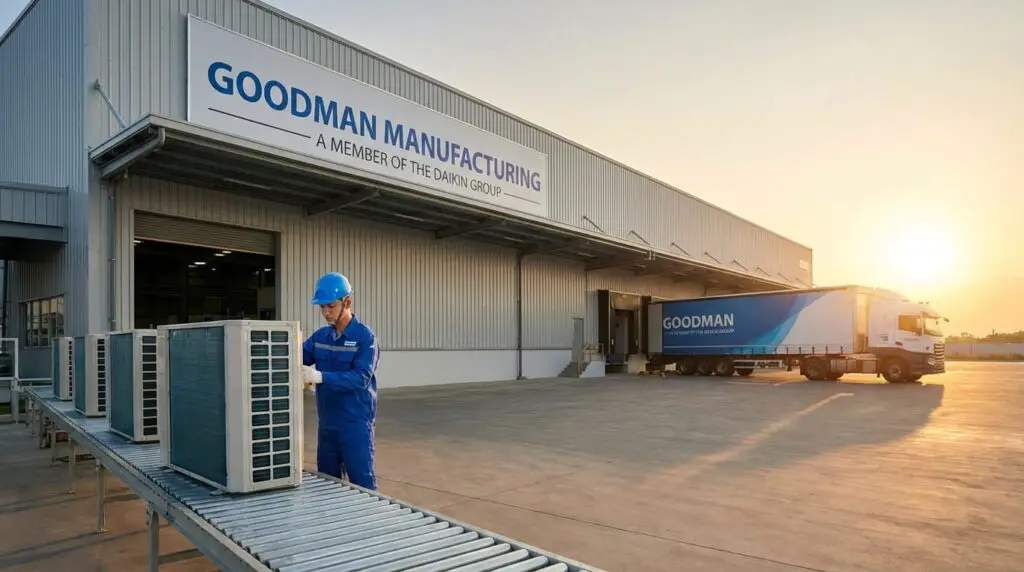
Goodman HVAC units are primarily manufactured in the United States. Much of their production occurs at their state-of-the-art facility in Waller, Texas.
This massive campus, known as the Daikin Texas Technology Park, stands as one of the largest tilt-wall buildings worldwide.
The facility is designed for integrated manufacturing, bringing together research and development, engineering, manufacturing, and logistics under one roof.
This integrated approach allows Goodman and Daikin to streamline production, maintain strict quality control, and quickly respond to market demands for their heating and cooling products.
Producing units domestically ensures product availability, supports local economies, and allows for close oversight of manufacturing processes.
What Types of HVAC Products Does Goodman Offer?
Goodman offers a wide selection of heating, ventilation, and air conditioning products designed for both residential and light commercial applications.
Their product line includes central air conditioners, a core offering known for efficiently cooling homes.
They also manufacture gas furnaces, which provide reliable heating during colder months and are available in various efficiencies to suit different needs.
Heat pumps are another key product, offering both heating and cooling in a single unit, making them a versatile choice for many climates.
Beyond the main systems, Goodman produces evaporator coils, essential components for air conditioning and heat pump systems.
They also provide air handlers, which work with heat pumps and air conditioners to circulate conditioned air.
To improve indoor air quality, Goodman offers a selection of air purification systems, humidifiers, and dehumidifiers, addressing common airborne pollutants and humidity issues.
Thermostats and control systems are also part of their portfolio, allowing users to manage HVAC systems for optimal comfort and energy efficiency.
Is Goodman Considered a Good Quality HVAC Brand?
The HVAC industry generally views Goodman as a reliable, value-oriented brand. It has built a reputation for providing dependable heating and cooling solutions at a more accessible price point than some premium brands.
While often positioned as a budget-friendly option, this does not mean it lacks quality. Instead, Goodman focuses on proven technology and standardized components to deliver consistent performance.
Under Daikin’s ownership, Goodman has benefited from improved manufacturing processes and quality control, further solidifying its reputation for durability.
Many HVAC technicians and homeowners appreciate Goodman’s straightforward design, which can lead to easier installation and maintenance.
Consumer experiences vary, as with any brand. However, in discussions on platforms like Reddit’s r/HVAC, Goodman is often recommended for those seeking a balance of cost-effectiveness and functionality.
Ultimately, the quality of an installed Goodman system, like any HVAC brand, depends heavily on the installation contractor’s expertise and adherence to proper maintenance schedules.
How Does Goodman Compare to Other HVAC Brands?
When compared to other HVAC brands, Goodman typically occupies a specific market niche, often characterized by its balance of affordability and functionality.
Compared to premium brands like Daikin (its parent company), Carrier, or Trane, Goodman systems generally come with a lower initial purchase price.
Premium brands often feature proprietary technologies, higher SEER ratings across more models, and sometimes more advanced features or quieter operation.
Goodman, in contrast, focuses on delivering reliable cooling and heating using established technologies, without necessarily incorporating every cutting-edge innovation found in higher-tier products.
Its product line offers good energy efficiency, with many models meeting or exceeding minimum federal standards. However, it may have fewer ultra-high-efficiency options compared to some competitors.
For consumers prioritizing value and dependable performance without needing the absolute highest efficiency ratings or most advanced features, Goodman presents a compelling option.
Brands like Lennox or York might offer a broader range of high-end features and technologies. Goodman, however, aims for broader market appeal through cost-effectiveness.
It’s important to consider that while equipment cost can be lower, overall system performance and longevity are greatly influenced by installation quality, a factor true for any brand.
Are Goodman HVAC Parts Readily Available?
Yes, Goodman HVAC parts are generally readily available throughout North America, which is a significant advantage for both homeowners and HVAC service professionals.
Goodman has a robust distribution network, supported by its extensive dealer and service technician base, ensuring that replacement parts can be sourced efficiently.
The brand’s focus on standardized designs and widely used components also contributes to easy part availability, as many parts are not proprietary or difficult to find.
This widespread availability helps minimize downtime if a repair is needed, allowing technicians to quickly obtain components and restore system function.
The large number of Goodman systems installed across the country further incentivizes distributors and suppliers to stock a broad inventory of their parts.
Ultimately, easy access to parts contributes to lower long-term maintenance costs and provides peace of mind regarding your Goodman HVAC system’s longevity.
What is the Typical Lifespan of a Goodman HVAC System?
The typical lifespan of a Goodman HVAC system, like most central heating and air conditioning systems, generally falls within the range of 10 to 15 years.
Several factors significantly influence a system’s lifespan, including the quality of the original installation.
Proper sizing of the unit for a home’s square footage and insulation is critical. An undersized or oversized unit will cycle improperly and wear out faster.
Regular maintenance is another key determinant. Annual professional tune-ups, filter changes, and coil cleanings can considerably extend a system’s life by ensuring components operate efficiently.
Environmental factors, such as extreme temperatures or corrosive atmospheres, can also impact durability over time.
Frequency of use also plays a role. Systems in areas with more extreme weather patterns that run almost year-round may experience more wear and tear.
While 10 to 15 years is a common estimate, a well-maintained Goodman system with excellent installation can sometimes exceed this timeframe, potentially reaching 20 years or more.
What is Daikin’s Relationship with Goodman HVAC?
Daikin Industries, Ltd. has a direct and significant relationship with Goodman HVAC as its parent company. Daikin acquired Goodman Global Group, Inc. in 2012, bringing the North American brand under its global umbrella.
This acquisition allowed Daikin, a Japanese company known for its strong international presence and focus on high-efficiency, innovative HVAC solutions, to gain significant market share in the United States.
For Goodman, this relationship provides access to Daikin’s extensive research and development capabilities, advanced technological expertise, and global best practices in manufacturing.
It led to investments in new facilities, such as the Daikin Texas Technology Park, where many Goodman products are now produced.
While Goodman maintains its distinct brand identity and focus on value, it benefits from the backing of a global HVAC technology leader, enhancing its product quality and overall market standing.
This partnership enables both brands to cater to different market segments while utilizing shared resources and operational efficiencies.
Daikin also offers its own line of premium HVAC products in North America, distinct from Goodman. Both companies, however, operate under the same corporate ownership structure.

I am Jack Neel, a mechanical engineer, researcher, and writer. I created this website to share my knowledge about different brands and products with you. I research the manufacturers behind the brands and provide you with the information you need to make smart buying decisions.