
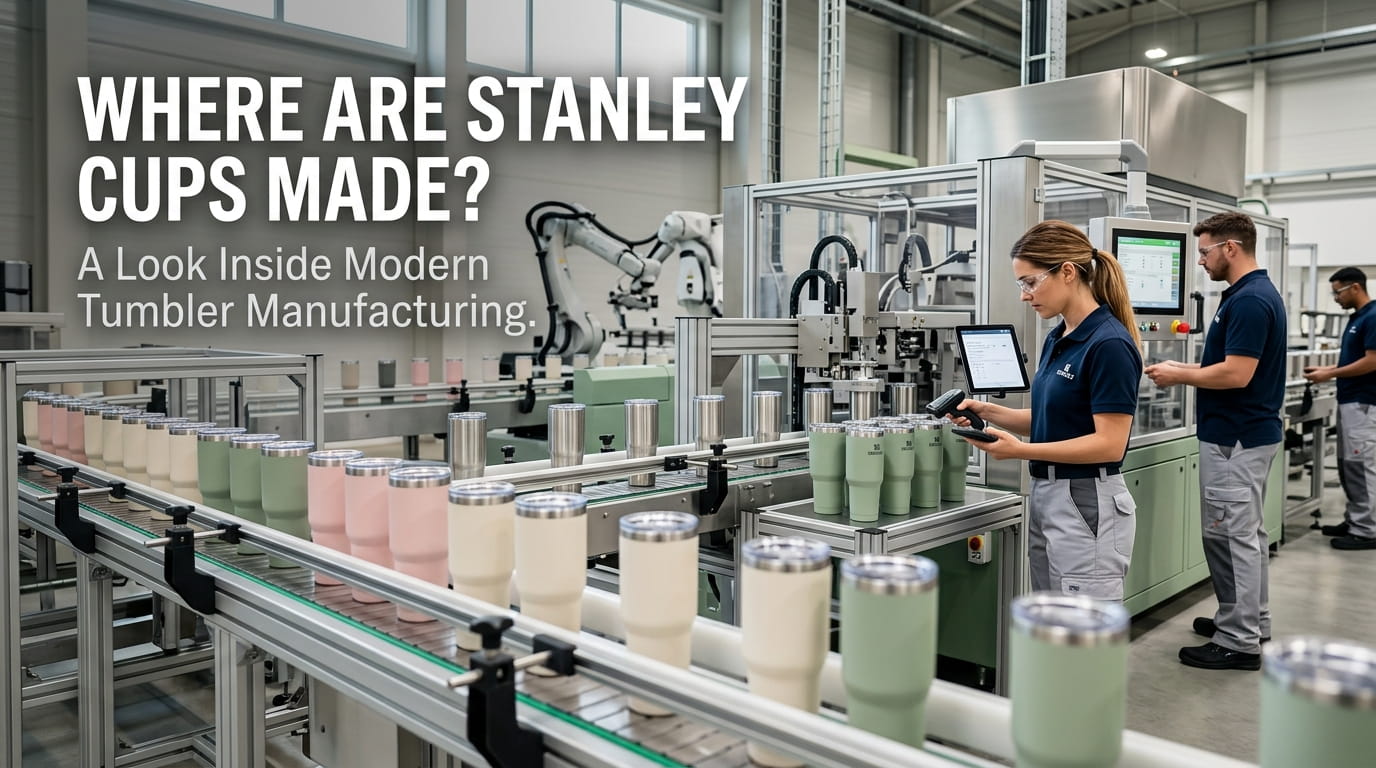
Stanley cups are made in China, where the brand’s contract manufacturers produce virtually the entire Stanley product lineup including the famous Quencher tumbler, Classic vacuum bottles, IceFlow flasks, and Adventure series drinkware.
Stanley is an American brand founded in 1913 by inventor William Stanley Jr., but manufacturing moved to China in 2002 when Pacific Market International, now known as PMI Worldwide, acquired the brand.
PMI Worldwide, headquartered in Seattle, Washington, is the brand owner and designs all Stanley products in Seattle but contracts all physical production to specialized factories in China.
The Stanley Quencher tumbler, which went viral on social media between 2020 and 2023, grew the brand’s annual revenue from approximately $70 million to over $750 million, yet every unit was made in China throughout that period.
A smaller share of Stanley production takes place in Brazil, primarily at facilities in Manaus and Rio de Janeiro serving South American markets and select European distribution channels.
To check where your specific Stanley cup was made, look at the base of the cup or read the packaging, which will state the country of manufacture clearly as required by U.S. FTC rules.
Table of Contents
Who Owns Stanley and Who Makes the Cups?
Stanley 1913 is a brand operated by PMI Worldwide, a Seattle-based product company that also owns the Aladdin drinkware brand. PMI Worldwide is not a manufacturer.
It functions as a brand and design company that sets product specifications, owns the intellectual property, and oversees quality standards, but contracts actual production to outside factories.
All Stanley cups are manufactured by OEM (original equipment manufacturer) factories in China.
The primary production clusters are in Yongkang City, Zhejiang Province, which is sometimes called the Hardware Capital of China and houses the highest concentration of vacuum-insulated drinkware factories in the world, and in Dongguan, Guangdong Province.
Both regions have decades of stainless steel drinkware manufacturing experience and supply most major global drinkware brands.
PMI maintains oversight offices in Shanghai and Shenzhen to manage quality control, supplier relationships, and production scheduling.
The “Designed in Seattle” phrase that appears on Stanley packaging is a design attribution, not a country-of-origin claim, a distinction the U.S. Federal Trade Commission treats as legally separate from “Made in” labeling.
Where Are Stanley Cups Made by Product Line?
The Stanley Quencher H2.0, the 40-ounce tumbler that became the most sought-after water bottle in the country between 2022 and 2024, is made entirely in China across factories primarily in Yongkang, Zhejiang. Every size of the Quencher, from the 14-ounce to the 40-ounce, is Chinese-manufactured.
The Stanley Classic Legendary vacuum bottle, the brand’s original product dating to 1913 and still one of its best-sellers, is also made in China.
This bottle was at one point made in the United States, but domestic production ended decades ago following the general migration of stainless steel drinkware manufacturing to Asia.
The Adventure series, the IceFlow series, and the Go series of tumblers are all manufactured in China.
A limited number of premium products in the 1913 Heritage Series carry “Assembled in USA” markings, indicating that certain finishing steps occur domestically, but the core components are still Chinese-made.
Newer eco-focused product lines have begun emerging from Vietnam and Thailand factories as Stanley diversifies its supply chain to reduce dependence on Chinese production and manage U.S.-China tariff exposure.
Why Are Stanley Cups Made in China and Not the USA?
The stainless steel vacuum-insulated drinkware manufacturing infrastructure that Stanley relies on is almost entirely concentrated in China, specifically in the Yongkang industrial cluster in Zhejiang Province.
When PMI acquired Stanley in 2002 and needed to scale production to grow the brand globally, there was simply no comparable domestic manufacturing base in the United States capable of producing vacuum-insulated double-wall stainless steel containers at competitive costs and volumes.
The same is true for virtually every premium drinkware brand on the American market. Yeti, Hydro Flask, Thermos, S’well, Contigo, and most competitors all manufacture in China despite being American or European brands.
The vacuum insulation technology and the precision welding required to seal the inner and outer walls correctly without compromising insulation performance is a specialization that the Yongkang cluster developed over decades, making it effectively irreplaceable for the time being.
Stanley Cup vs. Yeti: Where Is Each One Made?
Both Stanley and Yeti manufacture their drinkware products in China. This surprises many buyers who assume premium American brands produce their goods domestically, but the entire vacuum-insulated tumbler and bottle category relies on Chinese OEM manufacturing regardless of the price point or brand prestige.
Stanley uses factories primarily in Yongkang, Zhejiang. Yeti uses factories in China as well for its Rambler drinkware line, though Yeti’s hard coolers, specifically the Tundra series, are made in Iowa and Wisconsin in the United States. On drinkware specifically, both brands are Chinese-manufactured.
The practical quality difference between Stanley and Yeti cups is minimal in everyday use. Both use 18/8 stainless steel, double-wall vacuum insulation, and BPA-free materials.
Yeti carries a premium price and a stronger outdoor lifestyle brand identity, while Stanley has broader mainstream retail penetration and the social-media driven cachet of the Quencher’s viral success.
Stanley’s Brief History: From Vermont Workshop to Social Media Phenomenon
William Stanley Jr. was a Vermont-born inventor who worked as an electrical engineer before pivoting to product design.
In 1913, he invented the first all-steel vacuum bottle, an improvement on the glass-lined Thermos bottles of the era that were fragile and prone to breakage in outdoor conditions. He founded the Stanley Bottle Company in Brooklyn, New York, to produce and sell the product.
For most of the 20th century, Stanley was primarily an outdoor and workwear brand, beloved by construction workers, hunters, campers, and military personnel for its extreme durability and lifetime warranty. The classic green Stanley bottle became a cultural icon of American working-class toughness.
In 1965, Aladdin Industries acquired Stanley and shifted some production to Tennessee. PMI acquired the brand in 2002 and moved manufacturing to China.
The modern era of Stanley’s popularity began in 2020 when president Terence Reilly, formerly of Crocs, launched an influencer-driven social media strategy targeting women and a younger audience than Stanley’s traditional customer base.
The Quencher tumbler became the centerpiece of that strategy, generating the kind of viral moment-driven demand that drove revenue tenfold in just a few years.
Are Stanley Cups Safe? Lead and Material Questions Answered
In early 2024, concerns circulated about lead content in Stanley cups following reports that some cups contained small amounts of lead in the pellet used to seal the vacuum insulation at the base. Stanley confirmed that a small amount of lead-containing material is used in that sealing pellet but stated that it is fully encased under a stainless steel cover and does not come into contact with beverages.
Stanley’s position is that the lead is inaccessible under normal use conditions and does not pose a health risk. California’s Proposition 65 regulations, which require warning labels for products containing lead above certain thresholds, apply to Stanley cups sold in California. The overall product body, including the interior surfaces that contact beverages, uses 18/8 food-grade stainless steel and carries no lead content.
Frequently Asked Questions About Where Stanley Cups Are Made
Are any Stanley cups made in the USA?
Essentially no. The vast majority of Stanley cups are made entirely in China. A small number of premium 1913 Heritage Series products carry “Assembled in USA” markings indicating some domestic finishing work, but the core materials and vacuum insulation components are Chinese-made. There is no meaningfully American-made Stanley tumbler currently in commercial production.
Is Stanley a Chinese brand?
No. Stanley is an American brand owned by PMI Worldwide, a Seattle-based company. The brand was founded in 1913 by an American inventor. China is where Stanley’s products are manufactured, but the brand ownership, design, and brand strategy are entirely American.
What factory makes Stanley cups?
Stanley does not publicly name its specific contract manufacturing partners in China. Production is spread across multiple OEM factories primarily in the Yongkang, Zhejiang Province industrial cluster and Dongguan, Guangdong Province. These factories also supply other major drinkware brands and operate under non-disclosure agreements with PMI Worldwide regarding their specific customer relationships.

I am Jack Neel, a mechanical engineer, researcher, and writer. I created this website to share my knowledge about different brands and products with you. I research the manufacturers behind the brands and provide you with the information you need to make smart buying decisions.