
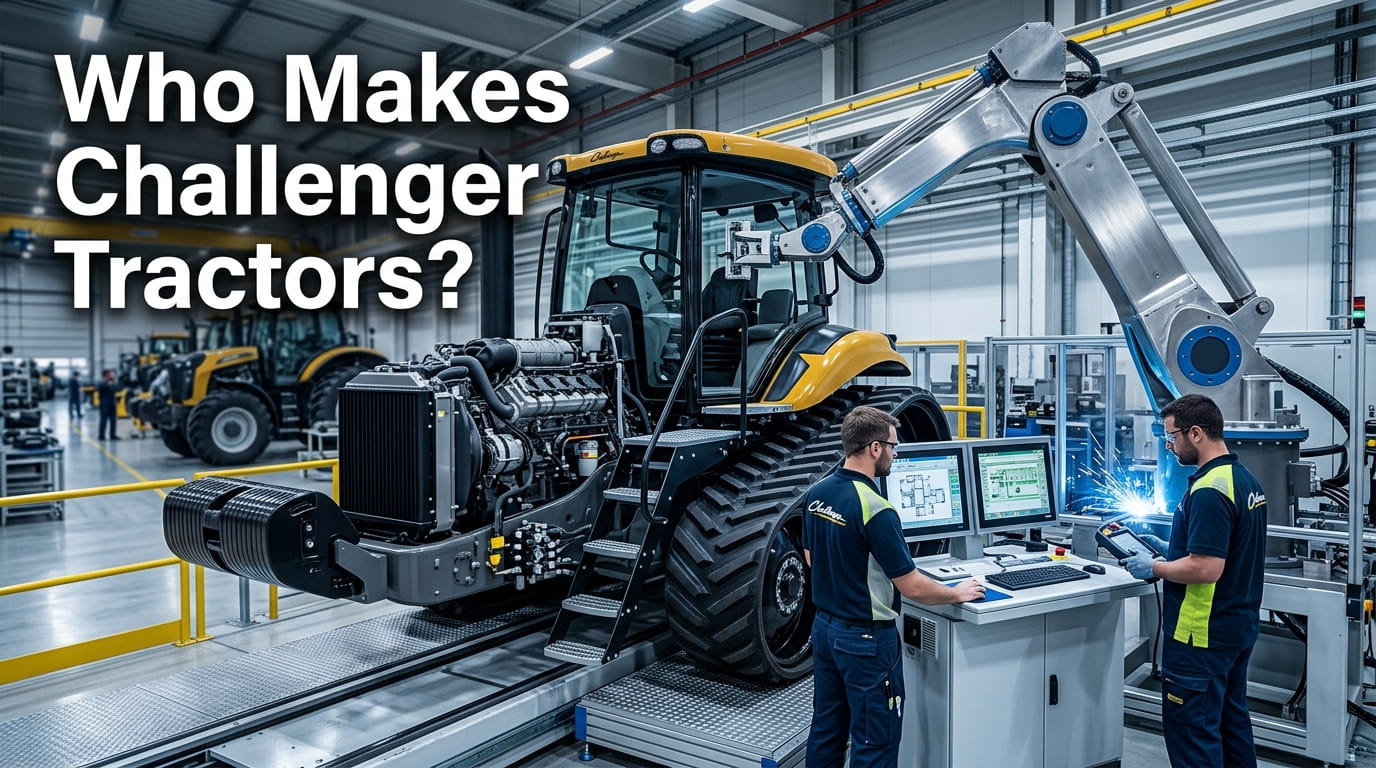
Challenger tractors are made by AGCO Corporation, which acquired the Challenger brand from Caterpillar Inc. in 2002 and has manufactured Challenger track and wheeled tractors at its Jackson, Minnesota facility ever since.
Challenger is a high-horsepower tractor brand focused on professional large-scale farmers, best known for its rubber belt track technology that provides exceptional flotation, reduced soil compaction, and high tractive efficiency compared to wheeled alternatives.
AGCO Corporation is headquartered in Duluth, Georgia, and is one of the world’s largest agricultural equipment manufacturers, also owning Fendt, Massey Ferguson, and Valtra alongside Challenger.
Knowing that AGCO’s Jackson, Minnesota plant is the largest tractor manufacturing facility in North America explains how Challenger can be produced at scale with the engineering resources of a global agricultural equipment company behind it.
This article covers who makes Challenger tractors, where they are produced, who owns the brand, its history, how it compares to a rival, and whether the tractors are any good.
So let’s get started.
Table of Contents
Who Makes Challenger Tractors?
Challenger tractors are made by Challenger, which operates as a brand of AGCO Corporation, produced at AGCO’s Jackson, Minnesota facility.
AGCO manufactures Challenger rubber belt track tractors and wheeled utility tractors designed for large row-crop and broad-acre farming operations where soil compaction and horsepower output are primary concerns.
The Challenger lineup currently covers high-horsepower rubber track tractors including the MT700, MT800, and MT900 series, as well as wheeled tractors in the 260 to 400-horsepower range.
AGCO also integrates its Fuse Technologies precision agriculture platform into the Challenger lineup, bringing GPS guidance, telematics, and data management capabilities to Challenger operators, as confirmed on AGCO’s company profile.
Where Are Challenger Tractors Made?
Challenger tractors are manufactured at AGCO’s Jackson, Minnesota facility, which is the largest tractor manufacturing plant in North America.
The Jackson plant produces Challenger, Massey Ferguson, and AGCO branded tractors on shared production lines, taking advantage of common components and economies of scale across AGCO’s North American portfolio.
AGCO’s Fendt tractor production remains in Marktoberdorf, Germany, with the Jackson facility focused specifically on the North American high-horsepower market where Challenger and Massey Ferguson compete.
AGCO’s broader manufacturing network includes 42 facilities across 21 countries, supporting the global distribution of all its brands.
Who Owns Challenger Tractors?
Challenger is owned by AGCO Corporation, which acquired the brand from Caterpillar Inc. in 2002 when Caterpillar decided to exit the agricultural rubber track tractor business.
Before AGCO, Challenger was a Caterpillar brand, launched in 1987 as the Caterpillar Challenger 65, the world’s first large agricultural rubber belt track tractor.
AGCO was founded in 1990 as Allis-Gleaner Corporation after the management buyout of Deutz-Allis’s North American operations, and has grown through acquisitions into one of the world’s four largest agricultural equipment companies.
AGCO’s full brand portfolio and corporate history are documented in AGCO’s company profile.
What Is the History of Challenger?
The Challenger brand was created by Caterpillar, which launched the Caterpillar Challenger 65 in 1987 as the world’s first large agricultural tractor to use rubber belt track technology instead of steel tracks or conventional tires.
The Challenger 65’s Mobil-trac rubber belt system delivered the flotation of tracks with the ride quality and field-to-road versatility of wheeled tractors, immediately attracting large-scale row-crop farmers who needed high tractive efficiency without destroying field surfaces or road infrastructure.
Caterpillar sold the agricultural Challenger business to AGCO in 2002, and AGCO has continued expanding the lineup with additional horsepower classes, wheeled models, and precision agriculture integration.
Today Challenger remains AGCO’s flagship brand for professional high-horsepower North American farming operations, competing directly with John Deere’s 9 Series and Case IH’s Steiger.
Challenger Tractors vs John Deere 9 Series Tractors: How Do They Compare?
Challenger and John Deere 9 Series are the two most commonly compared high-horsepower track tractor options for large North American row-crop operations.
John Deere’s 9RX series uses individual rubber track units at each corner, offering excellent flotation and high horsepower output with the benefit of the world’s largest dealer network behind it.
Challenger’s Mobil-trac belt system uses a single continuous belt on each side, which many farmers prefer for fuel efficiency, soil disturbance, and a smoother ride on roads between fields.
Both are premium professional machines, and the choice between them typically comes down to farm-specific soil conditions, operator preference for the belt system versus the four-track design, and which brand’s local dealer provides stronger support.
Are Challenger Tractors Any Good?
Challenger tractors are consistently rated as one of the most capable and fuel-efficient options in the high-horsepower track tractor category, earning strong marks from large-scale grain and row-crop farmers.
The Mobil-trac rubber belt system’s soil-preserving flotation and high tractive efficiency in wet or heavy conditions are particularly valued in the northern Corn Belt and Canadian Prairies where soil conditions challenge wheeled tractors.
AGCO’s integration of Fuse Technologies precision agriculture into Challenger gives operators access to competitive GPS guidance, data management, and fleet telematics capabilities.
Challenger’s dealer network is smaller than John Deere’s or Case IH’s, so buyers in areas with limited AGCO dealer coverage should evaluate local service availability carefully before purchasing.
For large-scale professional farmers who want the most fuel-efficient, soil-friendly, and high-horsepower track tractor technology backed by AGCO’s global engineering and North American manufacturing, Challenger is a premier choice in its category.
For more on related AGCO brands, see Where Are Mahindra Tractors Made and Who Makes RK Tractors.
Frequently Asked Questions About Challenger Tractors
Who makes Challenger tractors?
Challenger tractors are made by AGCO Corporation, which acquired the brand from Caterpillar Inc. in 2002. AGCO manufactures Challenger at its Jackson, Minnesota facility, the largest tractor plant in North America.
Where are Challenger tractors made?
Challenger tractors are made at AGCO’s Jackson, Minnesota manufacturing facility, which is the largest tractor production plant in North America and also produces Massey Ferguson and AGCO branded tractors.
Was Challenger originally a Caterpillar brand?
Yes. Caterpillar launched the original Challenger 65 in 1987, inventing the agricultural rubber belt track tractor concept. Caterpillar sold the agricultural Challenger business to AGCO in 2002.
What is the Challenger Mobil-trac system?
The Mobil-trac system is Challenger’s proprietary rubber belt track technology, which uses a single continuous rubber belt on each side of the tractor. It delivers the soil flotation benefits of tracks with the road-travel convenience of wheeled tractors.

I am Jack Neel, a mechanical engineer, researcher, and writer. I created this website to share my knowledge about different brands and products with you. I research the manufacturers behind the brands and provide you with the information you need to make smart buying decisions.