
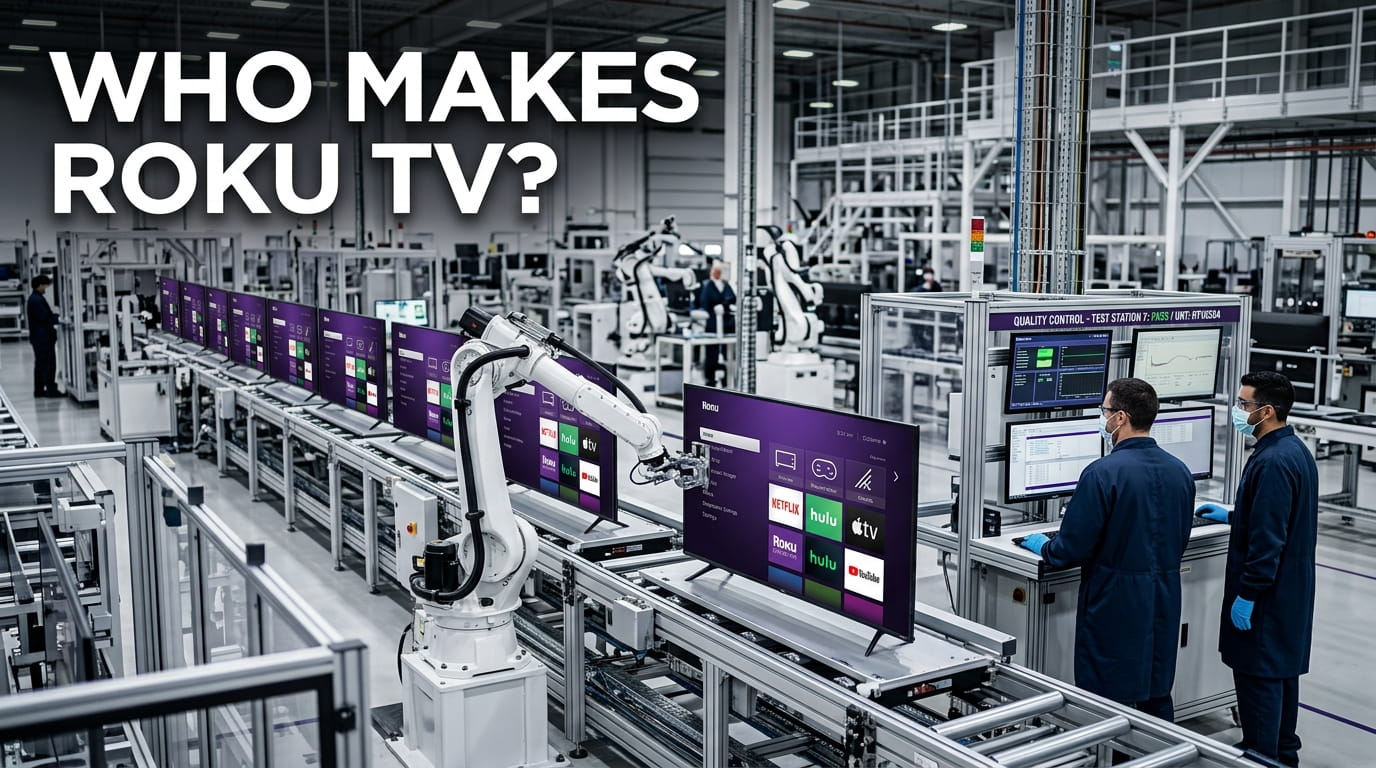
Roku TVs are made by two different types of manufacturers depending on the model: partner brands like TCL, Hisense, and Philips make the partner-branded Roku TVs, while Roku’s own Select, Plus, and Pro Series TVs are made by an undisclosed OEM manufacturer selected by Roku Inc. itself.
Roku Inc. is an American technology company headquartered in San Jose, California, founded in 2008 by Anthony Wood and publicly traded on the Nasdaq under the ticker ROKU.
Roku started as a streaming device company and began licensing its Roku OS to TV manufacturers in 2014, leading to the first Roku-branded televisions made by partner brands TCL and Hisense.
In 2023, Roku launched its own first-party TV lineup, the Roku Select and Plus Series, followed by the higher-end Roku Pro Series in 2024, competing directly in the smart TV market rather than just supplying the operating system.
In September 2025, Roku announced a manufacturing partnership with Vestel, a major Turkish electronics manufacturer, to produce Roku OS-powered TVs for European partner brands starting with Finlux.
Roku’s own branded TVs are designed in San Jose but manufactured by a third-party OEM whose identity has not been publicly disclosed. Roku confirmed it does not use its existing TV licensee partners like TCL or Hisense to make the Roku-branded sets.
Table of Contents
Who Makes Partner-Branded Roku TVs?
Roku licenses its Roku OS to numerous TV manufacturers who build and sell their own TVs with Roku’s platform pre-installed. These are called partner-branded Roku TVs and carry the manufacturer’s own logo alongside the Roku brand.
The most prominent Roku TV partners are TCL and Hisense, both Chinese TV manufacturers. Other brands that have produced Roku TVs include Philips, Westinghouse, Sharp, Magnavox, Hitachi, Sanyo, RCA, Onn (Walmart’s brand), Element, JVC, and Polaroid.
When you buy a “TCL Roku TV,” TCL makes the physical television and Roku provides the operating system. The hardware, build quality, and panel are entirely TCL’s responsibility while the software experience is Roku’s.
Who Makes Roku’s Own Branded TVs?
Roku Inc. launched its own first-party TV lineup in 2023 after TCL and Hisense began shifting more of their sets to Google TV, reducing the partner-brand Roku TV pipeline. Roku told media outlets at the time that its own branded TVs are not made by any of its existing TV licensee partners.
The actual OEM manufacturer behind Roku’s own Select, Plus, and Pro Series TVs has not been disclosed. Roku lists no manufacturing facilities on its website and maintains only corporate office locations in North America and internationally.
Consumer Reports completed testing of the 65-inch Roku Pro Series model and rated it well in its TV ratings. Independent reviewers found Roku’s own TVs slightly more responsive than equivalent partner-branded models, attributing the difference to Roku’s tighter hardware-software integration on its in-house sets.
What Is Roku OS and Why Does It Matter?
Roku OS is the operating system that powers all Roku TVs, both partner-branded and Roku’s own models. It is one of the most widely used smart TV platforms in the United States, competing with Google TV, Amazon Fire TV, and Samsung Tizen.
Roku OS is known for its simplicity, consistent performance, and extensive channel store with over 4,000 streaming apps available. It does not lock users into a single streaming ecosystem, which is a key advantage over Amazon Fire TV, which strongly favors Prime Video content.
Roku vs. Google TV vs. Fire TV: Which Is Best?
Roku, Google TV, and Amazon Fire TV are the three dominant smart TV platforms in the American market. Each has a distinct ecosystem strength.
Roku is the most platform-neutral, giving equal prominence to all streaming services with no preference for any single provider. Google TV integrates tightly with Google services including YouTube, Google Photos, and Google Assistant, and offers a strong content recommendation engine that pulls from multiple services at once. Amazon Fire TV integrates deeply with Prime Video and Alexa, making it ideal for Prime members but potentially disadvantageous for viewers who use other services primarily.
For buyers who want the simplest, most neutral smart TV experience at the widest range of price points and screen sizes, Roku remains the most accessible choice. For buyers already embedded in the Google ecosystem, Google TV is the natural fit. For heavy Amazon Prime Video users, Fire TV is the best integration. For other TV brand comparisons, see Who Makes Vizio TVs and Where Is Samsung Made.
Frequently Asked Questions About Who Makes Roku TV
Is Roku a Chinese brand?
No. Roku Inc. is an American company headquartered in San Jose, California, founded in 2008 by Anthony Wood. The company is traded on the Nasdaq. While many of its partner-branded Roku TVs are made by Chinese manufacturers like TCL and Hisense, Roku itself is a U.S. technology company.
Are Roku-branded TVs better than partner Roku TVs?
Roku’s own Select, Plus, and Pro Series TVs tend to have slightly faster OS performance and more consistent software updates than partner-branded Roku TVs. Partner TVs from TCL or Hisense may have better panel technology and more advanced picture processing features at equivalent price points. The best choice depends on whether you prioritize software smoothness or display technology.
Where are Roku streaming sticks made?
Roku’s streaming sticks and set-top boxes are manufactured in China, like virtually all streaming media players on the market. Roku designs its devices in San Jose, California and contracts with Chinese electronics manufacturers for production. The Roku Express, Streaming Stick, and Ultra all carry “Made in China” markings.

I am Jack Neel, a mechanical engineer, researcher, and writer. I created this website to share my knowledge about different brands and products with you. I research the manufacturers behind the brands and provide you with the information you need to make smart buying decisions.