
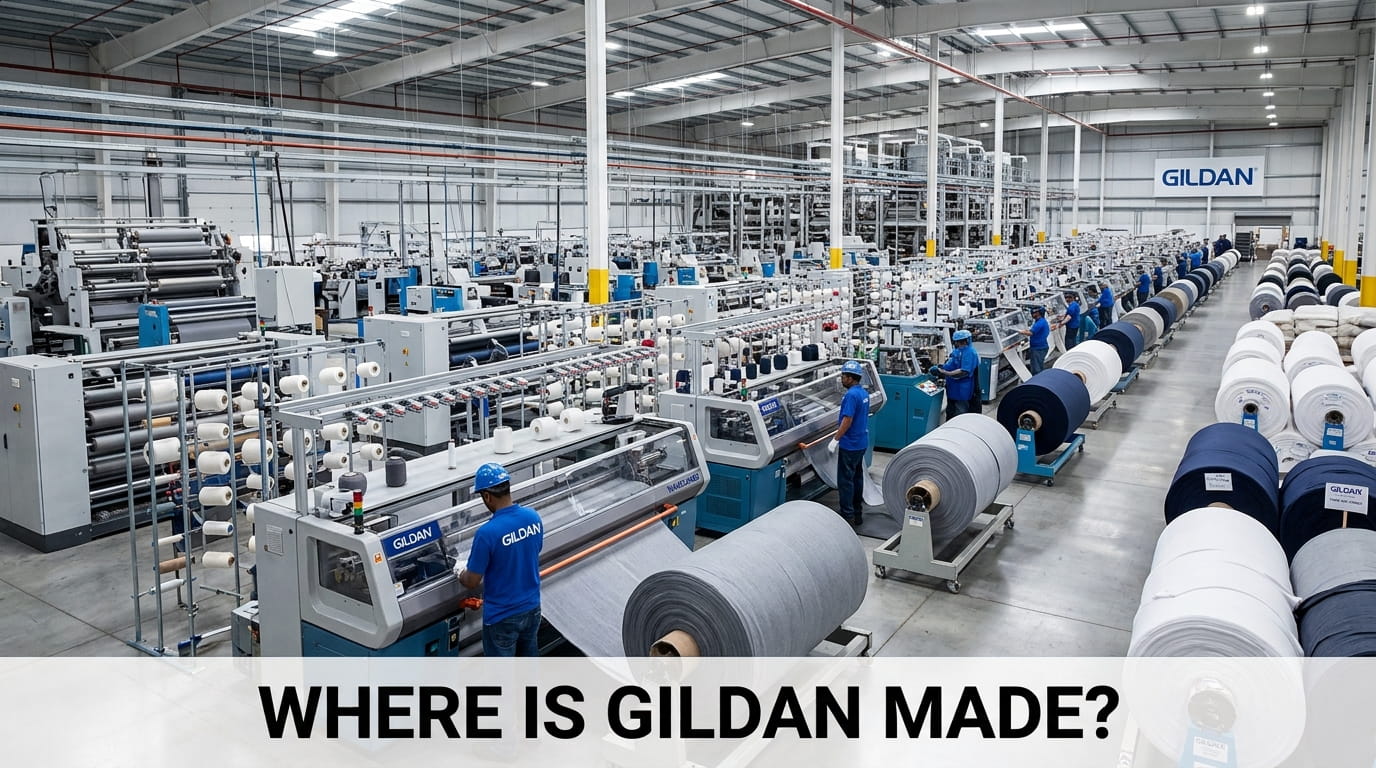
If you have ever printed a logo on a plain tee shirt, there is a decent chance it started life as a Gildan blank.
Gildan is not exactly a household fashion name.
But it is quietly one of the biggest apparel manufacturers on the planet.
Screen printers, promotional companies, and small businesses everywhere rely on its shirts, hoodies, and socks.
That scale did not happen by accident, and it did not happen in a single country either.
Gildan built an enormous vertically integrated supply chain to keep costs low and output high.
So let’s get started.
Table of Contents
Where Is Gildan Made?
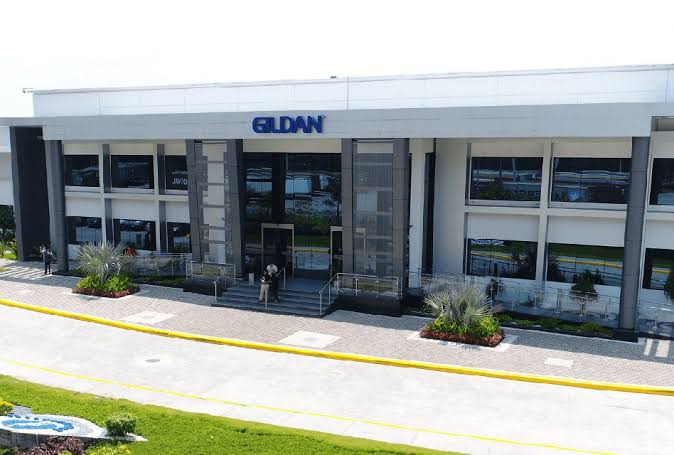
Gildan manufactures the overwhelming majority of its apparel in Honduras and Bangladesh, with additional production in Haiti and Nicaragua. You can browse the brand directly at gildancorp.com.
Honduras is Gildan’s single largest manufacturing hub, with more than two decades of operations there and over ten facilities in the country.
That includes textile plants in Rio Nance and sewing facilities in San Pedro Sula, Villanueva, and Choloma.
Bangladesh is Gildan’s second major hub, with operations dating back to 2010 and thousands of employees working across vertically integrated knitting, dyeing, and sewing facilities in Dhaka.
Altogether, Gildan runs more than 30 manufacturing facilities employing over 44,000 people, according to the company’s own operational disclosures.
Who Owns Gildan?
Gildan Activewear is a publicly traded company, listed on both the Toronto Stock Exchange and the New York Stock Exchange.
Institutional investors hold roughly 78 percent of the company, making it a widely held public firm rather than a family owned business today.
That said, its roots are deeply family driven.
Brothers Glenn and Greg Chamandy founded the company in 1984, and Glenn Chamandy has remained the central figure in Gildan’s leadership for most of its history, including through a very public boardroom fight in 2024.
Gildan’s board dismissed Chamandy as CEO in December 2023, replacing him with a former Fruit of the Loom executive named Vince Tyra.
Major shareholders revolted, the entire board eventually resigned, and Chamandy was reinstated as CEO in May 2024.
Where Did Gildan Come From?
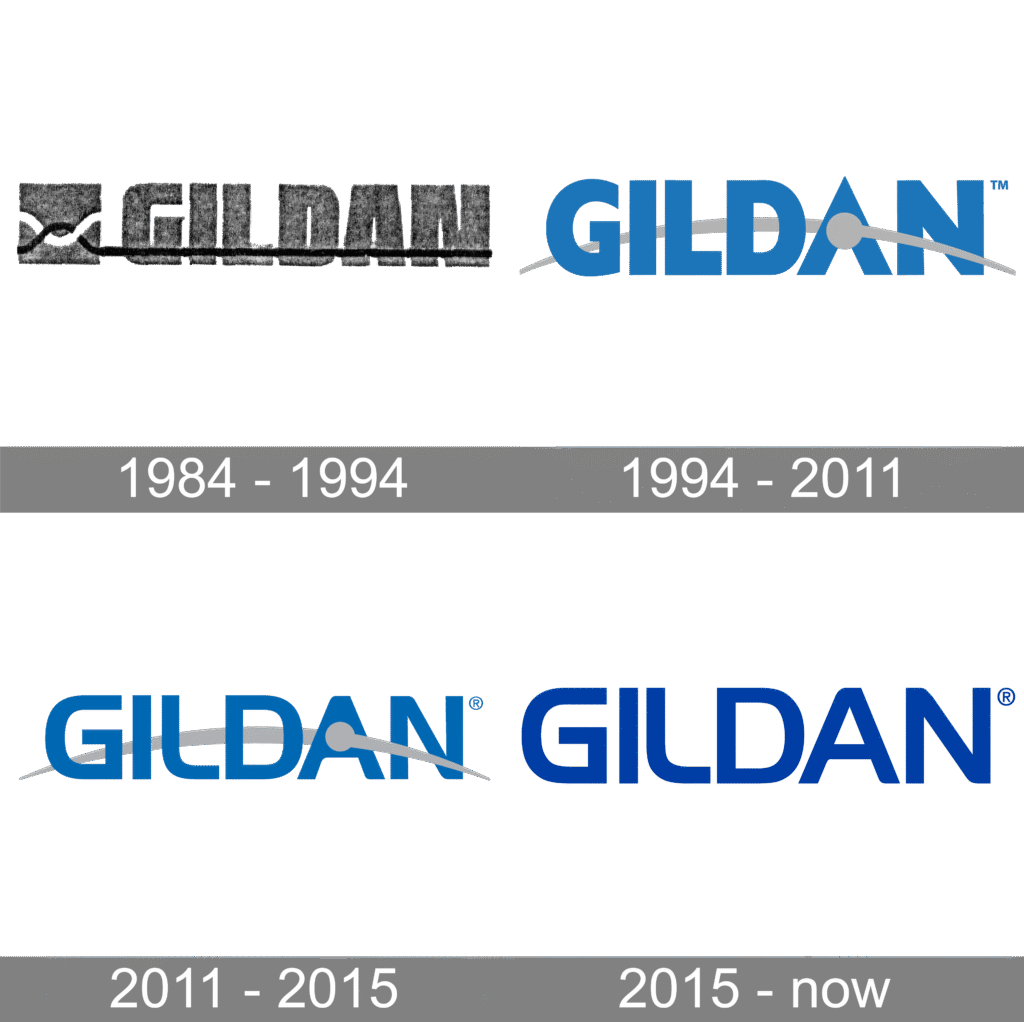
Gildan started in 1984 when Glenn and Greg Chamandy bought a knitting mill in Montreal, Canada.
The original plan was to produce fabric for a children’s wear business the family already ran.
The brothers quickly pivoted, though, and began manufacturing and selling plain cotton tee shirts to wholesalers who resold them to screen printers across Canada and the United States.
That pivot turned out to be the entire business model.
Gildan became a public company through TSX and NYSE listings in the late 1990s, and it has spent the decades since building out low cost, large scale manufacturing capacity across Central America and South Asia.
How Gildan Structures Its Manufacturing
Gildan is known in the apparel industry for vertical integration, meaning it controls most steps of production itself rather than outsourcing to independent contractors.
That includes yarn spinning, knitting, dyeing, cutting, and sewing, largely under one corporate roof across its own owned facilities.
This is different from brands like The North Face or Nike, which typically contract out production to third party factories they do not own.
Gildan’s approach gives it tighter control over cost and consistency, which is a big part of why it can sell blank shirts so cheaply in bulk.
The tradeoff is that Gildan has concentrated a huge share of its output in just a few countries, mainly Honduras and Bangladesh.
Does Gildan Make Anything in the USA?
Gildan does not manufacture apparel in the United States at any meaningful scale.
Its business model is built entirely around low cost offshore and near shore production in Honduras, Bangladesh, Haiti, and Nicaragua.
Unlike The North Face or Wolverine, Gildan has never marketed a domestic Made in USA product line, since its entire value proposition is built on manufacturing efficiency abroad.
That is worth knowing if you are buying blanks specifically because you assume they carry a domestic label.
Gildan vs Fruit of the Loom: Who Makes Each?
Fruit of the Loom is Gildan’s closest direct rival in the blank apparel and promotional tee shirt space.
Both companies now manufacture heavily in Honduras, though for different reasons and through different ownership structures.
Fruit of the Loom is owned by Berkshire Hathaway and has actually been closing several of its Honduras factories in recent years, including unionized plants, while shifting more capacity to non union facilities.
Gildan, by comparison, has been expanding, particularly in Bangladesh, where it recently announced plans to build a second textile facility.
The biggest twist in this rivalry is that Gildan completed its acquisition of HanesBrands in December 2025, a deal that roughly doubled Gildan’s revenue and made it one of the largest basic apparel companies in the world, putting even more competitive pressure on Fruit of the Loom.
What Is Next for Gildan?
Gildan closed its acquisition of HanesBrands on December 1, 2025, a deal originally valued at an enterprise value of around 4.4 billion dollars.
The combined company is targeting at least 200 million dollars in run rate cost synergies as it merges HanesBrands operations into its existing network.
Gildan also announced plans in early 2026 to build a second textile facility as part of its Bangladesh complex, with production expected to begin in late 2027.
On the trade front, Gildan’s 2026 guidance reflects the impact of a February 2026 US Supreme Court decision that invalidated certain tariffs, though the company has cautioned that trade policy remains difficult to predict.
For 2026, Gildan is guiding toward roughly 6.0 to 6.2 billion dollars in revenue on a continuing operations basis, alongside an adjusted operating margin near 20 percent.
For more brand supply chain breakdowns like this one, see our guides on Levi’s and Wrangler Jeans.
Frequently Asked Questions About Where Gildan Is Made
Is Gildan made in China?
No, Gildan’s manufacturing is centered almost entirely in Honduras and Bangladesh, not China.
The company built its business model around Central America and South Asia rather than East Asian manufacturing hubs.
This is one of the more distinctive things about Gildan compared to many other clothing brands.
Does Gildan own its factories?
Yes, largely.
Gildan is known for vertical integration, meaning it owns and operates most of its own textile and sewing facilities rather than relying purely on independent contractors.
This includes everything from yarn spinning to final garment sewing in many of its Honduras and Bangladesh operations.
Is Gildan the same company as Hanes now?
As of December 2025, Gildan completed its acquisition of HanesBrands, so the two companies are now under the same corporate parent.
They still operate as separate brands in the market, but Gildan Activewear now owns HanesBrands as part of one larger organization.
This merger roughly doubled Gildan’s overall revenue.
Why did Gildan fire and then rehire its own CEO?
In December 2023, Gildan’s board dismissed cofounder Glenn Chamandy over disagreements about succession planning.
Major shareholders, including Browning West and Turtle Creek Asset Management, pushed back hard and demanded his reinstatement.
The dispute escalated into a full boardroom battle, and by May 2024 the entire outgoing board had resigned, clearing the way for Chamandy to return as CEO and president.

I am Jack Neel, a mechanical engineer, researcher, and writer. I created this website to share my knowledge about different brands and products with you. I research the manufacturers behind the brands and provide you with the information you need to make smart buying decisions.