
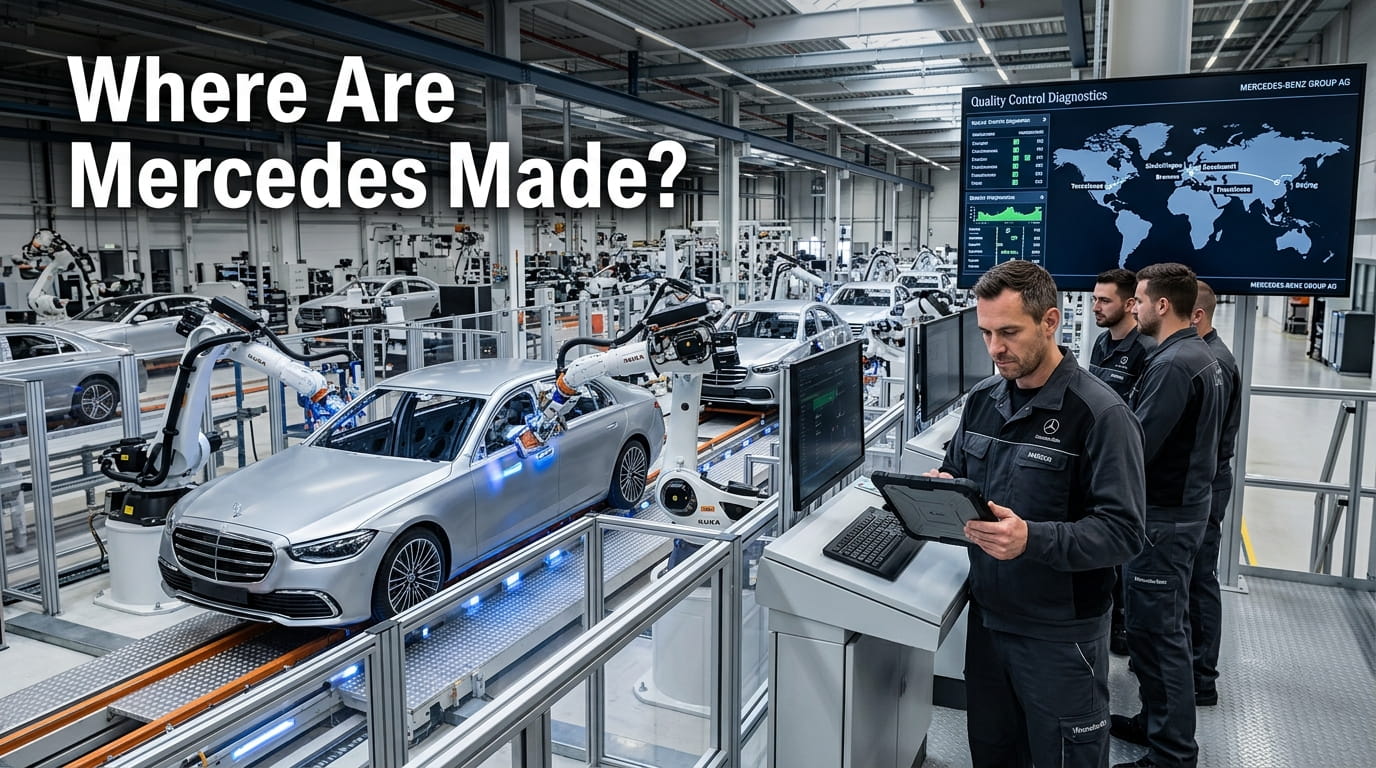
Mercedes-Benz vehicles are primarily made in Germany, with major production facilities also operating in the United States, Hungary, South Africa, and China. Full model details are at Mercedes-Benz USA’s official website.
Mercedes-Benz is known for pioneering automotive safety technology, its three-pointed star emblem representing engineering excellence, and a model range that spans from the compact A-Class to the ultra-luxury Maybach and AMG performance vehicles.
Mercedes-Benz vehicles are produced by Mercedes-Benz Group AG, a publicly traded German company listed on the Frankfurt Stock Exchange, with a heritage stretching back to Karl Benz’s invention of the first petrol-powered automobile in 1885.
Knowing where Mercedes vehicles are made helps buyers understand which plants build their specific model and the manufacturing standards that define the brand’s quality.
This article covers Mercedes-Benz’s ownership, manufacturing locations, models built in the USA, and how the brand compares to BMW and Audi.
So let’s get started.
Table of Contents
Who Owns Mercedes-Benz?
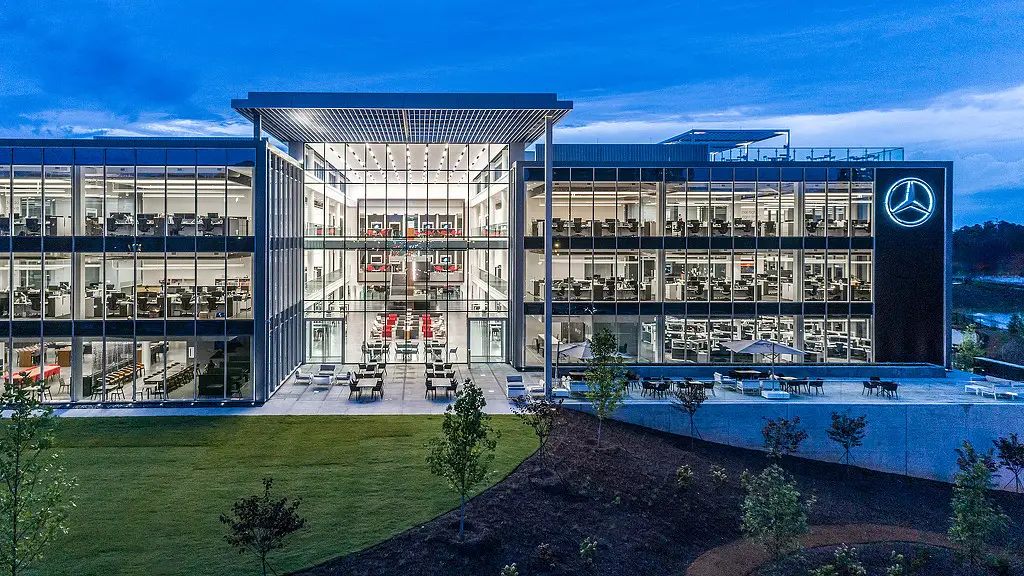
Mercedes-Benz Group is not owned by any other automaker or parent conglomerate. Its largest shareholders are institutional investors, the Chinese automaker BAIC Group (holding approximately 9.9%), and the Kuwaiti Investment Authority.
The company produces both Mercedes-Benz passenger cars and commercial vehicles under the Mercedes-Benz Vans and Mercedes-Benz Trucks divisions, though the car division generates the majority of revenue and profit.
Where Are Mercedes Cars Made in Germany?
Germany is home to Mercedes-Benz’s most important manufacturing sites. The Sindelfingen plant near Stuttgart is the brand’s flagship facility and assembles the S-Class flagship sedan, the EQS electric sedan, and AMG performance models.
The Bremen plant produces the C-Class, E-Class, GLC, and GLE. The Rastatt plant assembles the compact A-Class and CLA models. The Daimler-owned Hambach plant in France produces the EQA electric compact SUV.
Germany houses Mercedes’ most advanced engineering, design, and research operations, and produces the vehicles that represent the brand’s highest level of craftsmanship.
Which Mercedes Models Are Made in the USA?
Mercedes-Benz operates a major US plant in Vance, Alabama, run by Mercedes-Benz US International (MBUSI). The plant covers over 1,000 acres and employs approximately 6,000 workers.
The Vance plant assembles the GLE, GLS, GLE Coupe, EQE SUV, and EQS SUV. It also exports vehicles from Alabama to more than 130 countries, making it one of the largest automotive exporters in the United States by value.
The Alabama plant has been expanding steadily since it opened in 1997 and has produced over 4 million vehicles to date. It represents Mercedes’ largest single manufacturing investment outside Germany.
Where Else Are Mercedes Vehicles Made?
The Kecskemet plant in Hungary assembles the A-Class, CLA, and AMG GT sports car for European and global markets.
In South Africa, the East London plant produces the C-Class for the local and African markets. Mercedes also has manufacturing in India, Thailand, and Egypt for their respective regional demands.
China is served by joint ventures producing Mercedes vehicles in Beijing. The Beijing Mercedes-Benz Automotive plant is one of the highest-volume Mercedes facilities globally, assembling the E-Class, C-Class, and GLB for the Chinese market.
Mercedes vs BMW vs Audi: Who Makes Each Brand?
All three are German luxury automakers, each with independent ownership. Mercedes-Benz Group AG is publicly traded and fully independent. BMW AG is publicly traded and controlled by the Quandt family, which holds a majority stake. Audi AG is wholly owned by Volkswagen Group.
Of the three, BMW has the Quandt family as a controlling shareholder, giving it more concentrated ownership than either Mercedes or Audi. Audi is the least independent, operating within Volkswagen Group’s strategic framework.
All three maintain major US manufacturing. Mercedes assembles SUVs in Alabama. BMW assembles SUVs in Spartanburg, South Carolina. Audi assembles the Q5 in San José Chiapa, Mexico.
What Is Next for Mercedes?
Mercedes-Benz is pursuing a strategy it calls “top-end vehicles first,” focusing investment on its highest-margin luxury and ultra-luxury products including AMG, Maybach, and G-Class.
The brand has expanded its EQ electric vehicle lineup and continues to invest in its Vance, Alabama plant to produce electric SUVs for the North American and export markets.
Mercedes has announced plans to produce fully electric versions of its most important model lines by 2030, with the Sindelfingen plant being the key site for electric flagship production.
Frequently Asked Questions About Where Mercedes Are Made
Is Mercedes a German car?
Yes. Mercedes-Benz is a German brand with roots dating back to 1885 and is headquartered in Stuttgart, Germany. Its most prestigious models are assembled in Germany. However, several popular models including the GLE and GLS are assembled in the United States.
Where is the Mercedes GLE made?
The Mercedes GLE is assembled at the Mercedes-Benz US International plant in Vance, Alabama. It is one of the primary models produced at the Alabama facility, which exports GLE vehicles to over 130 countries globally.
Is Mercedes-Benz owned by BMW?
No. Mercedes-Benz Group AG and BMW AG are completely separate, independent companies. They are competitors, not affiliates. Both are publicly traded German companies but have no ownership relationship with each other.
When was Mercedes-Benz founded?
The Mercedes-Benz brand traces its origins to 1885, when Karl Benz invented the first petrol-powered automobile. The company formally became Daimler-Benz AG in 1926 through a merger. The Mercedes-Benz brand name itself dates to 1900, named after Mercedes Jellinek, the daughter of an important early customer.

I am Jack Neel, a mechanical engineer, researcher, and writer. I created this website to share my knowledge about different brands and products with you. I research the manufacturers behind the brands and provide you with the information you need to make smart buying decisions.