
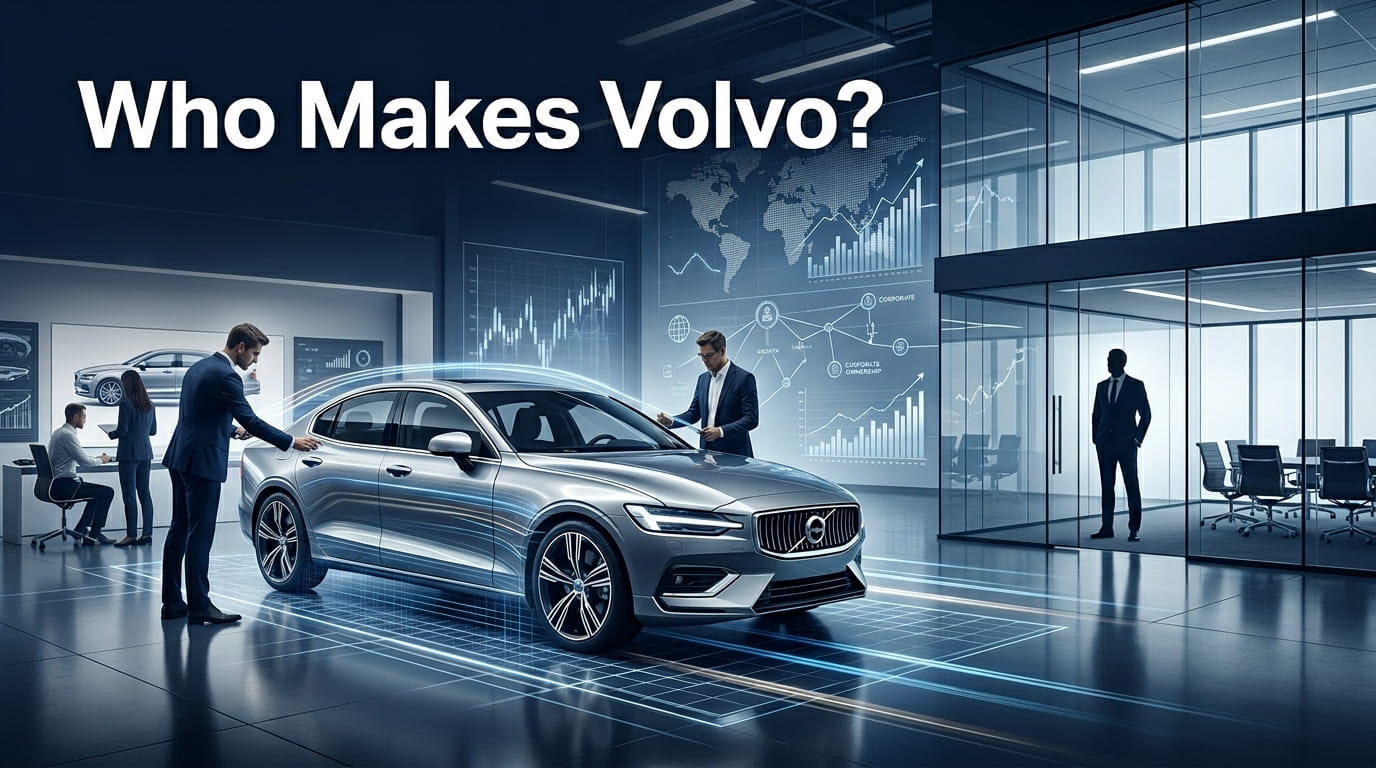
Volvo cars are made by Volvo Cars, a Swedish automotive company owned by Zhejiang Geely Holding Group, a Chinese conglomerate that acquired the brand from Ford Motor Company in 2010.
Volvo is known for pioneering automotive safety technology, a Scandinavian design philosophy that values calm and purpose over flash, and an engineering culture that produced the world’s first three-point seatbelt in 1959.
Volvo Cars is listed on the Nasdaq Stockholm stock exchange under ticker VOLCAR B, with Geely Holding as its largest shareholder, while the brand maintains its headquarters, design studios, and primary engineering operations in Gothenburg, Sweden.
Knowing who makes Volvo helps buyers understand the Swedish heritage, Chinese ownership, and global manufacturing footprint behind every vehicle in the current lineup.
This article covers Volvo’s ownership history, manufacturing locations, current model lineup, and what is next for the brand’s US production expansion.
So let’s get started.
Table of Contents
Who Owns Volvo Cars?

Volvo Cars is majority owned by Zhejiang Geely Holding Group, a Chinese privately held company founded by Li Shufu in 1986.
Geely acquired Volvo Cars from Ford Motor Company in August 2010 for $1.8 billion. Ford had owned Volvo Cars since 1999 as part of its now-dissolved Premier Automotive Group.
Despite Chinese ownership, Volvo operates with significant independence from Geely. Its management, design, engineering, and brand strategy are led from Gothenburg, Sweden, where the company was founded in 1927.
Is Volvo Cars the Same as Volvo Trucks?
No. Volvo Cars and Volvo Group AB are two completely separate companies that share a name and heritage but have had no ownership connection since 1999.
Volvo Group AB produces trucks, buses, construction equipment, and marine engines. It is a publicly traded Swedish company with no ownership stake in Volvo Cars.
Buyers sometimes confuse the two, but purchasing a Volvo XC60 has nothing to do with the company that makes Volvo semi-trucks. They are entirely separate businesses.
Where Are Volvo Cars Made?
Volvo’s primary manufacturing base is the Torslanda plant in Gothenburg, Sweden, which has been in operation since the 1950s. It currently produces the XC60, XC90, and V90 Cross Country.
The Ghent plant in Belgium assembles the XC40, C40 Recharge, and EX30 electric models for European markets. Both European plants are Volvo’s most technologically advanced production facilities outside Sweden.
In the United States, the Volvo Cars plant in Ridgeville, South Carolina, near Charleston, currently assembles the fully electric EX90 SUV and the Polestar 3. The XC60 is set to join South Carolina production in late 2026, with a fourth hybrid model also announced for the facility.
Which Volvo Models Are Made in the USA?
As of 2025, the Volvo EX90 is the only model fully assembled at the South Carolina plant. The Polestar 3 is also produced there under a shared manufacturing arrangement.
Volvo has announced the XC60 will be added to South Carolina production in late 2026, making it the second mainstream Volvo model assembled in the US. A fourth vehicle, described as a hybrid crossover designed for US market preferences, has also been announced for the plant.
Volvo has invested $1.3 billion in the South Carolina facility since it opened in 2018, and the plant has capacity for up to 150,000 vehicles per year once fully ramped.
Volvo vs Mercedes vs BMW: Who Makes Each?
All three compete in the European luxury car segment but come from very different ownership structures. Volvo is owned by Chinese conglomerate Geely but operates from Sweden. Mercedes-Benz Group AG is an independent publicly traded German company. BMW AG is a publicly traded German company controlled by the Quandt family.
Volvo has historically differentiated itself through safety innovation rather than pure performance or status, a positioning that has given it a distinct identity separate from the German luxury trio.
In terms of manufacturing, all three have significant US assembly operations. Mercedes builds SUVs in Alabama. BMW builds SUVs in South Carolina. Volvo also builds in South Carolina, making the Palmetto State an unusual concentration of European luxury car manufacturing.
What Is Next for Volvo?
Volvo is expanding its South Carolina plant significantly, with the XC60 and a new hybrid model joining the EX90 in production there before the end of 2026.
The brand has committed to making its entire global lineup available as fully electric by 2030, though it has since acknowledged that market conditions may require maintaining hybrid options alongside pure electric vehicles.
Volvo is also in the process of taking full ownership of its Chinese joint venture manufacturing operations, which would give it direct control over production in China rather than operating through a shared arrangement with Geely.
Frequently Asked Questions About Who Makes Volvo
Is Volvo a Swedish or Chinese car?
Volvo Cars is a Swedish brand with Chinese ownership. It was founded in Gothenburg, Sweden in 1927, remains headquartered there, and is designed and engineered by Swedish teams. Its parent company, Geely Holding, is Chinese. Most Volvos sold outside Asia are assembled in Sweden, Belgium, or South Carolina.
When did China buy Volvo?
Geely Holding completed the acquisition of Volvo Cars from Ford Motor Company in August 2010 for $1.8 billion. Ford had owned Volvo Cars since 1999. The Geely acquisition marked the first time a major European automotive brand was purchased by a Chinese company.
Is the Volvo XC60 made in the USA?
Not yet, but starting in late 2026. Volvo announced the XC60 will be added to production at the Ridgeville, South Carolina plant in late 2026. Currently, the XC60 is assembled at the Torslanda plant in Gothenburg, Sweden.
Does Geely also own other car brands?
Yes. Geely Holding owns a significant portfolio of automotive brands including Volvo Cars, Polestar (jointly with Volvo), Lotus, London Taxi Company, and several Chinese brands including Geely Auto and Lynk & Co. It also holds a stake in Mercedes-Benz Group AG.

I am Jack Neel, a mechanical engineer, researcher, and writer. I created this website to share my knowledge about different brands and products with you. I research the manufacturers behind the brands and provide you with the information you need to make smart buying decisions.