
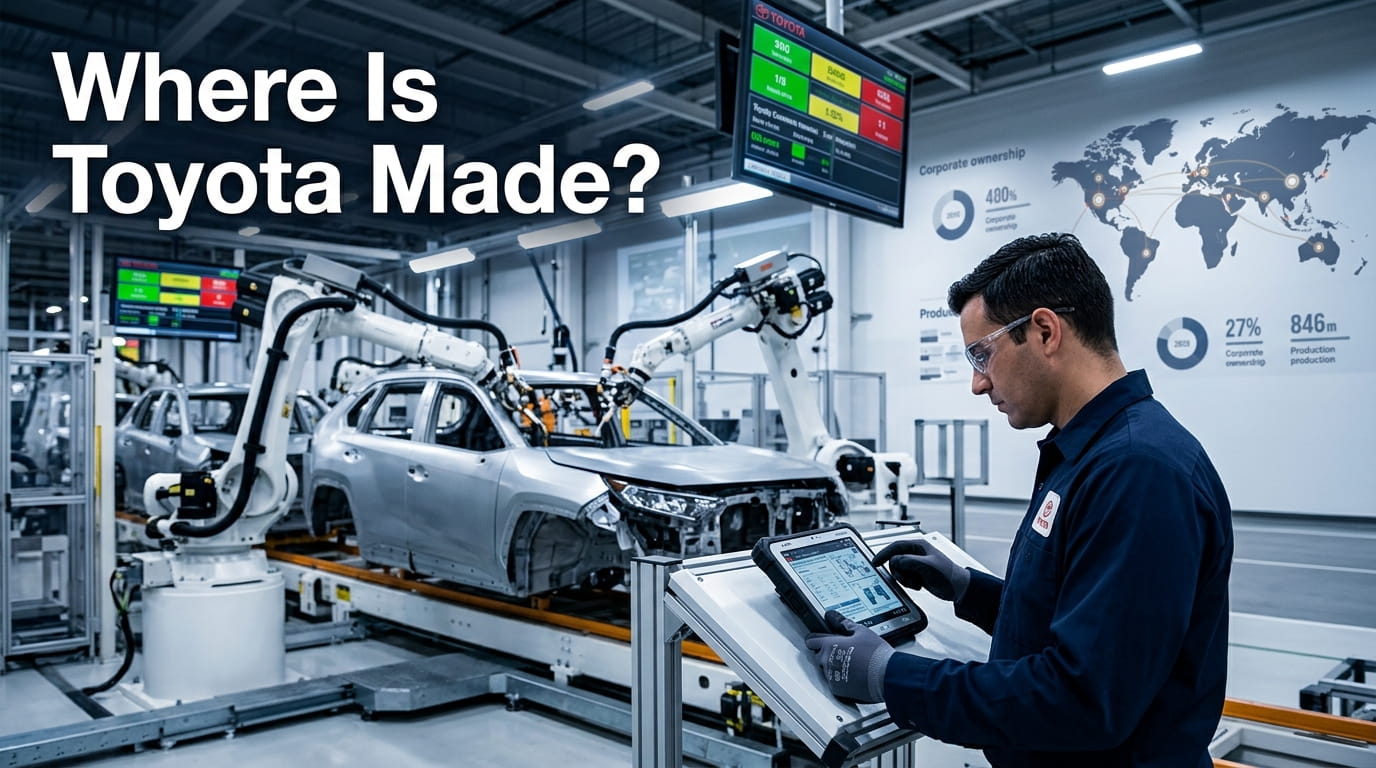
Toyota vehicles are made in Japan and across a global network of manufacturing plants that spans more than 28 countries, with major production facilities in the United States, Canada, the United Kingdom, Brazil, and several other nations.
Toyota is known for its legendary reliability, the Toyota Production System that revolutionized manufacturing efficiency worldwide, and a consistent track record of building vehicles that hold their value longer than almost any competitor.
Toyota Motor Corporation is an independent Japanese automaker founded in 1937 and headquartered in Toyota City, Aichi, Japan, operating as one of the largest vehicle manufacturers in the world by annual production volume.
Knowing where Toyota vehicles are made helps buyers understand which specific plants produce their model, whether their vehicle is domestically assembled, and what quality standards govern its production.
This article covers Toyota’s ownership structure, its main manufacturing locations in Japan and the US, which models come from which plant, and what is next for Toyota’s North American production strategy.
So let’s get started.
Table of Contents
Who Owns Toyota?

Toyota Motor Corporation is a publicly traded Japanese company listed on the Tokyo Stock Exchange. It is not owned by any other automaker or parent conglomerate. Toyota is controlled by the Toyota family through a network of cross shareholdings among Toyota Group companies, but no single entity holds a majority stake.
Toyota owns several other brands entirely, including Lexus, its luxury division, and holds partial stakes in Daihatsu, Hino, Subaru, Suzuki, and Mazda. These are strategic investments and partnerships, not full ownership in most cases.
The company was founded by Kiichiro Toyoda in 1937 as a spinoff from Toyoda Automatic Loom Works. It has since grown into one of the largest corporations in Japan and one of the most valuable automotive companies in the world.
Where Are Toyotas Made in Japan?
Toyota’s home manufacturing base is concentrated in Aichi Prefecture, Japan, where Toyota City is located. The company operates multiple plants in the region, including the flagship Motomachi plant, the Tsutsumi plant, the Takaoka plant, and the Tahara plant, which also produces Lexus models.
Japan assembles Toyota’s most significant global models, including the Camry for Japanese market buyers, the Corolla sedan, Prius, Crown, Land Cruiser, Supra, and GR86. Japan also remains the home of Toyota’s most advanced engineering and powertrain development work.
Toyota produces millions of vehicles annually in Japan across these facilities, making Japan the center of gravity for the brand’s global production network despite the significant expansion of its overseas factories over the past four decades.
Where Are Toyotas Made in the United States?
Toyota operates multiple US manufacturing plants serving the North American market. The Georgetown, Kentucky plant is the largest, assembling the Camry, RAV4 Hybrid, and Lexus ES. The San Antonio, Texas plant produces the Tundra pickup and Tacoma. The Princeton, Indiana plant builds the Sequoia and Sienna.
In Alabama, Toyota operates an engine manufacturing plant in Huntsville that supplies powertrains to multiple assembly facilities. Toyota also co-owns the Mazda Toyota Manufacturing USA plant in Madison, Alabama, a 50/50 joint venture with Mazda that assembles the Toyota Corolla Cross and the Mazda CX-50.
Together, Toyota’s US plants employ tens of thousands of American workers and represent some of the largest automotive manufacturing investments in the Southeast United States.
Where Are Toyotas Made in Canada?
Toyota Motor Manufacturing Canada operates facilities in Cambridge and Woodstock, Ontario. The Cambridge plant has been producing Toyotas since 1988 and currently assembles the Toyota RAV4 and both the Lexus RX and Lexus NX for the North American market. The Woodstock plant produces additional RAV4 models.
The Cambridge plant holds the distinction of being the first Toyota manufacturing facility outside Japan to produce a Lexus branded vehicle. It employs approximately 9,700 people and is one of the most productive automotive plants in Canada.
The RAV4 is Toyota’s global best seller, and the Canadian plants play a central role in meeting North American demand for the model year round.
Which Toyota Models Are Made in the USA?
Several of Toyota’s most popular North American models are assembled in the United States.
The Camry is built in Georgetown, Kentucky. The Tundra and Tacoma are assembled in San Antonio, Texas. The Sequoia and Sienna are built in Princeton, Indiana. The Corolla Cross is assembled in Madison, Alabama.
Models that are not assembled in the US include the Corolla sedan and hatchback, the Highlander, the 4Runner, the Land Cruiser, the Prius, the GR86, and the Supra. These are imported from Japan, Canada, or other global production facilities depending on the model.
Toyota has been one of the largest foreign investors in US manufacturing for decades, and its American plants are consistently recognized for quality and operational efficiency within the broader Toyota global network.
Toyota vs Honda vs Nissan: Where Does Each Build Its Cars?
All three are major Japanese automakers with significant North American manufacturing presence. Toyota has the broadest US footprint, with plants in Kentucky, Texas, Indiana, and Alabama.
Honda has major plants in Marysville, Ohio and Lincoln, Alabama, where it builds Civics and Ridgelines respectively. Nissan operates plants in Smyrna, Tennessee and Canton, Mississippi.
All three brands maintain Japan as their primary engineering base while using North American factories to reduce shipping costs, shorten delivery times, and serve local market demand more efficiently. Each brand has invested billions in US plant infrastructure over the past 40 years.
Toyota leads the three in total US production volume and North American plant investment. Its commitment to domestic assembly in the US has made it one of the country’s largest automotive employers among both domestic and international brands.
What Is Next for Toyota Manufacturing?
Toyota is investing heavily in battery electric vehicle production capacity in North America. A joint battery manufacturing plant between Toyota and Panasonic is under construction in North Carolina, expected to supply battery cells to Toyota and Lexus electric vehicles produced in the region.
The Georgetown, Kentucky plant is being retooled to accommodate future electric models alongside its current Camry production. Toyota has announced plans to produce multiple dedicated electric vehicle models in the US to reduce reliance on imports as EV demand grows.
Toyota’s global production strategy continues to evolve toward a mix of traditional hybrid, plug-in hybrid, and fully electric models, with North American factories expected to play a larger role in its electrified lineup as the decade progresses.
Frequently Asked Questions About Where Toyota is Made
Is Toyota a Japanese company?
Yes. Toyota Motor Corporation is a Japanese company founded in 1937 and headquartered in Toyota City, Aichi, Japan. It is publicly traded on the Tokyo Stock Exchange and remains one of Japan’s most valuable corporations.
Where is the Toyota Camry made?
The Toyota Camry sold in the United States is assembled at Toyota Motor Manufacturing Kentucky in Georgetown, Kentucky. The Georgetown plant has produced the Camry since 1988, making it one of the longest running automotive manufacturing relationships in US history.
Where is the Toyota Tundra made?
The Toyota Tundra is assembled at Toyota Motor Manufacturing Texas in San Antonio. The Texas plant also produces the Tacoma. Both are pickups built exclusively in the United States for the North American market.
Does Toyota own Lexus?
Yes. Lexus is fully owned by Toyota Motor Corporation and operates as Toyota’s dedicated luxury vehicle division. The two brands share engineering platforms and corporate resources but maintain separate identities, dealer networks, and vehicle lineups.

I am Jack Neel, a mechanical engineer, researcher, and writer. I created this website to share my knowledge about different brands and products with you. I research the manufacturers behind the brands and provide you with the information you need to make smart buying decisions.