
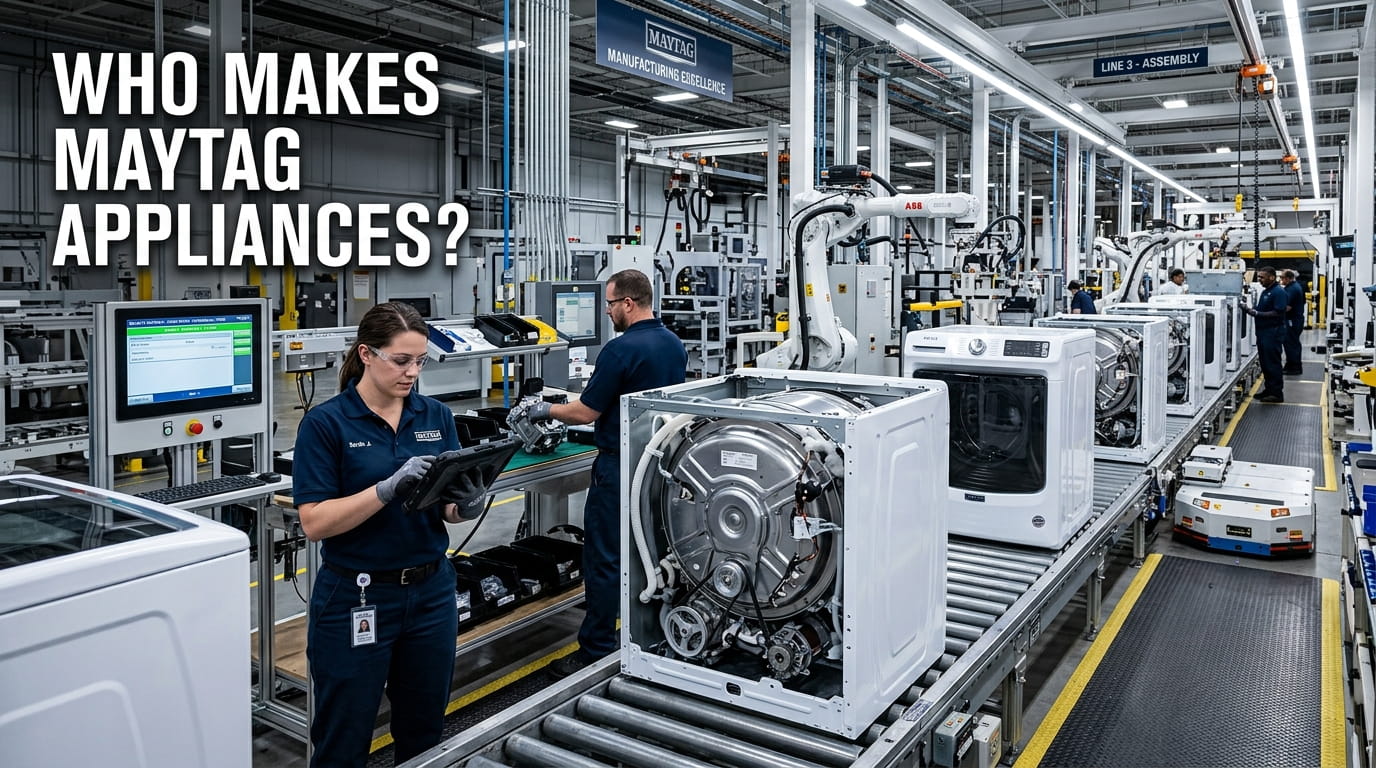
Maytag appliances are made by Whirlpool Corporation, the American multinational that acquired the Maytag brand in 2006.
Maytag is one of the most trusted appliance names in America, built on a reputation for heavy duty, no nonsense performance in washers, dryers, and kitchen appliances.
Whirlpool Corporation is headquartered in Benton Harbor, Michigan, and is the world’s largest home appliance manufacturer by revenue, trading on the NYSE under the ticker WHR.
Knowing that Whirlpool makes Maytag explains why a nearly 130-year-old American brand still carries serious engineering and strong domestic manufacturing behind it.
This article covers who makes Maytag appliances, where they are produced, who owns the brand, its history, how it compares to a rival, and whether the appliances are any good.
So let’s get started.
Table of Contents
Who Makes Maytag Appliances?

Maytag appliances are made by Maytag, which operates as a brand of Whirlpool Corporation.
Whirlpool acquired Maytag Corporation in 2006 for approximately $1.7 billion, making Maytag one of the most valuable brands in its portfolio.
Whirlpool positions Maytag as its heavy duty, workhorse brand, distinct from its own Whirlpool brand which targets a slightly broader everyday market.
Maytag products are engineered and manufactured within Whirlpool’s North American plant network.
That shared infrastructure allows Maytag to benefit from Whirlpool’s scale while maintaining its own distinct design and performance identity.
Where Are Maytag Appliances Made?
The majority of Maytag appliances sold in the United States are made in America.
Key production locations include Clyde, Ohio, for washers, Amana, Iowa, for refrigerators, Findlay, Ohio, for dishwashers, and Ottawa, Ohio, for freezers.
According to Whirlpool’s 2025 reporting, roughly 80% of its United States market appliances are built within the country, with 96% of the steel used sourced domestically.
Whirlpool announced a $300 million investment in its Clyde and Marion, Ohio laundry plants in October 2025, further strengthening domestic production for Maytag and other brands.
Some refrigerator production is shifting to a new Mexico facility, so checking the label before purchase is advisable for buyers who prioritize United States manufacturing.
Who Owns Maytag Appliances?
Maytag is owned by Whirlpool Corporation, which has held the brand since its 2006 acquisition of the Maytag Corporation.
Whirlpool is an American publicly traded company and the world’s largest home appliance maker, owning brands including KitchenAid, JennAir, Amana, and Maytag.
Analysts estimate Maytag remains one of Whirlpool’s highest revenue contributors in North America, particularly in the laundry category where it has historically dominated, as detailed in Maytag’s company history.
Whirlpool reported total annual net sales of approximately $15.5 billion for fiscal 2025, as confirmed in its company filings.
What Is the History of Maytag?
Maytag was founded in 1893 by Frederick Maytag in Newton, Iowa, initially building farm equipment attachments.
The company moved into washing machines in 1907 and quickly built a national reputation for durable, dependable laundry appliances.
The iconic Maytag Repairman advertising campaign, launched in 1967, became one of the longest running ad campaigns in American history.
After more than a century as an independent American company, Maytag was sold to Whirlpool in 2006, as confirmed by domestic manufacturing sources.
Maytag Appliances vs LG Appliances: How Do They Compare?
Maytag and LG are two of the most popular appliance brands in North America but take very different approaches.
Maytag is an American brand built on heavy duty reliability and domestic manufacturing, appealing to buyers who want a straightforward, durable appliance.
LG is a South Korean brand known for sleek designs, smart technology, and feature innovation, often appealing to tech oriented buyers.
Both compete in the mid to upper tier of the market, so the choice often comes down to whether you prioritize durability and domestic production or smart features and modern styling.
Are Maytag Appliances Any Good?
Maytag appliances are well regarded for their reliability and durability, which is the core of the brand’s identity.
The brand consistently earns strong marks in reliability surveys, particularly in laundry appliances where it has one of the longest track records of any American brand.
Maytag sits in the mid tier of the Whirlpool portfolio, below premium brands like JennAir but above the value Amana line.
Many Maytag appliances carry the “Designed, engineered and assembled in the USA” label, which matters to buyers who want domestic manufacturing.
For shoppers who want a dependable American brand with strong dealer support and a proven record, Maytag remains one of the best choices in the category.
For more on related Whirlpool brands, see Who Makes Whirlpool Appliances and Who Makes KitchenAid Appliances.
Frequently Asked Questions About Maytag Appliances
Who owns Maytag appliances?
Maytag is owned by Whirlpool Corporation, which acquired the Maytag Corporation in 2006 for approximately $1.7 billion. Whirlpool is headquartered in Benton Harbor, Michigan.
Are Maytag appliances made in the USA?
Yes, the majority of Maytag appliances sold in the United States are made domestically, primarily in Ohio and Iowa. Some refrigerator production is shifting to Mexico, so checking the label is advisable.
Is Maytag the same as Whirlpool?
Maytag is a separate brand owned by Whirlpool. Maytag is positioned as the heavy duty, reliability focused brand, while Whirlpool covers the broader everyday appliance market.
What is Maytag best known for?
Maytag is best known for its washers and dryers, which have a long reputation for durability. The brand also makes refrigerators, dishwashers, and ranges.

I am Jack Neel, a mechanical engineer, researcher, and writer. I created this website to share my knowledge about different brands and products with you. I research the manufacturers behind the brands and provide you with the information you need to make smart buying decisions.
I bought a Maytag washer in March of 2024 from Lowe’s in Southport, NC. I also purchased the extended warranty. In February of 2026 the door would not unlock. It was repaired and then in June of 2026 the same thing happened. Now it has happened for the third time. I want to support USA products but this does nothing to justify my confidence. Tomorrow will be 7 days without a washer and no update on when it will be fixed. I’m in my 80’s and going to the laundromat is something I gave up on decades ago. Thank you for letting me vent. But I doubt if I will be inclined to buy another Whirlpool product.
Thank you for sharing your experience, and please vent away you have every right to be frustrated. Going a week without a washing machine is a huge disruption, and expecting someone in their 80s to go back to using a laundromat because of a repeated product failure is completely unfair.Since you purchased the extended warranty from Lowe’s, you might actually have a hidden safety net here. Many of Lowe’s protection plans include a ‘No-Lemon’ policy. This usually means if the exact same major component fails three or four times, they are required to replace the entire unit rather than fixing it again.I highly recommend calling the Lowe’s Protection Plan line directly at 1-888-775-6937 (or checking your paperwork online at lowesprotect.com). Tell them this is the third time the door has failed, and ask if your plan qualifies you for a full replacement machine. I truly hope they step up, honor your warranty, and get this resolved for you quickly!