
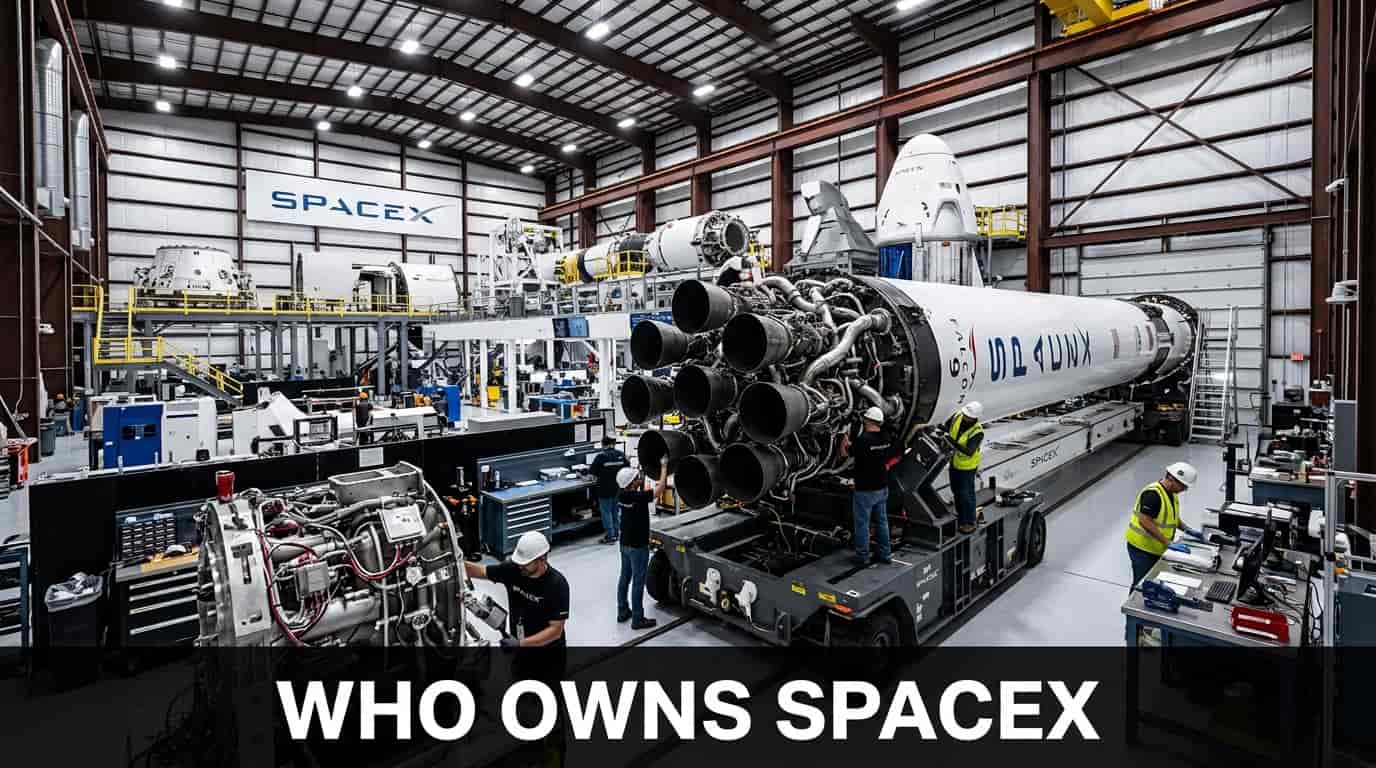
SpaceX is majority controlled by founder Elon Musk, who holds roughly 42 percent of company equity and about 82 percent of total voting power, following the company record breaking initial public offering in June 2026.
SpaceX built its reputation as the leading private rocket and space launch company in the world, later expanding into satellite internet through its Starlink division.
Musk founded SpaceX in 2002, betting his own fortune on the idea that rockets could eventually become reusable and dramatically cheaper to launch.
So now that SpaceX has gone public, how much control does Musk actually still hold over the company.
This guide will explore SpaceX record breaking IPO, Elon Musk voting control through dual class shares, its other major shareholders, and how the company fits alongside its Starlink division.
So let us get started.
Table of Contents
Who Owns SpaceX Right Now
Elon Musk remains SpaceX largest shareholder and controlling voting power holder, even after the company completed its public listing. Company information is available on the official SpaceX website.
SpaceX began trading publicly on Nasdaq under the ticker SPCX on June 12, 2026, after selling 555.6 million shares at 135 dollars apiece.
The offering raised roughly 85.7 billion dollars once the overallotment was exercised, making it the largest initial public offering ever completed, well ahead of Saudi Aramco previous 2019 record.
How Elon Musk Keeps Voting Control After The IPO
SpaceX uses a dual class share structure, issuing Class A shares carrying one vote each and Class B super voting shares carrying ten or more votes each.
Musk holds approximately 850 million Class A shares and nearly 5.6 billion Class B shares, giving him about 82.4 percent of all voting power despite owning only about 42 percent of total equity, according to the company S1A filing.
That structure ensures Musk can outvote all other shareholders combined on major company decisions, even as outside investors now hold a meaningful economic stake following the public offering.
SpaceX Other Major Shareholders
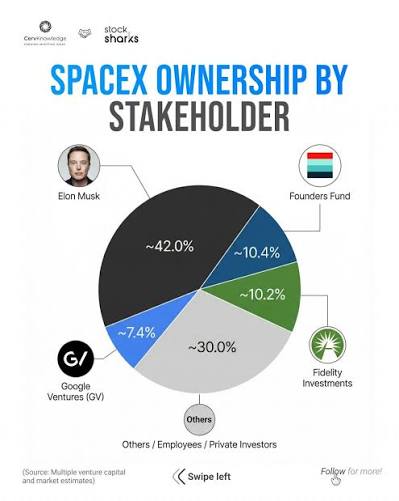
Alphabet, Google parent company, holds an estimated 6 to 7.5 percent stake in SpaceX, one of the largest outside institutional positions in the company.
Fidelity, Founders Fund, Sequoia Capital, and Andreessen Horowitz also rank among SpaceX significant shareholders, alongside several sovereign wealth funds that participated in earlier funding rounds.
Gwynne Shotwell, who joined SpaceX as its seventh employee in 2002, serves as president and chief operating officer, though her personal ownership stake remains far smaller than Musk own holdings, according to industry ownership analysis.
SpaceX Falcon And Starship Rocket Programs
Falcon 9, SpaceX workhorse reusable rocket, has flown hundreds of successful missions, dramatically driving down the cost per launch compared to traditional expendable rockets.
Starship, the company next generation fully reusable rocket, remains in active development and testing, with SpaceX betting heavily on its eventual role in both satellite deployment and potential deep space missions, according to industry ownership analysis of the company priorities.
Both programs remain central to SpaceX long term strategy, even as Starlink continues generating the majority of the company current revenue.
SpaceX Compared To Other Musk Owned Companies
Musk also holds major ownership stakes in Tesla, xAI, and other ventures, spreading his enormous personal wealth across multiple industries beyond just aerospace.
Unlike Tesla, which has traded publicly for well over a decade, SpaceX only recently completed its own public listing, giving outside investors a much newer opportunity to buy shares directly.
Musk approach to maintaining voting control through dual class shares mirrors similar structures used at other founder led companies, including some of the largest technology firms in the world. Our guide to who owns Waymo covers another capital intensive technology company that recently raised a massive private funding round.
How Starlink Fits Inside The Public SpaceX
Starlink operates as a division within SpaceX rather than a separately traded company, meaning there is no distinct Starlink stock even after the broader SpaceX IPO. Our guide to who owns Starlink covers that satellite internet business in more detail.
Starlink has grown into one of SpaceX largest revenue sources, and its continued growth was a major factor cited by analysts explaining strong investor demand for the SpaceX public offering.
SpaceX Starship program also remains central to Musk long term ambitions for Mars colonization, a goal that continues shaping the company research and development priorities even as its satellite and launch businesses generate the bulk of current revenue.
Is SpaceX Really Good Or Really Worth It
SpaceX earns strong praise across the aerospace industry for its reusable rocket technology, which has dramatically lowered the cost of launching satellites and cargo into orbit.
Critics point to Musk polarizing public persona and concerns about workplace culture at SpaceX as ongoing sources of controversy separate from the company technical achievements.
Industry analysts frequently cite SpaceX dominant position in the commercial launch market as evidence of a durable competitive advantage over rival rocket companies.
For investors, SpaceX record breaking IPO reflected enormous confidence in both its rocket business and Starlink growing satellite internet revenue.
For anyone following the space industry, SpaceX continued dominance in commercial launches makes it one of the most closely watched companies in the sector.
SpaceX also continues holding major government contracts with NASA and the Department of Defense, providing a stable revenue base alongside its commercial satellite and launch business.
Those government contracts, combined with commercial Starlink subscriptions and satellite launches for outside companies, give SpaceX one of the most diversified revenue bases of any aerospace company operating today.
That diversification remains one of the key reasons investors were so eager to participate in the record breaking public offering earlier in 2026.
Analysts expect that diversified base to keep supporting strong valuation growth well beyond the initial public offering price.
Whether that growth continues will likely depend heavily on Starship progress and Starlink continued subscriber expansion worldwide in the coming years.
Investors will be watching closely for updates on both fronts in upcoming quarterly reports.
For now, SpaceX remains one of the most closely watched newly public companies on Wall Street.
Frequently Asked Questions About SpaceX
Is SpaceX A Public Company Now?
Yes. SpaceX began trading publicly on Nasdaq under the ticker SPCX in June 2026, after completing the largest initial public offering in history.
How Much Of SpaceX Does Elon Musk Own?
Musk holds roughly 42 percent of SpaceX equity and about 82.4 percent of total voting power through a dual class share structure.
Does Google Own Part Of SpaceX?
Alphabet, Google parent company, holds an estimated 6 to 7.5 percent stake in SpaceX, making it one of the company largest outside shareholders.
Is Starlink A Separate Public Company?
No. Starlink remains a division within SpaceX, with no separate stock of its own even after the broader SpaceX public listing.

I am Jack Neel, a mechanical engineer, researcher, and writer. I created this website to share my knowledge about different brands and products with you. I research the manufacturers behind the brands and provide you with the information you need to make smart buying decisions.