
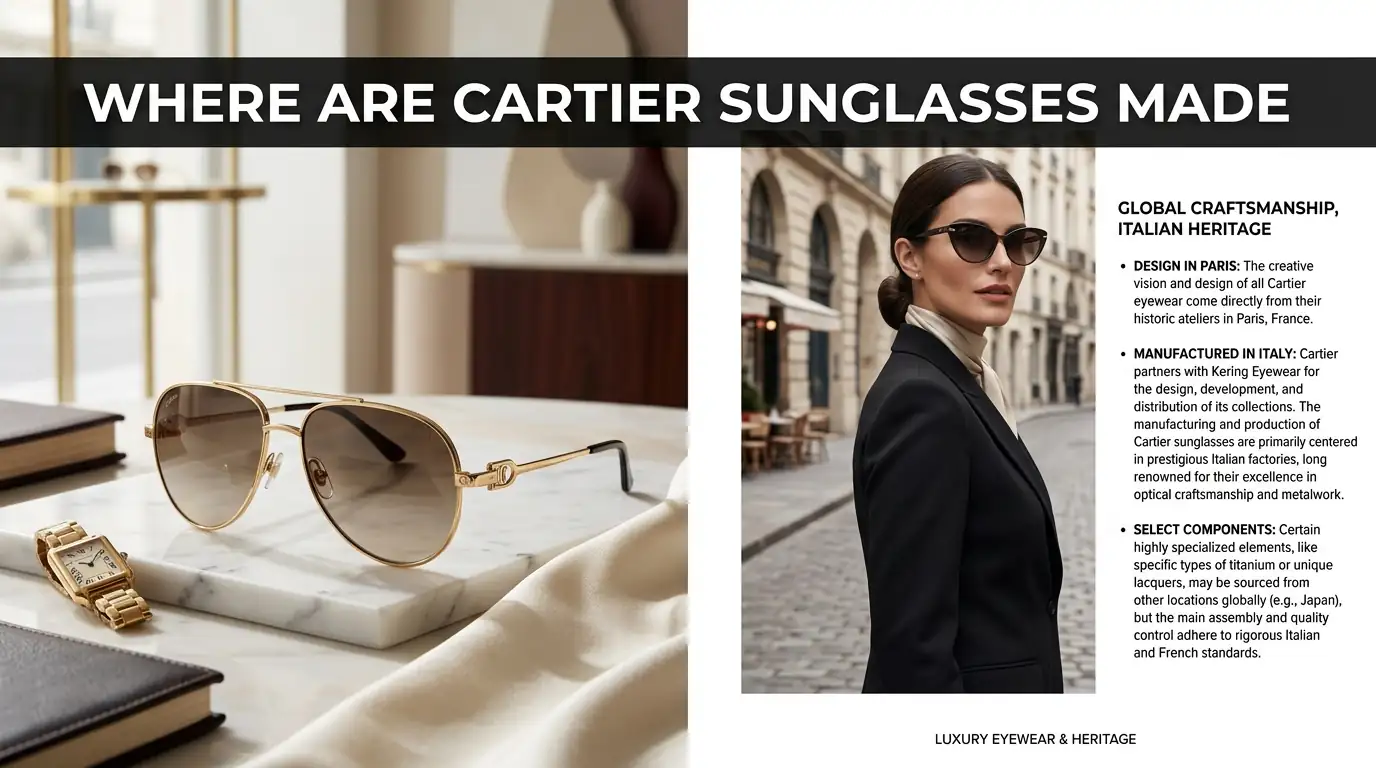
Cartier sunglasses are made in France, at a dedicated manufacture in Sucy en Brie near Paris, and in Italy, through Kering Eyewear, the licensed producer that has held the Cartier eyewear license since 2018.
Cartier began life in 1847 as a Parisian jewelry workshop, and that jewelry heritage still shapes how the house approaches eyewear today. Frames carry design cues from Cartier watches and jewelry, from the Panthere motif to the screw details borrowed from the Santos watch case.
It helps to separate three things that get blurred together: the brand you see on the frame, the company that actually manufactures the product, and the parent group that owns the brand. Cartier is the brand. Kering Eyewear is the manufacturer under license. Richemont is the parent company that owns Cartier itself. This split ownership pattern is common in luxury eyewear, and Gucci follows a similar arrangement through its own licensing history.
Because Cartier sunglasses regularly sell for four figures, and because the name is one of the most counterfeited in luxury eyewear, a lot of shoppers want more than a country of origin. They want to know why the price is so high and how to avoid buying a fake.
This guide covers where Cartier sunglasses are manufactured, who owns the company, how the Kering Eyewear license works, and practical ways to check authenticity before you buy.
Table of Contents
Where Are Cartier Sunglasses Made?

Cartier sunglasses are made in France and Italy under a licensing and production partnership with Kering Eyewear, the eyewear division of the Kering luxury group.
The core of Cartier eyewear production is a manufacture in Sucy en Brie, a town just outside Paris. Cartier itself established this facility in 1983 to produce its own eyewear collections in house.
In 2017, Cartier parent company Richemont and Kering struck a partnership under which Kering Eyewear took over the licensing, design coordination, and manufacturing management of Cartier eyewear, with the first Kering managed Cartier collection launching for Spring Summer 2018.
The Sucy en Brie site itself joined Kering Eyewear in September 2019 and continued making Cartier frames rather than being shut down or relocated, a shift covered in detail by Business of Fashion.
In October 2024, the facility was awarded the Entreprise du Patrimoine Vivant label, a French government recognition for companies with exceptional craftsmanship and industrial expertise, which confirms the site was still an active production hub as of that date.
Kering Eyewear also runs its own manufacturing and design operations from its headquarters in Padova, Italy, where many of its licensed luxury eyewear brands are engineered and finished.
So depending on the specific model and material, a pair of Cartier sunglasses may be built primarily at the French manufacture, or produced through Kering Eyewear production lines in Italy, with final quality control carried out to Cartier specifications either way.
Who Owns Cartier?

Cartier is owned by Richemont, the Swiss luxury goods group headquartered in Geneva.
Richemont is a public holding company controlled by the Rupert family through a dual class share structure, and it owns a portfolio of luxury maisons that includes Van Cleef and Arpels, Piaget, Montblanc, and several Swiss watchmakers.
Cartier is Richemont’s largest and most valuable maison, generating a significant share of the group’s jewelry and watch revenue each year.
Ownership of the Cartier brand is separate from ownership of the eyewear manufacturing. Richemont owns Cartier, but Kering, a rival French luxury group, produces Cartier’s sunglasses and optical frames under license through its Kering Eyewear subsidiary.
Richemont also holds a minority stake in Kering Eyewear itself, which is part of what made the Cartier eyewear partnership possible in the first place.
What Is Cartier’s Country of Origin?

Cartier’s country of origin is France. The house was founded in Paris in 1847 by Louis Francois Cartier and remains headquartered there today.
Cartier’s jewelry, watches, and leather goods are still strongly associated with French craftsmanship, even though the brand has operated globally for well over a century.
Eyewear is a slightly different story because of the Kering Eyewear arrangement. The brand identity and design direction remain French, but day to day production runs through a group that is also based partly in Italy.
For a shopper, the practical takeaway is that Cartier as a company is French, while the sunglasses on your face were most likely assembled at a French or Italian facility operated by Kering Eyewear.
Are Cartier Sunglasses Made in Italy or Switzerland?
Cartier sunglasses are made in Italy and France, not Switzerland, even though Cartier watches are Swiss made.
This mix up is common because Cartier the company is owned by Richemont, a Swiss group, and Cartier watches carry the Swiss Made designation earned at Richemont owned Swiss manufactures.
Eyewear is a different product category with a different supply chain. Cartier never built a Swiss eyewear manufacture, and the license now sits with Kering Eyewear, an Italian headquartered company.
Kering Eyewear’s main production and design center is in Padova, Italy, while the historic Cartier eyewear manufacture in Sucy en Brie, France, continues to operate within that same group structure.
In short, if you are looking at a Cartier watch, Switzerland is the accurate answer. If you are looking at Cartier sunglasses, France and Italy are the accurate answers.
How to Tell if Cartier Sunglasses Are Real or Fake
No single detail proves a pair of Cartier sunglasses is authentic on its own. Checking several indicators together gives a much more reliable read.
Start with the temple markings. Genuine Cartier frames typically carry the Cartier name, a model or serial reference, and the frame size and material engraved cleanly on the inside of the temple arm, not printed or stamped in a way that looks shallow or smudged.
Look closely at the lenses. Authentic Cartier sunglasses use precisely cut, optical grade lenses, and many current models carry a small Cartier or C de Cartier logo etched discreetly into a corner of the lens.
Check the hardware and screws. Cartier is known for jewelry level metalwork, so screws should be flush, hinges should move smoothly without wobble, and any gold tone plating should look even rather than patchy or overly bright.
Review the packaging and paperwork. Authentic pairs come with a branded Cartier case, a cleaning cloth, and an authenticity or warranty card, and the box construction should feel substantial rather than flimsy.
Be cautious of price. Cartier sunglasses rarely sell far below retail from anyone other than an authorized boutique, department store, or a small list of vetted resellers, so a steep discount from an unfamiliar seller is a warning sign.
When in doubt, buy from Cartier directly, from an authorized retailer, or from a specialist reseller that offers third party authentication, and keep the receipt in case you need to verify the piece later.
When Was Cartier Founded?
Cartier was founded in 1847 in Paris, France, when Louis Francois Cartier took over the workshop of his master, Adolphe Picard, a detail confirmed on Cartier’s Wikipedia history page.
His grandsons Louis, Pierre, and Jacques Cartier later expanded the business internationally in the early twentieth century, opening branches in London and New York.
The family sold its shares in the 1960s and 1970s, and the various Cartier businesses were eventually reunited under one ownership structure before joining what became Richemont.
Cartier entered eyewear relatively late in its history, launching its first sunglasses and optical collections in the 1980s using materials like gold, platinum, and buffalo horn.
Why Are Cartier Sunglasses So Expensive?
Cartier sunglasses are expensive because of premium materials, jewelry inspired construction, brand heritage, and a distribution model built around boutiques rather than mass retail.
Many frames use solid metals like titanium alongside high grade acetate, and some models incorporate finishes and screw details lifted directly from Cartier’s watch and jewelry lines.
Production runs through a specialized manufacture rather than a high volume factory, which keeps output smaller and per unit costs higher than typical mass market eyewear brands.
Brand equity plays a real role too. Cartier has spent over a century building a reputation in fine jewelry and watchmaking, and that reputation carries a price premium into every category the house enters, including sunglasses.
A higher price does not automatically mean better optical performance than a well made mass market pair. It reflects materials, craftsmanship, and brand positioning more than it reflects any single measurable quality metric, which is worth keeping in mind when comparing a luxury pair against a mass market brand like Ray Ban.
Are Cartier Sunglasses Good Quality? Are They Worth It?
Cartier sunglasses are generally well regarded for build quality, materials, and design detail, consistent with their positioning as a luxury product.
Owners commonly note sturdy hinges, solid metal components, and finishing that holds up over years of use when the glasses are cared for properly.
Whether they are worth it depends heavily on what you value. If you want a design connected to Cartier’s jewelry aesthetic and are comfortable paying for that heritage, most buyers report satisfaction with the physical product.
If your main priority is UV protection and optical clarity at the lowest possible cost, plenty of non luxury brands deliver comparable lens performance for a fraction of the price.
It is worth noting that Cartier’s Trustpilot rating for overall customer service sits low, around 1.8 out of 5 as of recent review data, with complaints concentrated on repair turnaround and communication rather than the sunglasses themselves. That is useful context on the ownership experience, separate from the physical quality of the eyewear.
Cartier Customer Service and Where to Buy Authentic Pairs
The safest place to buy Cartier sunglasses is directly through Cartier’s official website or an authorized Cartier boutique.
Authorized department stores and licensed optical retailers that carry Cartier eyewear are also reliable, since they source stock through official distribution channels rather than gray market suppliers.
If you are buying secondhand, look for resellers that offer authentication services or a clear return policy, and always ask for close up photos of the temple markings and lens etching before paying.
For repairs, warranty questions, or general support, contact Cartier through the customer service channels listed on its official site rather than a third party seller, since only Cartier or its authorized network can verify and service a genuine frame.
Frequently Asked Questions About Cartier Sunglasses
Does Cartier still make its own sunglasses in house?
No, Cartier eyewear is produced under license by Kering Eyewear as of 2026, following a partnership that began in 2017 and launched its first collection in 2018. Cartier designs the collections and sets brand standards, while Kering Eyewear manages manufacturing and distribution.
Is Cartier a French or Swiss brand?
Cartier is a French brand, founded in Paris in 1847. It is owned by the Swiss luxury group Richemont, which is why the ownership is often described as Swiss even though the brand’s heritage and headquarters are French.
What is the difference between Cartier eyewear and Cartier watches in terms of manufacturing?
Cartier watches are made in Switzerland at Richemont owned manufactures and typically carry a Swiss Made designation, while Cartier sunglasses are made in France and Italy through the Kering Eyewear license. The two product categories use entirely separate supply chains despite sharing the same brand name.
How can I verify a pair of Cartier sunglasses is genuine before buying online?
Ask the seller for clear photos of the temple engravings, lens etching, and included packaging, and compare the model details against the current lineup on Cartier’s official website. Buying from an authorized retailer or a reseller with third party authentication remains the most reliable option.

I am Jack Neel, a mechanical engineer, researcher, and writer. I created this website to share my knowledge about different brands and products with you. I research the manufacturers behind the brands and provide you with the information you need to make smart buying decisions.