
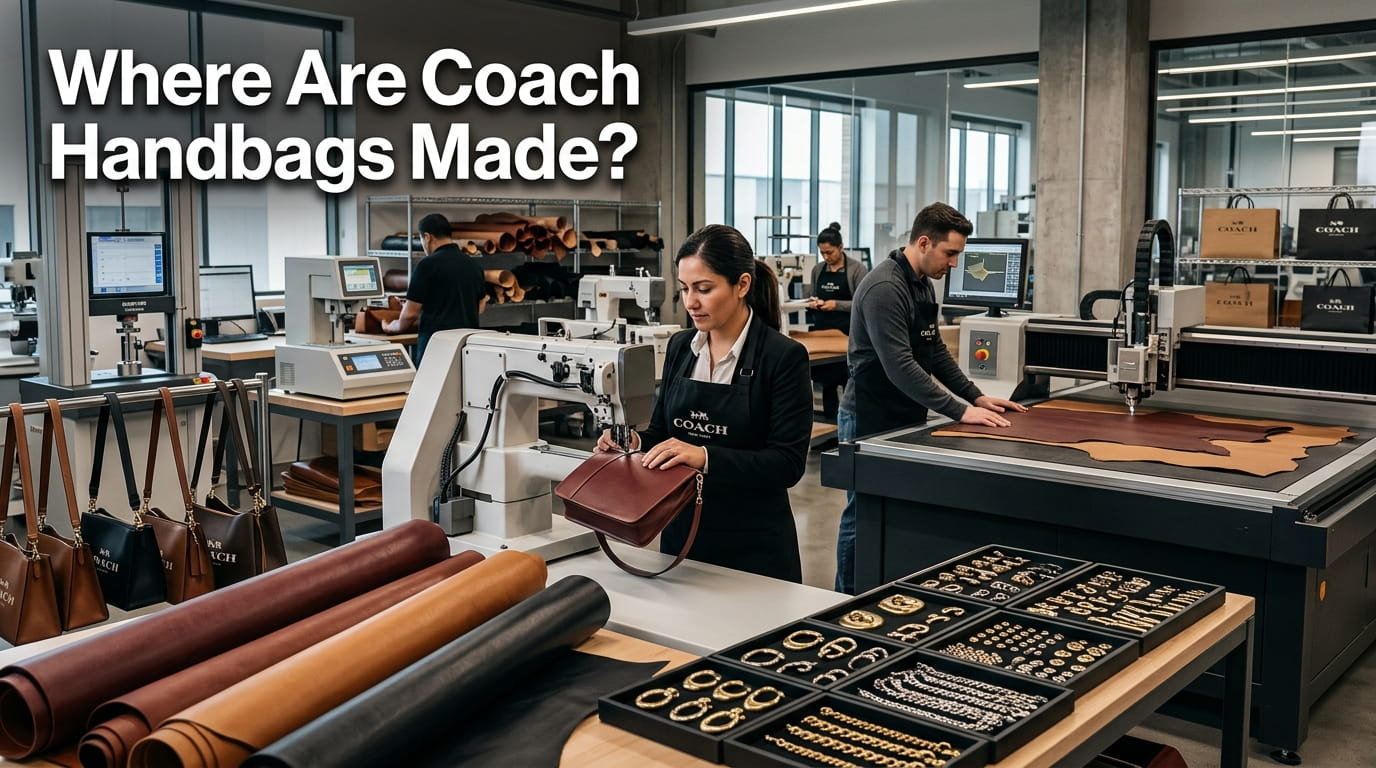
Coach handbags are primarily made in Vietnam, Cambodia, the Philippines, and India, according to Tapestry’s fiscal 2025 Annual Report filed with the U.S. Securities and Exchange Commission.
Coach is one of the most recognized American handbag brands, known for leather craftsmanship, accessible luxury pricing, and a heritage that began in a Manhattan loft in 1941 when six leather artisans started producing wallets and billfolds by hand.
Coach is owned by Tapestry, Inc. (NYSE: TPR), an American fashion holding company headquartered at 10 Hudson Yards in New York City, which also owns Kate Spade New York and, as of 2025, acquired Capri Holdings to add Versace, Michael Kors, and Jimmy Choo to its brand portfolio.
Knowing where Coach handbags are made helps shoppers understand whether a bag is authentic, why country-of-origin labels vary, and what Tapestry’s quality control standards mean in practice.
This article covers Coach’s current manufacturing countries, the history of where the bags have been made, how authenticity is determined regardless of production location, and how Coach compares to Kate Spade on manufacturing.
So let’s get started.
Table of Contents
Where Are Coach Handbags Made Today?

Tapestry, the parent company of Coach, publicly discloses its manufacturing countries through mandatory SEC filings.
According to the Tapestry fiscal 2025 Annual Report filed in August 2025, Coach products are primarily manufactured in Vietnam, Cambodia, the Philippines, and India.
Tapestry’s full corporate profile and ownership history is documented on the Tapestry, Inc. Wikipedia page.
Vietnam is Coach’s largest production hub as of 2026, responsible for the bulk of current handbag output including many modern styles across the Tabby, Brooklyn, and Empire lines.
Taiwan-owned Fulin Plastic Industry, operating in Haiphong since 1997, is a key materials supplier.
Luen Thai Holdings, a Hong Kong-based manufacturer, is a major production partner in the Philippines and has made bags for Coach since at least 2010.
India was added to Coach’s primary manufacturing list around 2024, initially for specialty leather work.
Some secondary sources also reference Indonesia as part of the production mix, reflecting the diversified supply chain Tapestry operates to reduce dependence on any single country.
Were Coach Bags Ever Made in the USA?

Yes. Coach’s earliest bags were made in New York City, where the company was founded in 1941. Through the 1960s, 1970s, and into the 1980s and 1990s, many Coach products carried “Made in New York City” or “Made in U.S.A.” labels, and those vintage pieces are still found in the secondhand market today.
In the 1990s, Coach briefly moved some high-end production to Italy to compete with European luxury brands, using Italian craftsmanship to introduce premium textures and hardware to select collections.
By the late 1990s and early 2000s, as the brand scaled nationally, production shifted primarily to Asia to meet growing demand at price points accessible to a broader audience.
Today, Coach maintains limited repair and heritage production in the United States, primarily for very small specialty runs and after-sales service.
New bags purchased at Coach boutiques, Nordstrom, Macy’s, or directly from Coach’s website are virtually all made in Asia.
Does Country of Origin Affect Coach Bag Authenticity?
No. A Coach bag’s authenticity is not determined by its country-of-origin label. An authentic “Made in Vietnam” Coach bag is just as genuine as one marked “Made in New York City” from the 1980s.
Tapestry enforces the same materials specifications, stitch counts, hardware standards, and quality audits at every approved manufacturing partner worldwide.
Counterfeit Coach bags are identified by inspecting the creed patch (the interior label with the style number and production details), stitching consistency, hardware weight and finish quality, leather texture, hangtag details, and verification against Coach’s official records.
Country of origin does not appear on the authentic criteria checklist used by professional authenticators.
Shoppers who distrust bags labeled “Made in China” or “Made in Vietnam” are responding to a common misconception.
China was historically a major Coach production location for nearly two decades, and thousands of completely authentic bags from that era exist in the market today.
Who Owns Coach and Who Is Tapestry?
Coach is owned by Tapestry, Inc., which trades on the New York Stock Exchange under the ticker TPR. Tapestry was formerly known as Coach, Inc., but rebranded on October 31, 2017 to better reflect its multi-brand identity when it acquired Kate Spade New York and Stuart Weitzman.
Its investor relations and shareholder FAQs are publicly available on the Tapestry investor FAQ page.
Tapestry sold Stuart Weitzman to Caleres in August 2025. The company then closed a roughly $8.3 billion acquisition of Capri Holdings in May 2025, adding Versace, Jimmy Choo, and Michael Kors to create an American-based luxury group with combined revenue expected to exceed $12 billion annually.
Tapestry’s CEO is Joanne Crevoiserat, who took the role in July 2020 and has led the company’s national and international expansion since.
As of fiscal 2025, Coach accounted for approximately 80 percent of Tapestry’s revenue and more than 90 percent of its operating profit, cementing it as the dominant brand in the portfolio despite the company operating under a different name.
Coach vs. Kate Spade: Where Are the Bags Made?
Both Coach and Kate Spade are owned by Tapestry, and both source their manufacturing from vetted factories in Southeast Asia under centralized quality control.
Kate Spade’s primary manufacturing footprint overlaps significantly with Coach’s, drawing on Vietnam, Cambodia, and the Philippines as core production hubs, as both brands benefit from Tapestry’s consolidated supplier relationships and factory audits.
The key difference between the two brands is positioning rather than manufacturing geography. Coach sits at a slightly higher accessible luxury price point, with a stronger emphasis on leather goods and heritage craftsmanship. Kate Spade skews younger and more colorful, with canvas and coated fabrics making up a larger share of its product mix, which influences which specific factories within the shared supply chain handle production for each brand.
From a country-of-origin standpoint, buyers will not find a meaningful quality difference between a similarly priced Coach and Kate Spade bag simply because of where each is made.
Both are produced under Tapestry’s oversight, and both carry the same supply chain accountability standards that Tapestry reports annually in its SEC filings. For more on fashion brand origins, see Where Is Gucci Made.
Frequently Asked Questions About Coach Handbags
Are Coach bags still made in the USA?
Coach no longer mass-produces handbags in the USA. New Coach bags sold today are made in Vietnam, Cambodia, the Philippines, and India. The brand was founded in New York City in 1941 and produced bags domestically for decades, but manufacturing shifted to Asia in the late 1990s and early 2000s as the brand scaled.
Are Coach bags made in China real?
Yes. Coach produced authentic bags in China for many years, and China was listed as a primary manufacturing location through at least 2020. Authentic “Made in China” Coach bags are genuine products. China is no longer listed among Coach’s primary manufacturing countries in Tapestry’s most recent SEC filings, but older authentic bags with that label are common and legitimate.
Where are the most expensive Coach bags made?
Higher-end Coach lines are primarily manufactured in Vietnam and the Philippines, where Tapestry works with factories that specialize in leather goods and detailed hand-stitching. India has been added more recently for specialty leather work on premium products. Country of origin does not necessarily correlate with price point for Coach bags.
Who is the parent company of Coach?
Coach is owned by Tapestry, Inc. (NYSE: TPR), an American fashion holding company headquartered in New York City. Tapestry also owns Kate Spade New York and, as of May 2025, completed the acquisition of Capri Holdings, which added Versace, Michael Kors, and Jimmy Choo to the group.

I am Jack Neel, a mechanical engineer, researcher, and writer. I created this website to share my knowledge about different brands and products with you. I research the manufacturers behind the brands and provide you with the information you need to make smart buying decisions.