
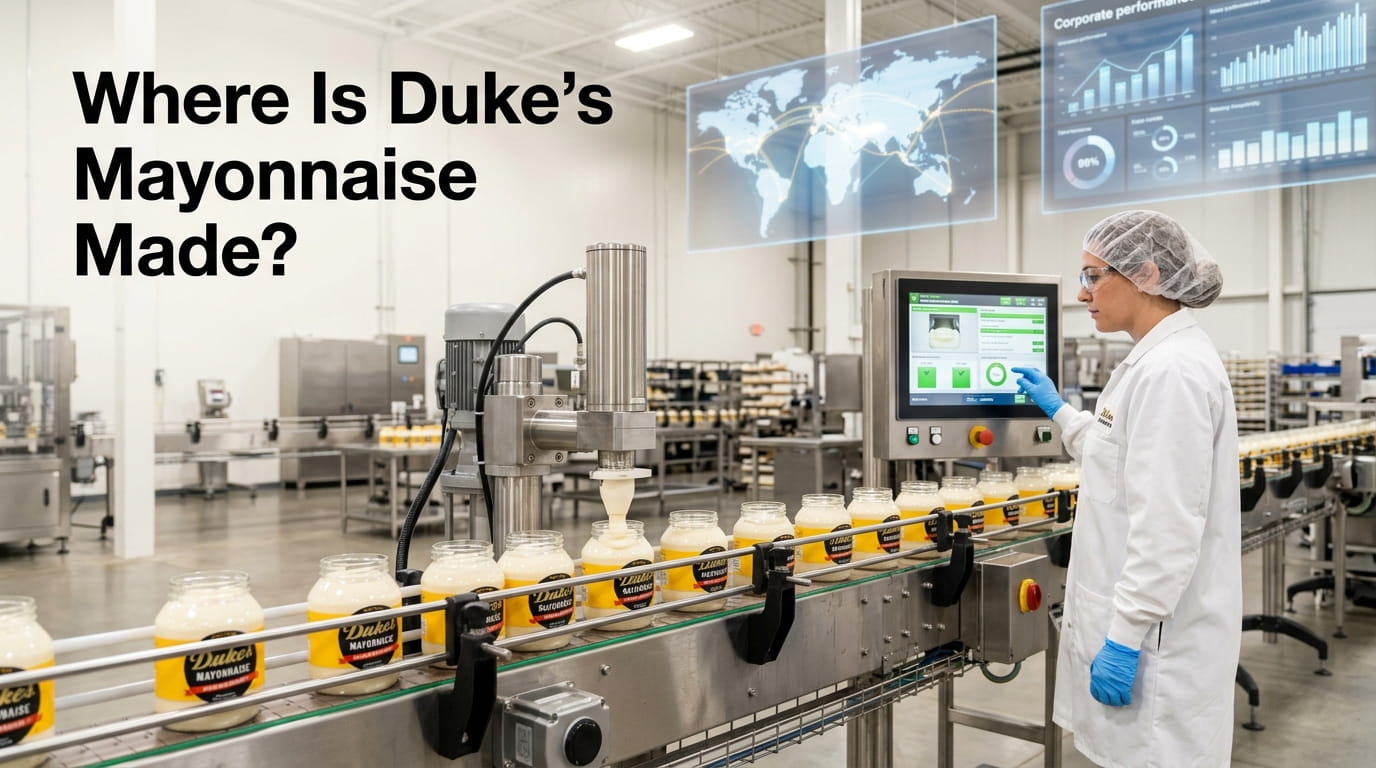
Duke’s Mayonnaise is made by Sauer Brands Inc., a condiments and seasonings company now owned by Advent International, with primary production at its factory in Mauldin, South Carolina, the state where Eugenia Duke first created the recipe in 1917.
Duke’s is the third-largest mayonnaise brand in the United States by volume and holds a particularly devoted following across the American South, where its tangier flavor profile, higher egg yolk content, and zero added sugar distinguish it from Hellmann’s, Kraft, and other national competitors.
Sauer Brands Inc. is a privately held company headquartered in Richmond, Virginia, owned by Advent International, a Boston-based global private equity firm that completed its acquisition of Sauer Brands from Falfurrias Capital Partners on February 19, 2025; Sauer Brands also owns Kernel Season’s, Mateo’s Gourmet Salsa, The Spice Hunter, and the Sauer’s spice brand.
Knowing where Duke’s Mayonnaise is made and who owns it matters particularly now, as the brand changed hands again in early 2025 and some loyal fans wanted to understand whether the new ownership would affect the recipe, production location, or Southern identity of the product.
This article covers who makes Duke’s, where it is produced, the brand’s history from Eugenia Duke’s kitchen to a national brand, and how Duke’s compares to Hellmann’s on ownership and ingredients.
So let’s get started.
Table of Contents
Who Makes Duke’s Mayonnaise?

Duke’s Mayonnaise is produced by Sauer Brands Inc., formerly known as C.F. Sauer Company. According to the Duke’s Mayonnaise Wikipedia entry, the C.F. Sauer Company purchased the recipe and brand from Eugenia Duke in 1929, and the product has been manufactured under Sauer ownership ever since.
The Mauldin, South Carolina facility is the primary production site and has operated continuously since Sauer began scaling the brand.
Sauer Brands also operates manufacturing facilities in Richmond, Virginia; New Century, Kansas; and San Luis Obispo, California, giving it a distributed U.S. production footprint that supports national distribution.
Duke’s Mayonnaise is now available throughout the United States and in select international markets including New Zealand, Australia, and the Middle East.
As of February 19, 2025, Advent International, a global private equity investor based in Boston with over 420 investments across 43 countries, became the new parent company of Sauer Brands following its acquisition from Charlotte-based Falfurrias Capital Partners.
Advent has indicated it plans to continue Sauer Brands’ growth trajectory while keeping the Duke’s brand identity intact.
Where Is Duke’s Mayonnaise Made?
Duke’s Mayonnaise is made in Mauldin, South Carolina, a town southeast of Greenville where the brand has its roots.
The Mauldin facility is the flagship production plant and the one most closely associated with the brand’s Southern identity.
It was even featured in a How It’s Made television episode about mayonnaise production in 2011, giving the factory a degree of public visibility unusual for a condiment production site.
The South Carolina production location is important to Duke’s brand story because the recipe was created in Greenville by Eugenia Duke in 1917, making the Mauldin facility’s location a continuation of the brand’s geographic heritage within the same state.
For many Duke’s loyalists in the Southeast, the made-in-South Carolina origin is part of the product’s identity and a point of regional pride.
Sauer Brands’ other facilities in Virginia, Kansas, and California handle production for other brands in the portfolio and may contribute to Duke’s distribution in regions far from the Southeast, but the Mauldin plant remains the brand’s manufacturing home.
What Makes Duke’s Mayonnaise Different?
Duke’s Mayonnaise uses more egg yolks than competing products, which gives it a richer, creamier texture and a higher fat content per serving.
It contains no added sugar, which is a notable distinction from Hellmann’s and Kraft, both of which include small amounts of sugar in their standard formulas.
Duke’s also uses apple cider vinegar rather than distilled white vinegar, which contributes to its distinctively tangy flavor profile that has become a hallmark of Southern cooking applications.
These ingredient differences are not just marketing claims. Duke’s recipe has remained unchanged since Eugenia Duke developed it in 1917, and Sauer has maintained that original formula through every corporate ownership change.
The absence of sugar means Duke’s often performs differently in baking applications like tomato pie or mayo cake compared to sweetened alternatives, and many Southern cooks specifically require Duke’s for recipes where the sugar in other brands would alter the flavor balance.
Duke’s has expanded its product line in recent years to include flavored mayonnaises, Southern sauces including Alabama-style white BBQ, Georgia Sweet Heat BBQ, and Carolina Gold BBQ, as well as dressings and dips.
These line extensions maintain the brand’s Southern flavor identity while broadening its appeal beyond the classic mayo jar.
Duke’s vs. Hellmann’s: Who Makes Each Brand?
Duke’s and Hellmann’s are the two most frequently compared mayonnaise brands in American cooking, and they are made by entirely different companies.
Duke’s is made by Sauer Brands, a private condiments company now owned by Advent International.
Hellmann’s is made by Unilever, the Anglo-Dutch consumer goods conglomerate that also owns Best Foods, Knorr, and dozens of other food brands. In the western United States, Hellmann’s is sold as Best Foods, though the recipe and manufacturer are identical.
The two brands differ on ingredients as noted above, but they also differ on distribution presence. Hellmann’s is the largest mayonnaise brand in the United States and is available at virtually every grocery retailer nationally.
Duke’s historically concentrated on the Southern market and only achieved nationwide distribution in recent years, which is why many consumers in the Northeast or Pacific Northwest may not have encountered it until relatively recently.
For consumers choosing between the two, the decision typically comes down to whether sugar in mayonnaise is a concern and whether the tangier Duke’s profile or the milder Hellmann’s profile better suits a given recipe.
Both products use the same fundamental mayonnaise structure of oil, egg, and acid, with the differences in the specific ingredients producing meaningfully different results in dishes where mayo is a prominent flavor. For other food brand origin articles, see Who Makes Sprite and Who Makes Kirkland Coffee.
Frequently Asked Questions About Duke’s Mayonnaise
Is Duke’s Mayonnaise still made in South Carolina?
Yes. Duke’s Mayonnaise is still produced at the Mauldin, South Carolina facility that has served as the brand’s primary production site. The 2025 acquisition by Advent International has not relocated production from South Carolina.
Who owns Duke’s Mayonnaise now?
Duke’s Mayonnaise is owned by Sauer Brands Inc., which is owned by Advent International, a Boston-based global private equity firm. The acquisition from Falfurrias Capital Partners closed on February 19, 2025. Sauer Brands is headquartered in Richmond, Virginia.
Why does Duke’s taste different from other mayonnaise?
Duke’s uses more egg yolks, no added sugar, and apple cider vinegar instead of distilled white vinegar. These ingredient differences produce a tangier, richer flavor than Hellmann’s or Kraft, and the absence of sugar makes Duke’s behave differently in recipes where sweetness would affect the overall balance.
Has the Duke’s Mayonnaise recipe changed?
No. The Duke’s Mayonnaise recipe has remained unchanged since Eugenia Duke developed it in 1917. Sauer Brands has maintained the original formula through every ownership change, and Advent International’s 2025 acquisition has been publicly characterized as a continuation of the brand’s existing quality standards.

I am Jack Neel, a mechanical engineer, researcher, and writer. I created this website to share my knowledge about different brands and products with you. I research the manufacturers behind the brands and provide you with the information you need to make smart buying decisions.