
Mr. Coffee sits on more American kitchen counters than almost any other coffee maker brand.
It has that homey, familiar name, the kind that sounds like it belongs to your grandmother’s kitchen.
But a lot of shoppers pause at checkout and wonder something simple.
Is Mr. Coffee actually made in America, or is that just the vibe the name gives off.
The real answer involves Cleveland engineers, a Yankees legend, and a modern supply chain that stretches across Asia.
It also involves a company called Newell Brands, which owns a long list of household names you probably use every day.
So let’s get started.
Table of Contents
Where Is Mr. Coffee Made?

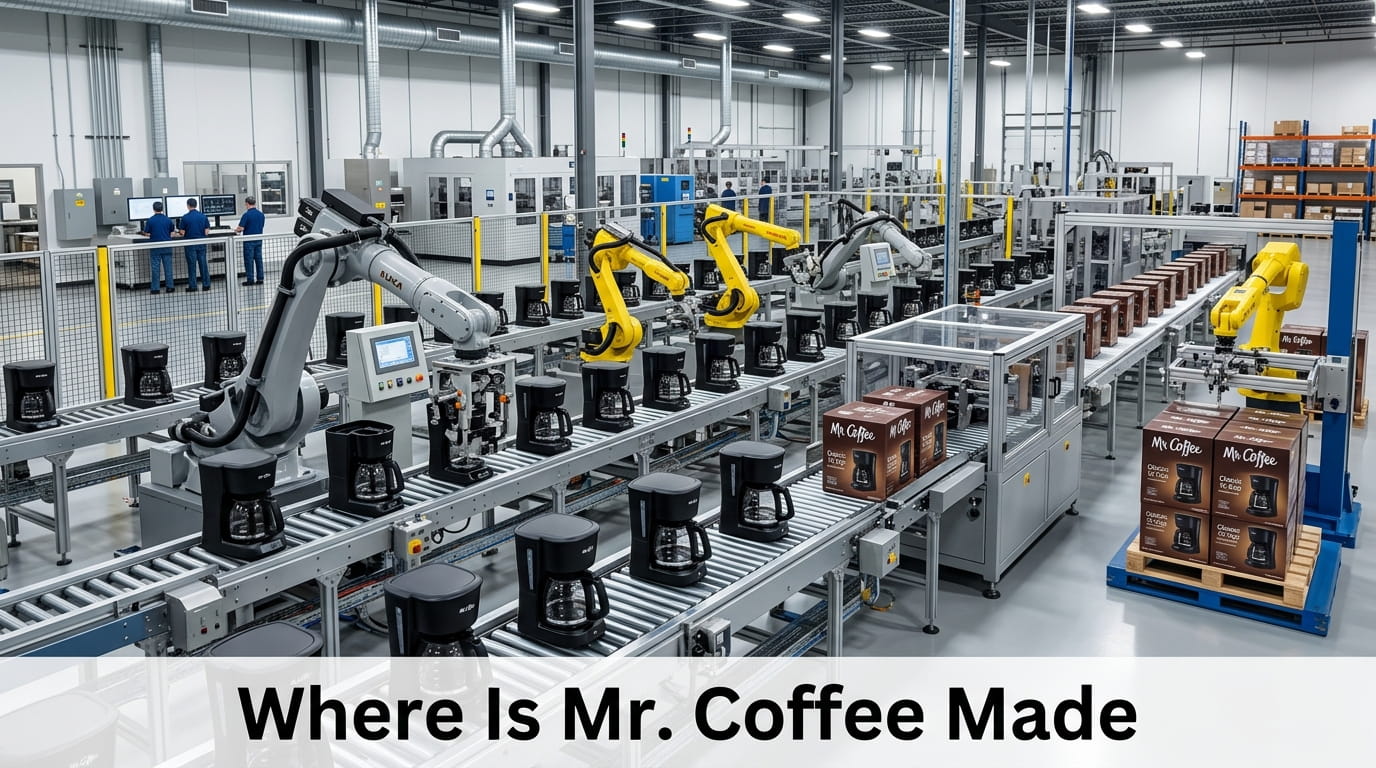
Today, most Mr. Coffee coffee makers are manufactured overseas, primarily in China, with some production shifting to other parts of Southeast Asia.
The brand is owned and marketed by Mr. Coffee, a division of Newell Brands, but Newell does not run its own coffee maker factories in the United States.
Instead, Newell contracts with overseas manufacturing partners to build the machines to its specifications.
Design, engineering direction, and quality standards are handled from the United States.
The physical assembly of the coffee maker itself, the plastic housing, the heating element, the carafe, generally happens in Chinese factories.
Some newer models are also being built in Vietnam, Thailand, or Indonesia as Newell diversifies its supply chain.
That mix has been shifting quickly in the past couple of years, which we will get into further down.
Who Owns Mr. Coffee?
Mr. Coffee is owned by Newell Brands, a large American consumer goods company based in Atlanta, Georgia.
Newell also owns brands like Rubbermaid, Sharpie, Yankee Candle, Graco, and Oster, according to Wikipedia.
Mr. Coffee became part of the Newell family through a long chain of acquisitions rather than a single clean purchase.
Newell Brands itself was formed when Newell Rubbermaid acquired Jarden in 2015 and took on the Newell Brands name.
Jarden had acquired Mr. Coffee back in 2005 through its purchase of American Household, Inc.
So Newell’s ownership of Mr. Coffee is really the end result of decades of consumer goods companies buying and reselling each other’s brand portfolios.
Where Did Mr. Coffee Come From?
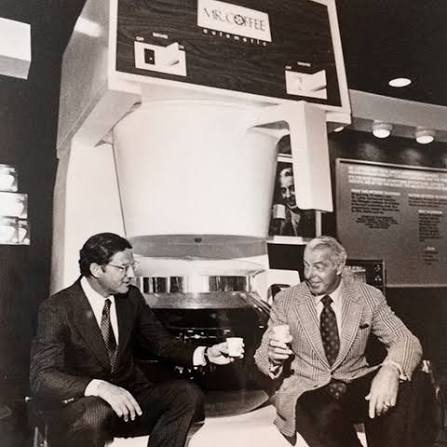
Mr. Coffee started in Cleveland, Ohio, in the early 1970s.
It was founded by Vincent Marotta and Samuel Glazer, who ran a coffee delivery company called North American Systems.
Marotta had an idea for an automatic drip coffee maker, a machine that would brew more consistent coffee than the percolators most homes used at the time.
He brought in two former Westinghouse engineers, Edmund Abel and Edwin Schulze, to help build it.
In 1972, the first Mr. Coffee drip machine hit the market, and it sold more than a million units within about two years.
Marotta later convinced baseball legend Joe DiMaggio to become the brand’s spokesman, which turned Mr. Coffee into a household name almost overnight.
That early manufacturing, back in the 1970s, really was rooted in Ohio.
How Manufacturing Moved Overseas
Mr. Coffee went through several ownership changes starting in the 1980s, including a leveraged buyout and a sale to Health O Meter Products in the early 1990s.
By the time Sunbeam and later Jarden owned the brand, most small kitchen appliance manufacturing across the entire industry had already shifted to Asia.
This was not unique to Mr. Coffee.
Nearly every major American coffee maker and small appliance brand followed the same path during the 1990s and 2000s, chasing lower labor and materials costs.
By the time Newell Brands took over in 2015, Mr. Coffee production was already firmly based overseas, and it has stayed that way.
Does Mr. Coffee Claim to Be Made in the USA?
No, Mr. Coffee does not market itself as a Made in USA product, and you will not find that claim on its packaging or its official site.
The brand leans instead on its American origin story, the Cleveland invention, the DiMaggio partnership, the phrase America’s original coffee maker that still appears in its marketing.
That is a subtler kind of claim, one about heritage rather than current manufacturing.
It is accurate as far as it goes, since the brand really was invented in Ohio in the early 1970s.
But it should not be confused with a promise that the coffee maker in the box was assembled domestically, because it almost certainly was not.
Mr. Coffee vs Keurig: Who Makes Each?
Keurig is Mr. Coffee’s biggest rival in the American coffee maker market, especially in the single serve category.
Keurig was founded in Massachusetts in 1992 and is now owned by Keurig Dr Pepper.
Like Mr. Coffee, Keurig designs its machines domestically but manufactures them overseas.
Reports and customer service responses have placed Keurig production in China, Indonesia, and Malaysia depending on the model.
So in practice, shoppers choosing between Mr. Coffee and Keurig are choosing between two American brands that both build their hardware in Asia.
Neither company currently offers a true Made in USA coffee maker at meaningful scale.
What Is Next for Mr. Coffee?
The biggest story for Mr. Coffee’s parent company right now is tariffs.
Newell Brands has said it expects a total gross cash tariff impact of around 130 million dollars in 2026, after absorbing roughly 174 million dollars in tariff costs in 2025.
In response, Newell has been actively reducing its dependence on China.
Company reporting shows China exposure has fallen from around 35 percent of sourcing a few years ago to closer to 10 percent now, with plans to keep shrinking that number, as detailed by Supply Chain Dive.
Some of that shift is landing in Vietnam, Thailand, and Indonesia, and some production is also being automated and brought closer to Newell’s existing domestic facilities.
Newell has also pushed through several rounds of price increases in 2025 to help offset the tariff hit, so shoppers may notice Mr. Coffee prices creeping upward through 2026.
For more brand supply chain breakdowns like this one, see our guides on Bunn Coffee Makers and Ninja Blenders.
Frequently Asked Questions About Where Mr. Coffee Is Made
Is Mr. Coffee an American company?
Mr. Coffee was founded in Cleveland, Ohio, in the early 1970s, so its roots are genuinely American.
The brand is still headquartered in the United States today, currently operating as part of Newell Brands, which is based in Atlanta.
However, the physical manufacturing of the coffee makers themselves has moved overseas, mostly to China, so being an American company does not mean the products are built domestically.
Are any Mr. Coffee products made in the USA?
There is no strong evidence that current Mr. Coffee coffee makers are assembled in the United States at any real scale.
Newell Brands has been public about its reliance on overseas manufacturing partners for small kitchen appliances across its portfolio.
If a shopper wants a genuinely domestically produced coffee maker, Mr. Coffee is not likely to be the brand that satisfies that specific requirement in 2026.
Why did Mr. Coffee move production to China?
The shift happened gradually, driven by the same economics that moved most small appliance manufacturing out of the United States starting in the 1990s.
Labor costs, materials costs, and the scale of Asian manufacturing hubs made it much cheaper to build coffee makers overseas than domestically.
By the time Newell Brands acquired the brand in 2015, this shift was already long complete across the industry, not something specific to Mr. Coffee’s choices alone.
Will tariffs bring Mr. Coffee production back to the USA?
It is too early to say for certain, but the pressure from tariffs does appear to be reshaping Newell’s supply chain in 2025 and 2026.
The company has stated it is cutting its China exposure sharply and shifting some production to countries like Vietnam and Indonesia, as well as investing in automation at its existing facilities.
That is a diversification away from China more than a full return to United States manufacturing, so buyers hoping for an American made Mr. Coffee machine should not expect that outcome soon.

I am Jack Neel, a mechanical engineer, researcher, and writer. I created this website to share my knowledge about different brands and products with you. I research the manufacturers behind the brands and provide you with the information you need to make smart buying decisions.