
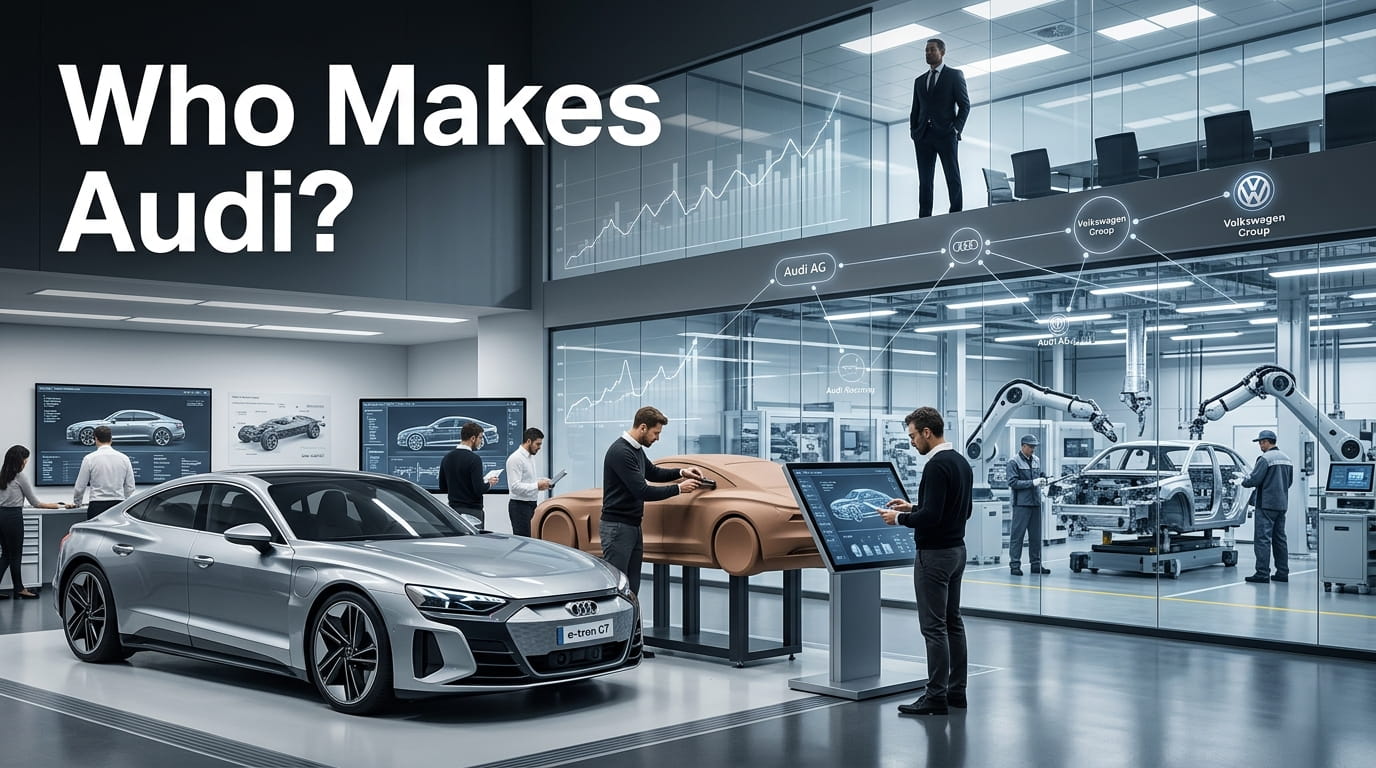
Audi cars are primarily made by Audi AG, a German luxury automaker headquartered in Ingolstadt, Bavaria, Germany.
Audi is known for its Vorsprung durch Technik philosophy, meaning advancement through technology, and for pioneering quattro all-wheel drive technology that transformed the performance car market in the 1980s.
Audi AG is a wholly owned subsidiary of Volkswagen Group, the German automotive conglomerate that also owns Volkswagen, Porsche, Lamborghini, Bentley, SEAT, Škoda, and several other brands.
Knowing who makes Audi helps buyers understand the ownership structure, manufacturing standards, and engineering resources that give Audi its position in the luxury car market.
This article covers Audi’s ownership, founding history, manufacturing locations, current model lineup, and how it compares to BMW and Mercedes-Benz.
So let’s get started.
Table of Contents
Who Owns Audi?

Audi is owned by Volkswagen Group, one of the largest automotive conglomerates in the world by revenue and vehicle production volume.
Volkswagen Group is a publicly traded German company listed on the Frankfurt Stock Exchange, with the Porsche SE holding company controlling a majority of voting rights.
Within Volkswagen Group, Audi occupies the upper-premium tier, positioned above Volkswagen and Škoda but alongside Porsche as the group’s highest performance and most prestigious brands.
When Was Audi Founded?
Audi’s origins trace back to 1909, when August Horch founded Audi Automobilwerke in Zwickau, Germany after leaving the company that would become Horch.
In 1932, four German automakers, Audi, DKW, Horch, and Wanderer, merged to form Auto Union. The four interlocking rings in the Audi logo represent those four founding brands.
The modern Audi AG was established in 1969 when Auto Union merged with NSU Motorenwerke. Volkswagen Group has owned Audi in its current form since the 1960s and has expanded it into a global luxury brand.
Where Are Audi Cars Made?
Audi’s primary manufacturing home is in Ingolstadt, Bavaria, where the main plant produces the A4, A5, Q5, and Q8 e-tron electric SUV.
The Neckarsulm plant in Baden-Württemberg, Germany assembles the A6, A7, A8 flagship, e-tron GT, and R8 supercar.
Outside Germany, Audi assembles vehicles at Volkswagen Group plants across Europe, including Győr in Hungary for the A3 and Q3, and San José Chiapa in Mexico for the Q5 SUV.
The Q7 and Q8 are assembled at the Bratislava plant in Slovakia. Audi also produces vehicles in China through joint ventures with local partners to serve that market.
What Models Does Audi Currently Offer?
Audi’s US lineup spans sedans, SUVs, and performance models across petrol, hybrid, and fully electric configurations.
Sedans include the A4, A5, A6, A7, and the flagship A8. SUVs run from the compact Q3 and Q5 up to the three-row Q7 and Q9.
The electric lineup includes the Q8 e-tron, Q4 e-tron, and e-tron GT performance sedan. The RS and S performance variants sit at the top of most model lines. Full details are listed on the Audi USA official website.
Audi vs BMW vs Mercedes-Benz: Who Makes Each?
All three are German luxury automakers, each with distinct ownership structures. Audi is owned by Volkswagen Group. BMW is an independent company. Mercedes-Benz is also independently listed on the Frankfurt Stock Exchange.
Volkswagen Group’s portfolio gives Audi access to shared engineering with Porsche and Lamborghini. BMW and Mercedes each stand alone without the backing of a broader automotive group.
In terms of manufacturing, BMW produces its core models in Munich and Dingolfing, Germany. Mercedes assembles its flagship vehicles in Stuttgart. Audi’s two main plants are in Ingolstadt and Neckarsulm.
Is Audi the Same as Volkswagen?
No. Audi and Volkswagen are separate brands within Volkswagen Group, positioned at different points in the market.
Volkswagen targets mainstream buyers. Audi occupies the premium luxury segment and competes with BMW and Mercedes, not with Volkswagen’s own Tiguan or Golf.
The two brands do share engineering platforms and powertrains. The Audi Q5 and Volkswagen Tiguan share an underlying chassis, but the vehicles are designed, built, and positioned entirely differently.
What Is Next for Audi?
Audi has committed to introducing only fully electric vehicles in new markets from 2026 onward, with a complete transition to electric globally by 2033.
The brand is expanding its e-tron electric lineup and updating its charging network through the Ionity joint venture in Europe and the IONNA network in North America.
Audi’s Ingolstadt plant is being converted to electric vehicle production, and the brand has announced plans to produce its first electric A6 sedan alongside the combustion version at the same facility.
Frequently Asked Questions About Who Makes Audi
Is Audi owned by Volkswagen?
Yes. Audi AG is a wholly owned subsidiary of Volkswagen AG, the German parent company of Volkswagen Group. Audi operates with considerable independence in design and engineering but is fully owned and controlled by Volkswagen Group.
Where is the Audi Q5 made?
The Audi Q5 sold in North America is assembled at the Audi plant in San José Chiapa, Mexico. It shares this plant with the Volkswagen Tiguan and several other Volkswagen Group models assembled for the North American market.
Is Audi a German car?
Yes. Audi was founded in Germany in 1909 and remains headquartered in Ingolstadt, Bavaria. Its most prestigious models, including the A8 flagship and R8 supercar, are assembled in Germany at the Ingolstadt and Neckarsulm plants.
What does the Audi logo mean?
The four interlocking rings in the Audi logo represent the four companies that merged in 1932 to form Auto Union: Audi, DKW, Horch, and Wanderer. The symbol has been part of the brand’s identity ever since, carrying the heritage of four separate German engineering traditions.

I am Jack Neel, a mechanical engineer, researcher, and writer. I created this website to share my knowledge about different brands and products with you. I research the manufacturers behind the brands and provide you with the information you need to make smart buying decisions.