
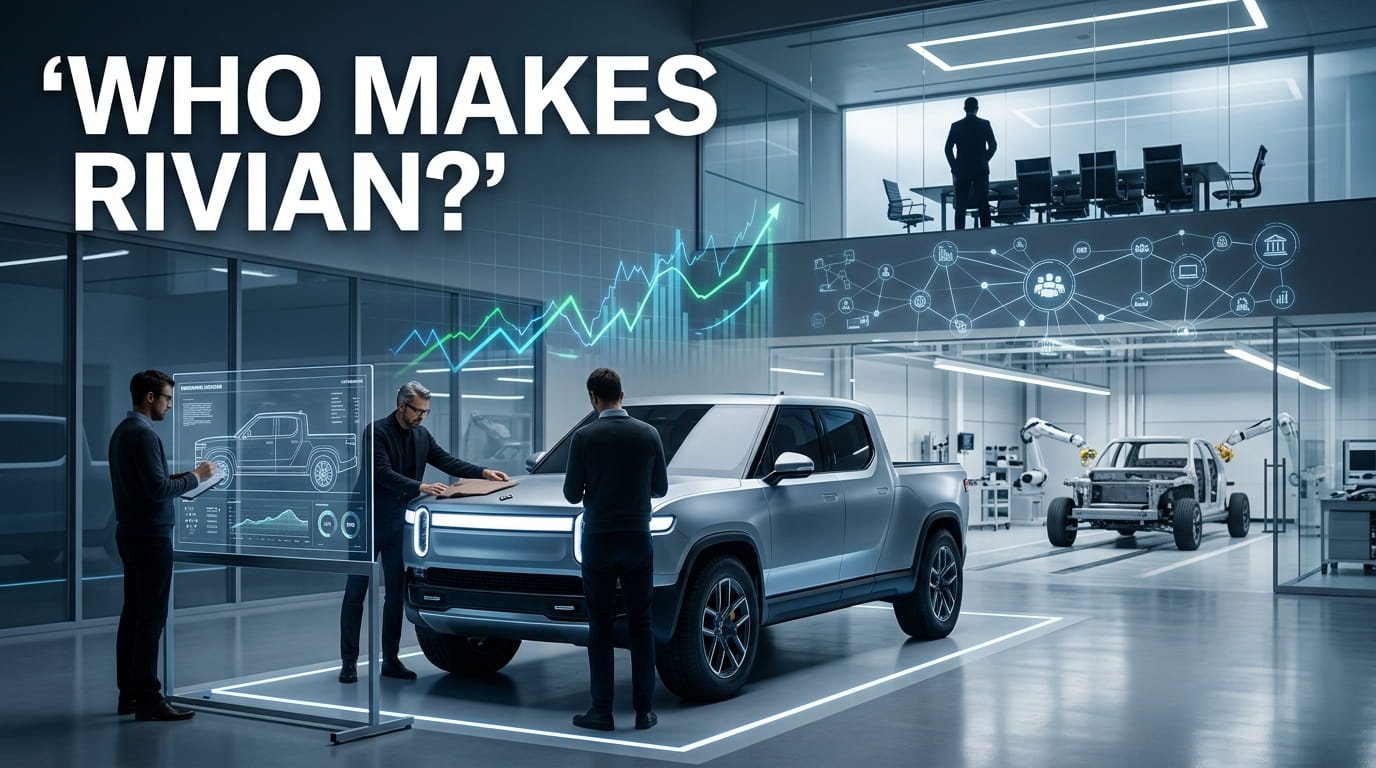
Rivian vehicles are made by Rivian Automotive, Inc., an American electric vehicle company headquartered in Irvine, California.
Rivian is known for its rugged adventure-focused electric trucks and SUVs, its dual motor and quad motor drivetrain configurations, and a loyal customer base that values outdoor capability alongside zero emissions.
Rivian Automotive is a publicly traded company on the NASDAQ exchange under the ticker RIVN, with Volkswagen Group becoming its largest shareholder in 2026 through a $5.8 billion joint venture agreement.
Knowing who makes Rivian helps buyers understand the company’s ownership, its manufacturing setup, and what the Volkswagen partnership means for the brand’s future technology.
This article covers Rivian’s founding, where its vehicles are made, its current lineup, the Volkswagen partnership, and what is next for the brand.
So let’s get started.
Table of Contents
Who Owns Rivian?
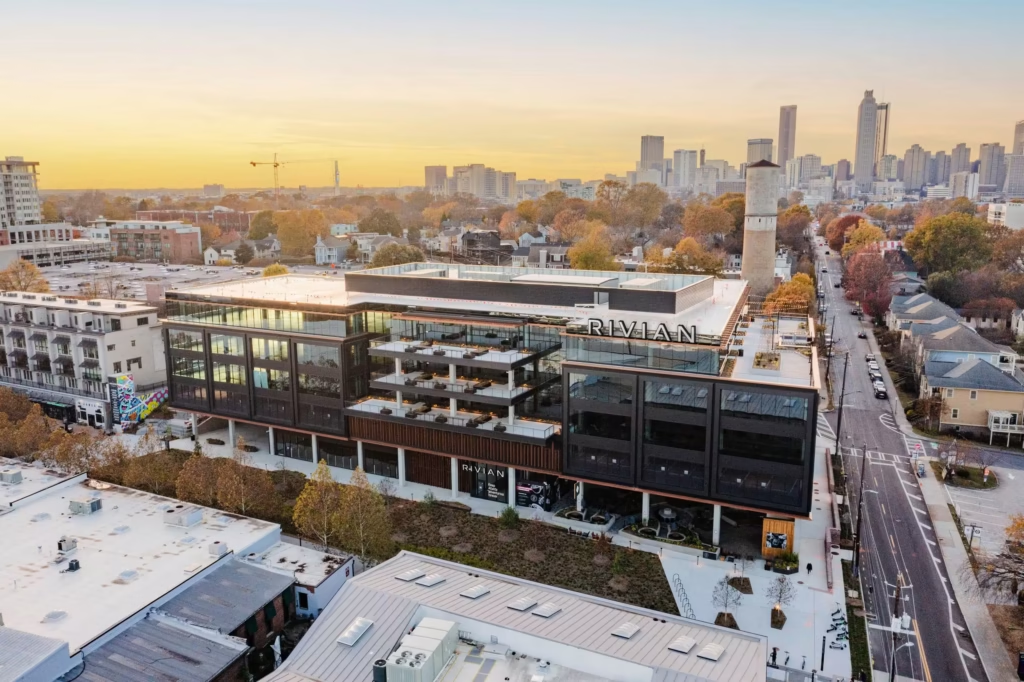
Rivian Automotive is a publicly traded company with no single majority owner. Its largest shareholders include Volkswagen Group, Amazon, and large institutional investors.
Volkswagen Group became Rivian’s largest shareholder in 2026, holding more than 209 million shares as part of a $5.8 billion joint venture focused on software and electrical architecture.
Amazon holds approximately 12.28% of Rivian and is also the brand’s largest fleet customer, having ordered 100,000 electric delivery vans for its logistics network.
When Was Rivian Founded?
Rivian was founded in 2009 by Robert Scaringe, who serves as the company’s CEO and remains its most prominent public figure.
The company spent its first decade in stealth mode, raising capital and developing technology without publicly announced products.
Rivian went public in November 2021 through one of the largest IPOs in US automotive history, raising approximately $11.9 billion and briefly achieving a market capitalization larger than Ford or General Motors.
Where Are Rivian Vehicles Made?
All Rivian vehicles are currently assembled at a single factory in Normal, Illinois, a converted former Mitsubishi plant on a 3.3 million square foot site.
The Normal plant produces the R1T electric pickup truck, the R1S electric SUV, and the EDV electric delivery vans for Amazon.
Rivian has confirmed plans for a second factory in Georgia, which will produce the upcoming R2 midsize electric SUV and help the company scale significantly beyond its current production capacity.
What Does Volkswagen’s Investment Mean for Rivian?
In June 2024, Volkswagen Group announced a joint venture with Rivian worth up to $5.8 billion, triggered by achieving specific financial and technology milestones.
The joint venture focuses on sharing Rivian’s software and electrical vehicle architecture with Volkswagen models, including future VW, Audi, and Scout Motors vehicles.
By March 2026, VW had already invested $3 billion across three milestone-triggered tranches, and the first VW prototype vehicles running Rivian’s platform had completed winter testing.
What Models Does Rivian Currently Offer?
Rivian’s current consumer lineup consists of two vehicles: the R1T electric pickup truck and the R1S electric SUV.
The R1S is a seven seat electric SUV with up to 401 miles of EPA-rated range in its largest battery configuration. The R1T was the first electric pickup truck to go on sale in the United States.
The R2 midsize SUV is in development and is expected to launch in 2026 at a significantly lower price point than the current R1 family. The R3 compact electric crossover has also been announced.
Rivian vs Tesla vs Ford: Who Makes Each EV Brand?
All three are American electric vehicle companies with distinct ownership structures. Rivian is publicly traded with VW and Amazon as major shareholders. Tesla is publicly traded with Elon Musk as its largest individual shareholder. Ford is an independent publicly traded American automaker.
Ford was an early investor in Rivian before selling its stake. The two companies had planned to co-develop an electric vehicle but ended that partnership before it produced a vehicle.
Rivian positions itself specifically around outdoor adventure and rugged capability. Tesla leads in total EV sales globally. Ford’s EV efforts center on the F-150 Lightning and Mustang Mach-E.
What Is Next for Rivian?
The R2 midsize SUV is Rivian’s most anticipated upcoming product, targeting a lower price point to reach a broader audience than the premium-priced R1 family.
Rivian achieved its first consecutive quarters of gross profit in early 2025, a milestone that triggered additional Volkswagen investment and signaled the company’s path toward financial sustainability.
In March 2026, Rivian and Uber announced a partnership to deploy up to 50,000 autonomous robotaxis, adding a significant commercial fleet opportunity alongside its consumer vehicle business.
Frequently Asked Questions About Who Makes Rivian
Is Rivian owned by Amazon?
Amazon is a significant shareholder in Rivian, holding approximately 12.28% of the company’s shares as of 2026. Amazon is also Rivian’s largest fleet customer. However, Amazon does not own or control Rivian, which remains an independent publicly traded company.
Where are Rivian trucks made?
All Rivian vehicles, including the R1T truck and R1S SUV, are assembled at the Normal, Illinois plant. This is currently Rivian’s only manufacturing facility. A second factory is planned in Georgia to produce the upcoming R2 SUV.
Is Rivian profitable?
Rivian achieved its first quarterly gross profit in the fourth quarter of 2024 and repeated it in the first quarter of 2025. The company continues to carry net losses due to high R&D spending, particularly on its autonomy and software programs.
Does Volkswagen own Rivian?
Volkswagen Group is Rivian’s largest shareholder as of 2026, with more than 209 million shares. However, Volkswagen does not have majority ownership or management control. Rivian remains an independent publicly traded company with its own CEO and board.

I am Jack Neel, a mechanical engineer, researcher, and writer. I created this website to share my knowledge about different brands and products with you. I research the manufacturers behind the brands and provide you with the information you need to make smart buying decisions.