
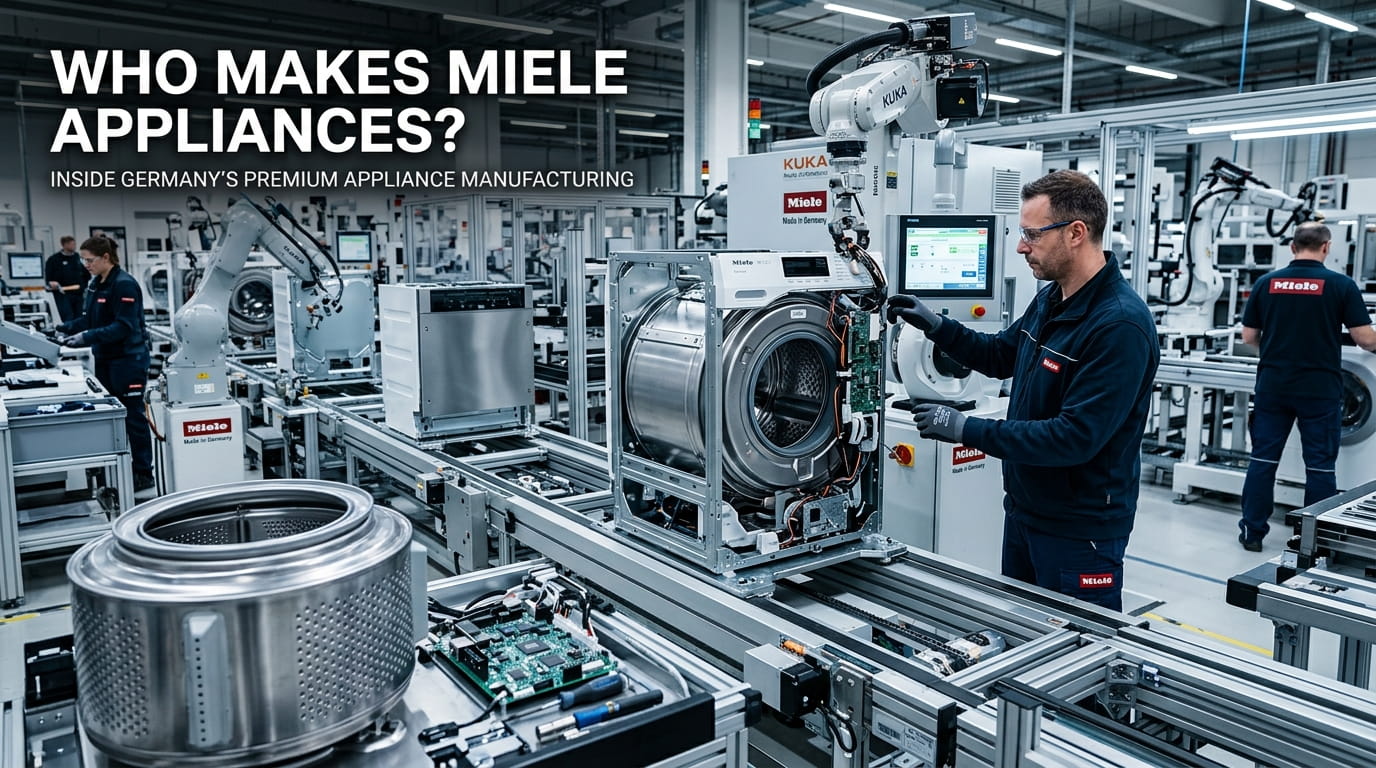
Miele appliances are made by Miele and Cie. KG, a German family owned manufacturer that has been building premium domestic and commercial appliances since 1899.
Miele is renowned worldwide for engineering products to last 20 years, a standard rare in the appliance industry, and its guiding motto “Immer Besser” translates from German as “Forever Better.”
The company is still privately owned by direct descendants of its two founders, the Miele family holding 51.1% and the Zinkann family holding 48.9%.
Knowing that Miele is a 125-year-old independent German family business helps explain why its appliances command premium prices and consistently rank at the top of reliability surveys.
This article covers who makes Miele appliances, where they are produced, who owns the brand, what they are known for, how they compare to a rival, and whether they are any good.
So let’s get started.
Table of Contents
Who Makes Miele Appliances?

Miele appliances are made by Miele itself, formally Miele and Cie. KG, a German manufacturer that designs and builds its own products.
Miele is one of the few premium appliance companies in the world that manufactures up to 50% of its components in-house, giving it exceptional control over quality.
The company operates eight production plants in Germany, plus facilities in Austria, the Czech Republic, Romania, Poland, China, and Italy.
Every Miele appliance is subjected to rigorous stress and endurance testing before release, with washers tested for the equivalent of 20 years of average use, as the company confirms on its official about page.
Miele entered the United States market in 1983 and maintains its American headquarters in Princeton, New Jersey.
Where Are Miele Appliances Made?
The majority of Miele appliances are made in Germany, with eight manufacturing plants spread across the country including facilities in Gütersloh, Bielefeld, Bünde, Euskirchen, Warendorf, Oelde, Lehrte, and Arnsberg.
The Gütersloh headquarters plant, founded in 1907, is the competence center for laundry appliances and also produces electronics used across the entire Miele range.
Miele also runs a dishwasher plant in the Czech Republic, a facility in Austria, electronics production in Romania, and a laundry plant in Poland that opened in 2019.
Certain product lines, including some cordless stick vacuums and robot vacuums, are made at Miele’s Dongguan, China facility, which the company has operated since 1996.
A new North American plant in Opelika, Alabama began producing cooking appliances in late 2024, marking Miele’s first United States manufacturing operation.
Who Owns Miele Appliances?
Miele is owned entirely by the Miele and Zinkann families, direct descendants of founders Carl Miele and Reinhard Zinkann.
The company has never been publicly listed on any stock exchange and has no outside investors or corporate parent.
That private ownership means Miele makes decisions based on long term quality and reputation rather than quarterly earnings.
The full history of the company and its family ownership is documented in its published company history.
What Is Miele Known For?
Miele is best known for premium washers, dryers, dishwashers, vacuum cleaners, and built-in kitchen appliances that consistently top independent reliability tests.
The brand produced Europe’s first electric dishwasher in 1929 and has continued setting industry benchmarks, including the world’s first dishwasher with a cutlery tray in 1987.
In 2025, Miele launched the M Sense intelligent cookware system and the W2 and T2 washer and dryer series, continuing a tradition of engineering led innovation.
The brand is represented in more than 100 countries and competes at the top tier against Sub-Zero, Wolf, Gaggenau, JennAir, and Dacor, as documented in independent company research.
Miele Appliances vs Bosch Appliances: How Do They Compare?
Miele and Bosch are both German appliance makers with strong reputations for quality, but they sit at different price points.
Miele is privately owned and positions itself at the very top of the premium market, with a focus on extreme durability and a 20-year product lifespan.
Bosch is owned by BSH Hausgeräte, a joint venture of Robert Bosch GmbH and Siemens, and competes in the mid to upper premium tier at a more accessible price.
For buyers who want the absolute best engineering and are willing to pay for it, Miele is the benchmark, while Bosch offers strong German quality at a lower entry price.
Are Miele Appliances Any Good?
Miele appliances are widely considered the gold standard of home appliance quality and durability.
The brand has won the German “Best Company” award and consistently tops long term reliability surveys across washing machines, dishwashers, and vacuum cleaners.
Owners often report minimal service calls even after many years of use, and Miele maintains spare parts availability for appliances made decades ago.
The price premium is real, with washers typically starting above $1,500 and dishwashers above $1,000, but the long service life makes the cost per year of use very competitive.
For buyers who want the best engineered, longest lasting appliances available, Miele is the clearest recommendation in the category.
For more on related premium appliance brands, see Who Makes Bosch Appliances and Who Makes KitchenAid Appliances.
Frequently Asked Questions About Miele Appliances
Who owns Miele appliances?
Miele is privately owned by the Miele and Zinkann families, direct descendants of founders Carl Miele and Reinhard Zinkann who started the company in Germany in 1899.
Are Miele appliances made in Germany?
Yes, most Miele appliances are made in Germany across eight plants. The company also has facilities in Austria, the Czech Republic, Poland, Romania, China, and a new plant in Alabama, USA.
How long do Miele appliances last?
Miele engineers and tests its appliances for a 20-year lifespan, which is significantly above the industry average of 10 to 12 years for most competing brands.
Is Miele worth the price?
For buyers who keep appliances long term, Miele’s cost per year of use is competitive with mid tier brands when factoring in its 20-year lifespan and lower repair frequency. The upfront investment is significant but well supported by consistent real world reliability data.

I am Jack Neel, a mechanical engineer, researcher, and writer. I created this website to share my knowledge about different brands and products with you. I research the manufacturers behind the brands and provide you with the information you need to make smart buying decisions.