
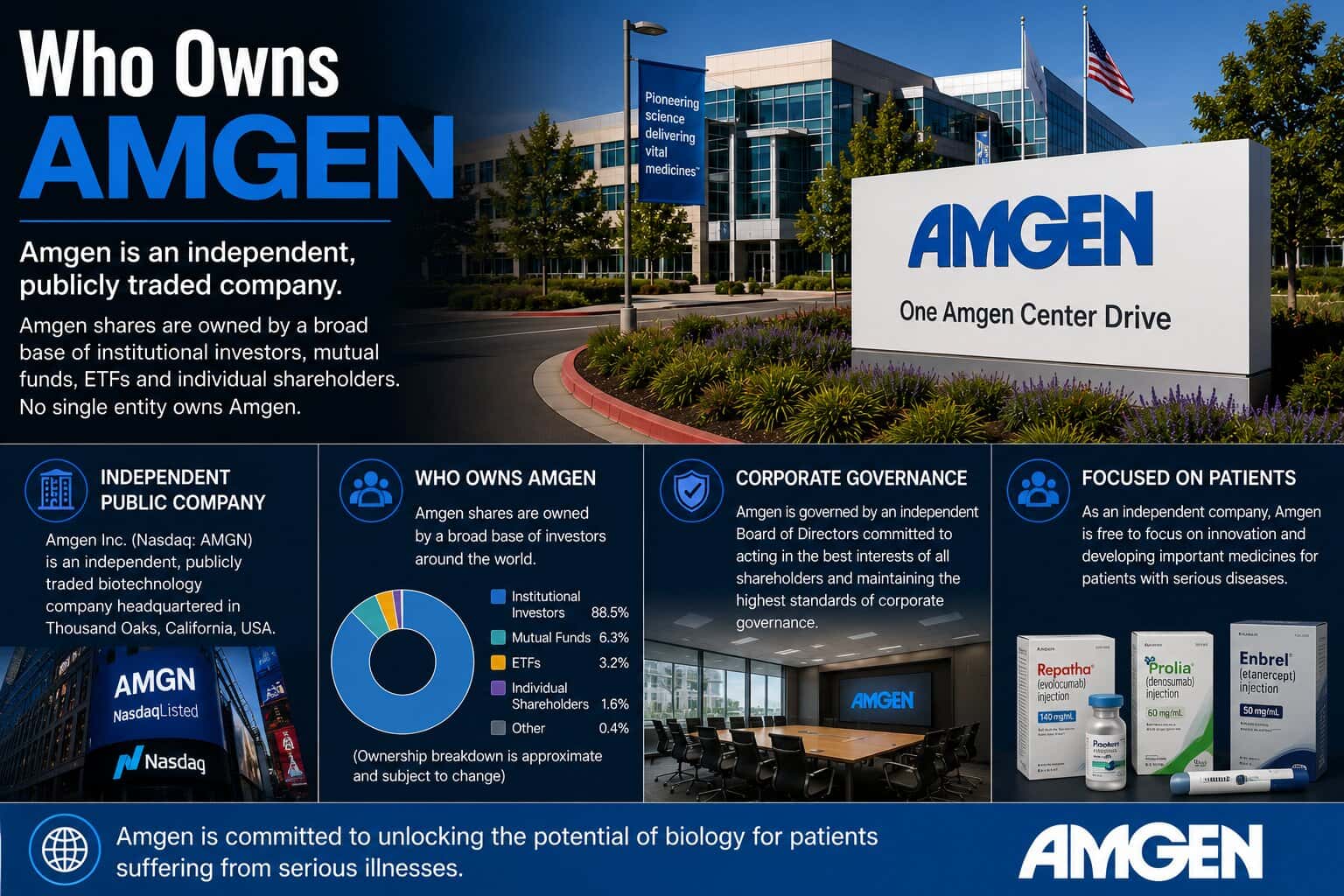
Amgen is a publicly traded American biotechnology company with no single controlling owner, listed on NASDAQ under the ticker AMGN, and is one of the world’s largest and most financially robust independent biotech companies.
Amgen was founded in 1980 in Thousand Oaks, California, as Applied Molecular Genetics by three biotechnology entrepreneurs, and has remained headquartered in Thousand Oaks ever since, growing from a startup into a global enterprise with 2025 revenues of 36.8 billion dollars.
Amgen is led by Chairman and CEO Robert A. Bradway, who has served as CEO since 2012 and as chairman since 2013, guiding the company through a decade of portfolio transformation from its original biologic medicines into biosimilars, novel small molecules, and obesity therapeutics.
Knowing who owns Amgen helps explain how one of America’s original biotech success stories has remained independent for over 45 years while building a product portfolio spanning bone health, oncology, cardiovascular, inflammation, and nephrology.
This article covers who owns Amgen, what the company does, its history, how it compares to a rival, and key facts about the business.
So let’s get started.
Table of Contents
Who Owns Amgen?

Amgen is publicly traded with no single controlling owner, with ownership distributed across institutional investors including BlackRock, Vanguard, and State Street, which collectively hold significant share blocks.
Unlike Genentech, which was absorbed into Roche, or Bausch Health, which carries the legacy of Valeant’s acquisition strategy, Amgen has remained a fully independent publicly traded company throughout its entire history.
Amgen’s board of directors operates with a strong independent director majority, and the company operates on a one-share-one-vote governance structure with no dual-class shares.
Robert A. Bradway’s tenure has seen Amgen acquire Horizon Therapeutics for 28 billion dollars in 2023 and make strategic investments in oncology, biosimilars, and obesity research, as confirmed in Amgen’s company profile.
What Does Amgen Do?
Amgen discovers, develops, manufactures, and delivers innovative human therapeutics across oncology, cardiovascular, bone health, inflammation, nephrology, and neuroscience.
Its flagship products include Repatha for cardiovascular disease, Prolia and Xgeva for bone health, Enbrel for inflammation, Otezla for psoriasis, and Blincyto for blood cancers.
ENBREL (etanercept) is one of Amgen’s most established products, a TNF inhibitor co-marketed with Pfizer in the United States for rheumatoid arthritis, psoriatic arthritis, and plaque psoriasis, originally developed by Immunex and brought to Amgen through its 2002 Immunex acquisition.
Amgen is also a major biosimilar manufacturer, producing biosimilar versions of leading biologics to expand patient access to complex medicines, as outlined on Amgen’s official about page.
What Is the History of Amgen?

Amgen was founded in 1980 as Applied Molecular Genetics by venture capitalist William Bowes and a team of scientists including George Rathmann, who became the company’s first CEO, in Thousand Oaks, California.
The company’s first breakthrough came with the development of erythropoietin (Epogen) in 1989, a recombinant protein that stimulates red blood cell production, which became the world’s first billion-dollar biotech drug and validated the commercial potential of recombinant biology.
Amgen acquired Immunex Corporation in 2002 for 16 billion dollars, gaining Enbrel and establishing itself as the world’s largest biotechnology company by revenue at the time of acquisition.
Under Robert Bradway from 2012 onward, Amgen has evolved from a legacy biologics-focused company into a diversified biopharmaceutical enterprise, with the 28 billion dollar Horizon Therapeutics acquisition in 2023 adding a rare disease and inflammation portfolio.
How Big Is Amgen?
Amgen generated total revenues of 36.8 billion dollars in 2025, a 10% increase over the prior year, driven by strong volume growth across 18 products that each achieved record annual sales.
The company employs approximately 28,000 people worldwide, primarily in the United States, with major operations in Thousand Oaks, California, and manufacturing sites across North America, Europe, and Puerto Rico.
Amgen paid 5.1 billion dollars in dividends in 2025 and has delivered fourteen consecutive years of dividend growth, reflecting its financial discipline and commitment to returning capital to shareholders.
In 2025, Amgen broke ground on a new 1 billion dollar manufacturing facility in the United States, reflecting its continuing investment in domestic biologic production capacity.
Amgen vs Genentech: How Do They Compare?
Amgen and Genentech are the two founding companies of the modern biotechnology industry, both created in California in the late 1970s and early 1980s, and represent two very different paths for pioneering biotechs.
Genentech became a wholly owned Roche subsidiary in 2009, giving it the backing of one of the world’s largest healthcare companies while losing its independence as a publicly traded entity.
Amgen has remained fully independent and publicly traded, allowing it to control its own capital allocation, acquisition strategy, and portfolio decisions without being subject to a parent company’s priorities.
Both companies produce medicines that have transformed treatment for cancer, autoimmune diseases, and metabolic conditions, and together they represent the foundational institutions of the biotechnology industry.
Frequently Asked Questions About Amgen
Who owns Amgen?
Amgen is publicly traded on NASDAQ under the ticker AMGN with no single controlling owner. Largest shareholders are major institutional investors. CEO and Chairman is Robert A. Bradway, who has held those roles since 2012 and 2013 respectively.
Where is Amgen headquartered?
Amgen is headquartered in Thousand Oaks, California, where it was founded in 1980 as Applied Molecular Genetics. The original Thousand Oaks building still stands on the company’s campus.
What is Amgen best known for?
Amgen is best known for Enbrel for arthritis and psoriasis, Repatha for cardiovascular disease, Prolia for osteoporosis, and Epogen, the first billion-dollar biotech drug. It is also one of the world’s largest biosimilar manufacturers.
How much revenue does Amgen generate?
Amgen generated 36.8 billion dollars in total revenues in 2025, a 10% increase over the prior year, with product sales of 35.1 billion dollars and R&D investment of 7.3 billion dollars.

I am Jack Neel, a mechanical engineer, researcher, and writer. I created this website to share my knowledge about different brands and products with you. I research the manufacturers behind the brands and provide you with the information you need to make smart buying decisions.