
Boehringer Ingelheim is owned by the Boehringer, Liebrecht, and von Baumbach families, making it the world’s largest privately held pharmaceutical company and one of the few major drug makers that has never been publicly listed on a stock exchange.
Founded in 1885 by Albert Boehringer in Ingelheim am Rhein, Germany, the company has remained under continuous family ownership for 140 years, a distinction that sets it apart from virtually every other large pharmaceutical company in the world.
Boehringer Ingelheim is headquartered in Ingelheim am Rhein, Rhineland-Palatinate, Germany, operates in 78 countries, and employs approximately 54,300 people worldwide.
Knowing that Boehringer Ingelheim is family owned and privately held helps explain its long-term investment philosophy, which prioritizes sustained research and development over the short-term pressures of public market reporting.
This article covers who owns Boehringer Ingelheim, what the company does, its history, how it compares to a rival, and key facts about the business.
So let’s get started.
Table of Contents
Who Owns Boehringer Ingelheim?
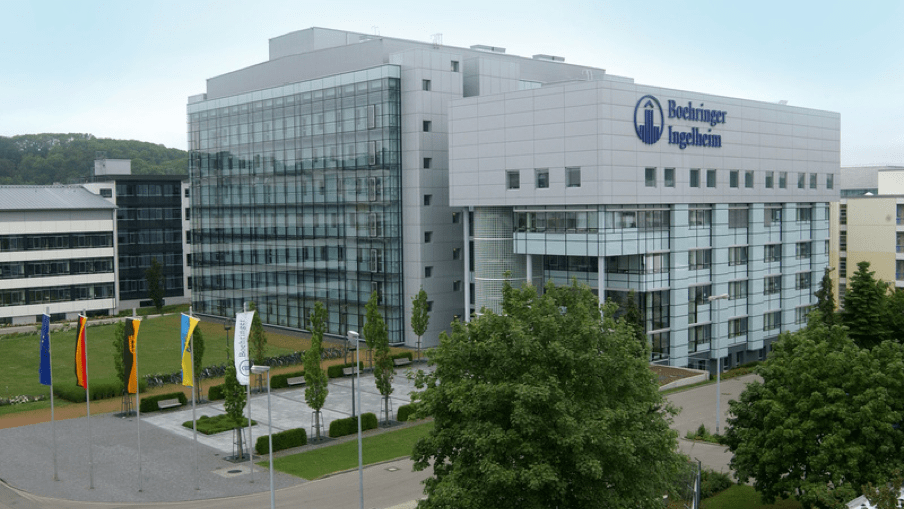
Boehringer Ingelheim is owned by the Boehringer, Liebrecht, and von Baumbach families, descendants of founder Albert Boehringer.
The holding company structure is C.H. Boehringer Sohn AG and Co. KG, the parent entity through which the family controls all Boehringer Ingelheim group companies globally.
Hubertus von Baumbach serves as chairman of the board of managing directors, representing the family’s active leadership of the business they have owned for over a century.
The family has deliberately maintained private ownership across generations, believing that the long-term investment cycles required for pharmaceutical research are better served without the quarterly earnings pressure of public markets, as documented in Boehringer Ingelheim’s company profile.
What Does Boehringer Ingelheim Do?
Boehringer Ingelheim researches, develops, manufactures, and markets prescription medicines and healthcare products across three core business areas: Human Pharma, Animal Health, and Biopharmaceutical Contract Manufacturing.
Its primary therapeutic focus areas include respiratory diseases, oncology, immunology, cardiometabolic conditions, and central nervous system disorders.
In cardiometabolic disease, Boehringer Ingelheim co-developed Jardiance (empagliflozin) and Tradjenta (linagliptin) with Eli Lilly and Company, with Jardiance becoming one of the world’s best-selling diabetes and heart failure medicines.
Its Animal Health division makes Boehringer one of the world’s top animal health companies, producing vaccines and treatments for companion animals, livestock, and poultry, as confirmed on Boehringer Ingelheim’s official about page.
What Is the History of Boehringer Ingelheim?
Albert Boehringer founded the company in 1885 at the age of 24 in Ingelheim am Rhein, Germany, initially hiring 28 people to produce tartaric acid salts for pharmacies and dyeing works.
The company made its first pharmaceutical product, the analgesic Laudanum, in 1912 and launched it for widespread marketing in 1915, beginning its evolution into a research-driven pharmaceutical company.
Through the twentieth century, Boehringer Ingelheim expanded globally, entering the United States market with its Ridgefield, Connecticut headquarters and establishing a worldwide research and development network.
By 2025, the company had grown to generate approximately 31 billion dollars in annual revenue while remaining fully family-owned, marking 140 years of continuous operation under the founding family’s stewardship.
How Big Is Boehringer Ingelheim?
Boehringer Ingelheim is one of the world’s top 20 pharmaceutical companies by prescription drug sales and the largest privately held pharmaceutical enterprise globally.
The company operates in 78 countries with approximately 54,300 employees and generated revenues of approximately 31 billion dollars in 2025.
In 2025, Boehringer Ingelheim serves patients in over 130 markets and invests heavily in research and development, with R&D investment consistently representing a high proportion of annual revenues.
The company has a US affiliate headquartered in Ridgefield, Connecticut, a veterinary subsidiary in St. Joseph, Missouri, and a biopharmaceutical contract manufacturing operation in Fremont, California.
Boehringer Ingelheim vs Novartis: How Do They Compare?
Boehringer Ingelheim and Novartis are both major European pharmaceutical companies headquartered within a few hundred miles of each other, but with very different ownership structures.
Novartis is a publicly traded Swiss company listed on the SIX Swiss Exchange with a market capitalization above 200 billion dollars, giving it access to public capital markets for acquisitions and growth.
Boehringer Ingelheim’s private ownership gives it the freedom to pursue long-term research projects without quarterly earnings pressure, an approach its leadership credits for its sustained pipeline productivity.
Both companies are major players in immunology, oncology, and cardiometabolic disease, competing across several overlapping therapeutic areas on the global pharmaceutical market.
Is Boehringer Ingelheim Publicly Traded?
No, Boehringer Ingelheim is not publicly traded and has never been listed on any stock exchange throughout its 140-year history.
The founding family has deliberately maintained private ownership across multiple generations, making it one of the rare examples of a company of this scale that has resisted going public while remaining globally competitive.
This private structure means Boehringer Ingelheim does not report quarterly earnings to public investors and is not subject to the same disclosure requirements as listed pharmaceutical companies.
The family’s estimated combined net worth is approximately 20 billion dollars, making the Boehringer and von Baumbach family one of the wealthiest pharmaceutical dynasties in Europe.
For more on major pharmaceutical company ownership, see Who Makes Tylenol.
Frequently Asked Questions About Boehringer Ingelheim
Who owns Boehringer Ingelheim?
Boehringer Ingelheim is owned by the Boehringer, Liebrecht, and von Baumbach families, descendants of founder Albert Boehringer. It is the world’s largest privately held pharmaceutical company.
Where is Boehringer Ingelheim headquartered?
Boehringer Ingelheim is headquartered in Ingelheim am Rhein, Rhineland-Palatinate, Germany, where Albert Boehringer founded the company in 1885.
How much revenue does Boehringer Ingelheim generate?
Boehringer Ingelheim generated approximately 31 billion dollars in annual revenue in 2025, making it one of the top 20 pharmaceutical companies in the world by sales.
What drugs does Boehringer Ingelheim make?
Boehringer Ingelheim’s key products include Jardiance and Tradjenta for cardiometabolic conditions, developed in partnership with Eli Lilly. Its pipeline also spans oncology, immunology, respiratory, and central nervous system therapeutics.

I am Jack Neel, a mechanical engineer, researcher, and writer. I created this website to share my knowledge about different brands and products with you. I research the manufacturers behind the brands and provide you with the information you need to make smart buying decisions.