
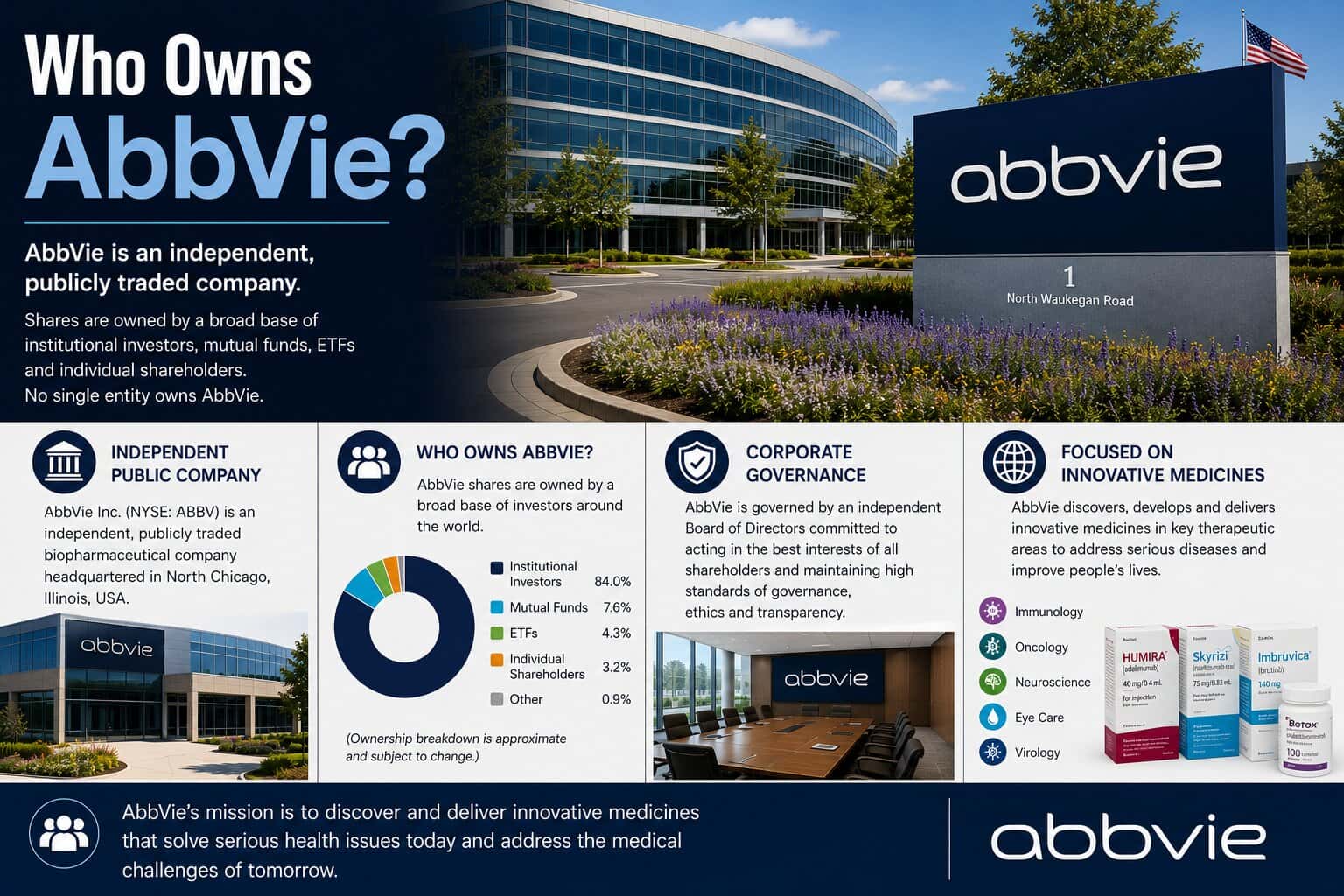
AbbVie is a publicly traded American biopharmaceutical company that has no single controlling owner, with institutional investors including BlackRock and Vanguard holding its largest share blocks, and is listed on the New York Stock Exchange under the ticker ABBV.
AbbVie was spun off from Abbott Laboratories as an independent publicly traded company in January 2013, created to focus exclusively on research-based pharmaceuticals after Abbott separated its pharmaceutical and medical device businesses.
AbbVie is headquartered in North Chicago, Illinois, employs approximately 55,000 people worldwide, and is led by CEO Robert A. Michael, who took over from founder-era CEO Richard A. Gonzalez in July 2024.
Knowing who owns AbbVie helps consumers and investors understand how one of the world’s top pharmaceutical companies governs its pipeline, pricing, and long-term strategy without a single family or founder controlling the business.
This article covers who owns AbbVie, what the company does, its history, how it compares to a rival, and key facts about the business.
So let’s get started.
Table of Contents
Who Owns AbbVie?
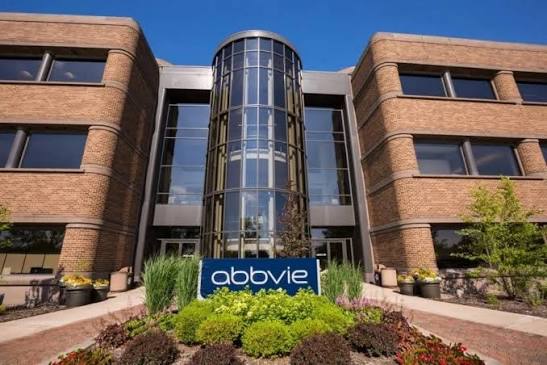
AbbVie is a publicly traded company with no single controlling owner, meaning ownership is distributed among millions of shareholders worldwide.
Large institutional investors including BlackRock, Vanguard, and State Street collectively hold significant share blocks and exercise influence through proxy voting at annual shareholder meetings.
AbbVie’s board of directors comprises 13 members as of 2025, with twelve independent directors, reflecting strong corporate governance with clear separation between ownership and management.
Robert A. Michael leads AbbVie as CEO while Richard A. Gonzalez, who led the company since its 2013 formation, transitioned to Chairman of the Board in July 2025, as confirmed in AbbVie’s company profile.
What Does AbbVie Do?
AbbVie is a global biopharmaceutical company that develops and markets treatments for immunology, oncology, neuroscience, and aesthetics.
Its blockbuster immunology portfolio includes Humira (adalimumab), the world’s best-selling drug for many years, and its successor generation products Skyrizi (risankizumab) and Rinvoq (upadacitinib), which combined generated approximately 25.9 billion dollars in 2025 sales.
CREON (pancrelipase), used for exocrine pancreatic insufficiency, is one of AbbVie’s digestive health products, and the company also owns the Allergan aesthetics portfolio including Botox following its 63 billion dollar Allergan acquisition in 2020.
AbbVie’s oncology business includes treatments for blood cancers including Imbruvica and Venclexta, with further oncology pipeline assets from the 10.1 billion dollar acquisition of ImmunoGen in 2024, as detailed on AbbVie’s official about page.
What Is the History of AbbVie?
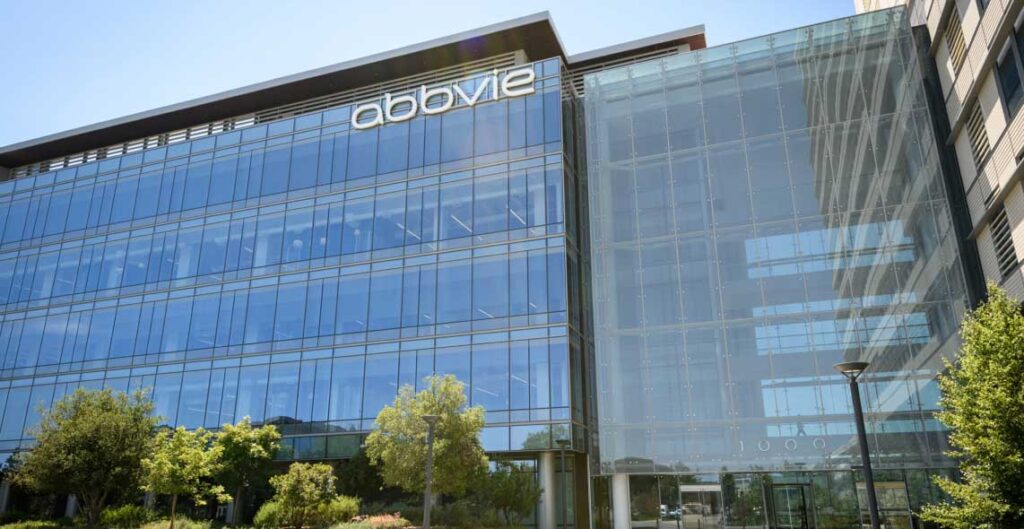
AbbVie was officially created in January 2013 when Abbott Laboratories separated into two independent public companies, with AbbVie taking the pharmaceutical business and Abbott retaining medical devices, nutritional products, and diagnostics.
Abbott’s pharmaceutical roots trace back to 1888 when pharmacist Wallace Calvin Abbott founded the Doxsee Drug Company in Chicago, eventually evolving into Abbott Laboratories and building one of America’s largest healthcare conglomerates.
Under Richard Gonzalez’s leadership from formation through 2024, AbbVie transformed from a Humira-dependent business into a diversified biopharmaceutical company, successfully navigating Humira’s US patent expiry in 2023 and replacing lost revenue with Skyrizi and Rinvoq growth.
In 2025, AbbVie announced a planned 2.1 billion dollar acquisition of Capstan Therapeutics to strengthen its immunology pipeline, reflecting its continued commitment to building beyond its current product portfolio.
How Big Is AbbVie?
AbbVie is one of the world’s largest pharmaceutical companies by revenue, with institutional investors and analysts tracking it as a top global biopharmaceutical enterprise.
The company employs approximately 55,000 people worldwide and has significant commercial operations across the United States, Europe, Japan, and other major pharmaceutical markets.
Its largest US facility investment in company history, a major North Carolina campus announced in 2025, reflects AbbVie’s continued commitment to American-based research and manufacturing operations.
AbbVie has paid fourteen consecutive years of dividend growth through 2025, reflecting its financial strength and commitment to returning capital to shareholders.
AbbVie vs Bristol Myers Squibb: How Do They Compare?
AbbVie and Bristol Myers Squibb are two of the world’s largest US-based biopharmaceutical companies and frequently compared competitors in immunology and oncology.
AbbVie leads in immunology, with Skyrizi and Rinvoq rapidly replacing Humira as the dominant biologics in inflammatory disease treatment across dermatology, rheumatology, and gastroenterology.
Bristol Myers Squibb leads in immuno-oncology with Opdivo and Yervoy, and in cardiovascular with Eliquis, giving it a different but equally large revenue base from AbbVie’s immunology concentration.
Both are top-10 global pharmaceutical companies competing across several therapeutic areas with strong pipeline depth and major acquisitions defining their respective strategies for the late 2020s.
Frequently Asked Questions About AbbVie
Who owns AbbVie?
AbbVie is publicly traded on the NYSE under the ticker ABBV with no single controlling owner. Largest shareholders are institutional investors including BlackRock, Vanguard, and State Street. CEO is Robert A. Michael.
Is AbbVie related to Abbott Laboratories?
Yes. AbbVie was spun off from Abbott Laboratories in January 2013. The two companies now operate as completely independent publicly traded companies with separate management, strategies, and products.
Where is AbbVie headquartered?
AbbVie is headquartered in North Chicago, Illinois, where it has operated since its 2013 formation as an independent company.
What is AbbVie best known for?
AbbVie is best known for Humira, once the world’s best-selling drug, and its successor immunology products Skyrizi and Rinvoq, which together surpassed 25 billion dollars in combined sales in 2025.

I am Jack Neel, a mechanical engineer, researcher, and writer. I created this website to share my knowledge about different brands and products with you. I research the manufacturers behind the brands and provide you with the information you need to make smart buying decisions.