
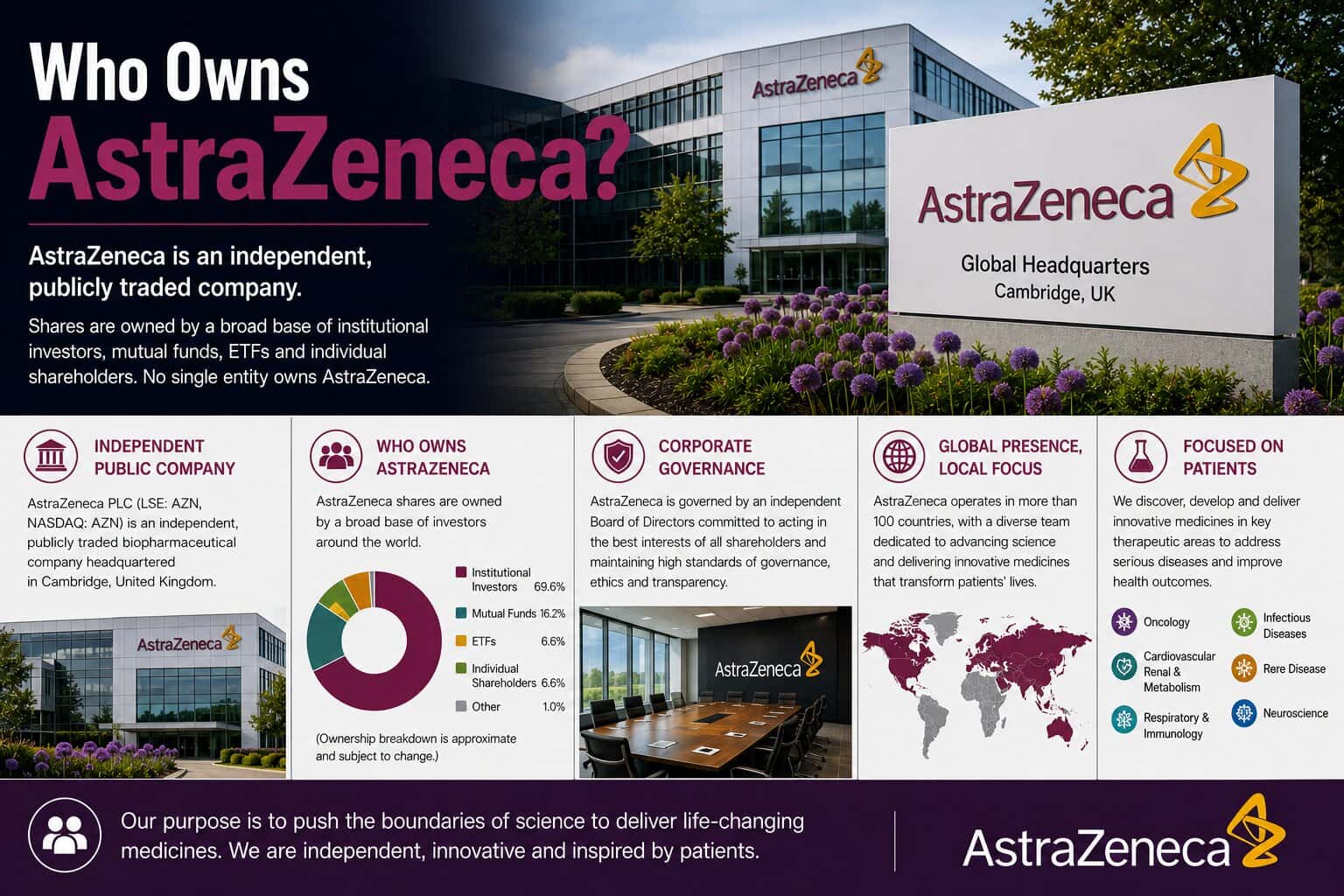
AstraZeneca is a publicly traded British-Swedish multinational pharmaceutical company with no single controlling owner, listed on the London Stock Exchange under the ticker AZN and on NASDAQ under the same ticker, with a market capitalization of approximately 250 to 300 billion dollars as of 2025.
AstraZeneca was formed in 1999 through the merger of Astra AB of Sweden, founded in 1913, and Zeneca Group plc of the United Kingdom, which was itself created in 1993 as a demerger from ICI.
AstraZeneca is headquartered in Cambridge, United Kingdom, at the Discovery Centre on the Cambridge Biomedical Campus, with CEO Pascal Soriot leading the company since 2012 and CFO Aradhana Sarin managing financial strategy.
Knowing who owns AstraZeneca helps investors and consumers understand the governance of one of the world’s largest pharmaceutical companies, which is aiming to reach 80 billion dollars in annual revenue by 2030.
This article covers who owns AstraZeneca, what the company does, its history, how it compares to a rival, and key facts about the business.
So let’s get started.
Table of Contents
Who Owns AstraZeneca?
AstraZeneca is publicly owned with no single controlling shareholder, with ownership distributed across millions of institutional and individual investors worldwide.
Large global institutional investment firms including BlackRock, Vanguard, and various sovereign wealth funds are among AstraZeneca’s largest shareholders, though none holds a controlling stake.
The company operates on a one-share-one-vote governance model with no dual-class shares, meaning voting power is directly proportional to share ownership for all investors equally.
AstraZeneca’s board is chaired by Michel Demaré, with CEO Pascal Soriot serving as executive director, as confirmed in AstraZeneca’s company profile.
What Does AstraZeneca Do?
AstraZeneca develops, manufactures, and markets pharmaceutical and biotechnology products for oncology, cardiovascular and renal, respiratory, immunology, and rare diseases.
Oncology now contributes over 35% of AstraZeneca’s revenue, with Tagrisso, Imfinzi, Lynparza, and Calquence among its leading cancer medicines.
FARXIGA (dapagliflozin) is one of AstraZeneca’s major cardiovascular and renal medicines, approved for type 2 diabetes, heart failure, and chronic kidney disease, and is a key contributor to the company’s strong cardiovascular and renal franchise.
In 2025, AstraZeneca announced a 50 billion dollar investment in the United States over five years, including a new manufacturing facility in Virginia and a cell therapy plant in Rockville, Maryland, as documented on AstraZeneca’s official about page.
What Is the History of AstraZeneca?

AstraZeneca was formed on April 6, 1999, through the 34 billion dollar merger of Astra AB of Sweden and Zeneca Group plc of the United Kingdom, creating one of the world’s largest pharmaceutical companies from two established European drug makers.
Astra AB was founded in Södertälje, Sweden, in 1913, while Zeneca was created in 1993 when ICI demerged its pharmaceutical division into a separately listed company.
Pascal Soriot took over as CEO in 2012 and immediately began restructuring the company, famously rejecting Pfizer’s 100 billion dollar takeover bid in 2014 and committing AstraZeneca to an independent growth path in oncology and biopharmaceuticals.
AstraZeneca gained global attention during the COVID-19 pandemic for developing a vaccine in partnership with Oxford University, and has since accelerated its oncology pipeline to become one of the fastest-growing large pharmaceutical companies in the world.
How Big Is AstraZeneca?
AstraZeneca is the most valuable company on the London Stock Exchange, with a market capitalization of approximately 325 billion dollars in early 2026, the largest single listing in London’s history.
The company employs approximately 85,000 people and markets medicines in over 100 countries.
AstraZeneca’s FY2024 revenue was approximately 54 billion dollars, with the company targeting 80 billion dollars annually by 2030, a target supported by over 20 anticipated late-stage pipeline launches in 2025 and 2026.
Research and development centers are maintained in Cambridge UK, Gaithersburg Maryland, Mölndal Sweden, and Warsaw Poland, supporting the company’s global clinical trial and drug development operations.
AstraZeneca vs Pfizer: How Do They Compare?
AstraZeneca and Pfizer are two of the world’s largest pharmaceutical companies and have a notable history, with Pfizer having attempted a 100 billion dollar hostile takeover of AstraZeneca in 2014 that AstraZeneca publicly rejected.
Pfizer is the larger company by revenue, with annual sales above 60 billion dollars, and is headquartered in New York with a broader portfolio spanning vaccines, oncology, and anti-infectives.
AstraZeneca has significantly outperformed Pfizer in share price growth since 2014, driven by its oncology-led strategy, and is now one of the most valuable pharmaceutical companies in the world by market capitalization.
Both companies are major COVID-19 vaccine developers, with AstraZeneca’s Oxford vaccine and Pfizer’s mRNA vaccine representing the two most widely distributed COVID-19 vaccines globally.
Frequently Asked Questions About AstraZeneca
Who owns AstraZeneca?
AstraZeneca is publicly traded with no single controlling owner. It is listed on the London Stock Exchange and NASDAQ under the ticker AZN. Largest shareholders are major global institutional investors.
Where is AstraZeneca headquartered?
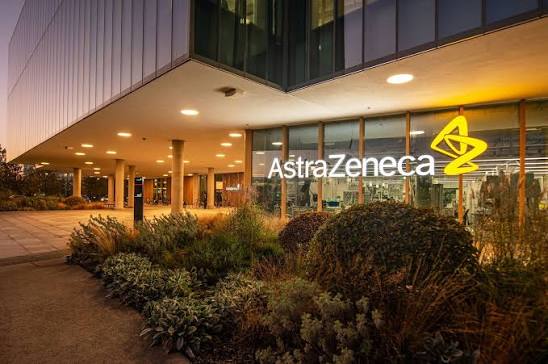
AstraZeneca is headquartered in Cambridge, United Kingdom, at the Discovery Centre on the Cambridge Biomedical Campus, a facility designed by Swiss architecture firm Herzog and de Meuron.
Is AstraZeneca British or Swedish?
AstraZeneca was formed from the 1999 merger of Astra AB of Sweden and Zeneca of the United Kingdom. It is incorporated in the UK and headquartered in Cambridge, with major R&D operations in both the UK and Sweden.
What is AstraZeneca best known for?
AstraZeneca is best known for its oncology portfolio including Tagrisso, Imfinzi, and Lynparza, its cardiovascular and renal drug FARXIGA, and its Oxford-developed COVID-19 vaccine. It is currently targeting 80 billion dollars in annual revenue by 2030.

I am Jack Neel, a mechanical engineer, researcher, and writer. I created this website to share my knowledge about different brands and products with you. I research the manufacturers behind the brands and provide you with the information you need to make smart buying decisions.