
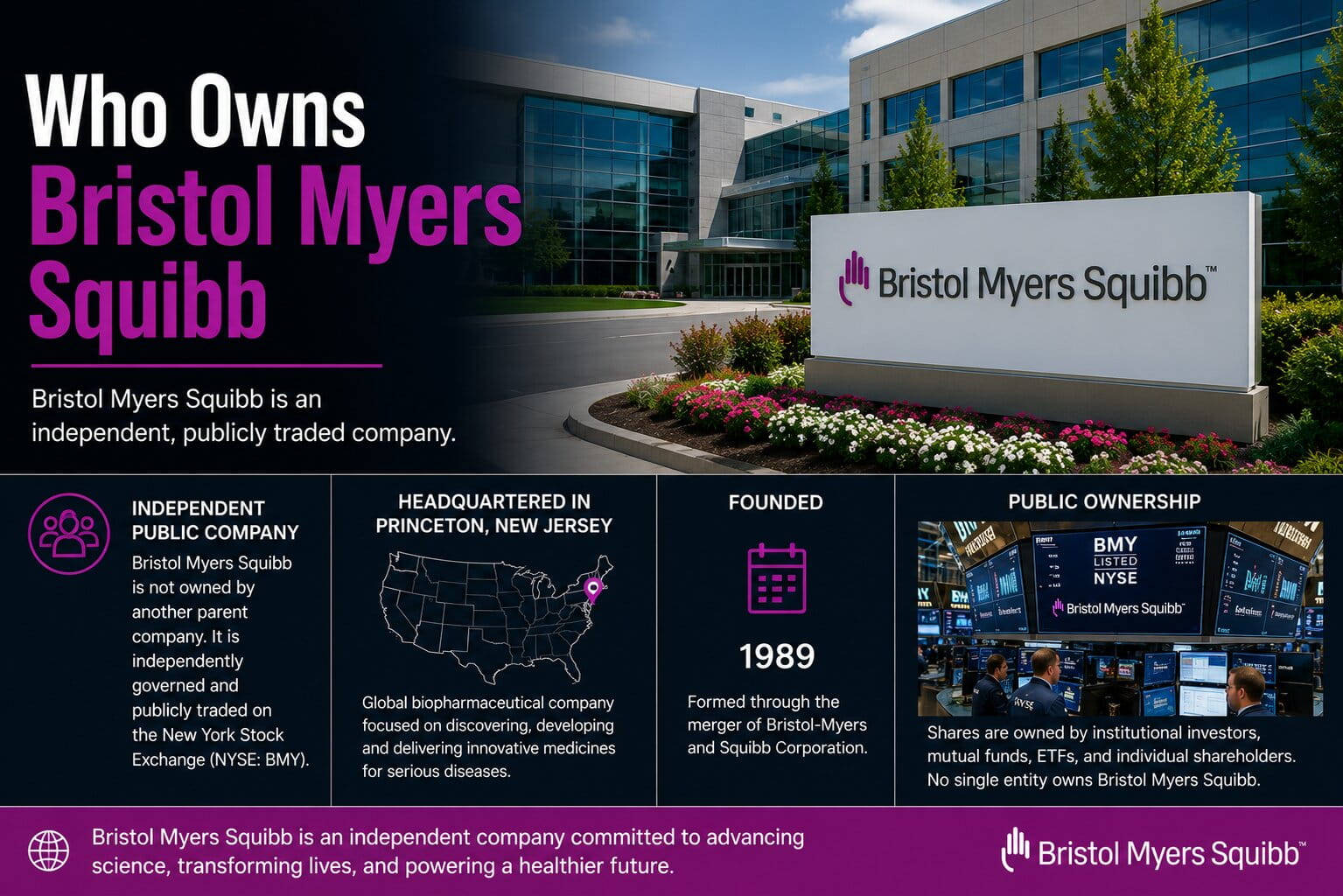
Bristol Myers Squibb is a publicly traded American biopharmaceutical company listed on the New York Stock Exchange under the ticker BMY, with no single controlling owner and institutional investors including BlackRock, Vanguard, and State Street holding its largest share positions.
Bristol Myers Squibb was formed in 1989 through the merger of Bristol-Myers Company and Squibb Corporation, combining two companies with pharmaceutical histories stretching back to the 1850s in New York and New Jersey.
BMS is headquartered in Princeton, New Jersey, employs approximately 32,500 people worldwide, and is led by Board Chair and CEO Christopher Boerner, Ph.D., who has steered the company through a major portfolio transition focused on oncology and cardiovascular growth brands.
Knowing who owns Bristol Myers Squibb helps explain how one of the world’s largest pharmaceutical companies governs a portfolio built around immuno-oncology, hematology, and cardiovascular medicine that generated 48.19 billion dollars in 2025 revenues.
This article covers who owns Bristol Myers Squibb, what the company does, its history, how it compares to a rival, and key facts about the business.
So let’s get started.
Table of Contents
Who Owns Bristol Myers Squibb?
Bristol Myers Squibb is publicly traded with no single controlling owner, with institutional investors collectively holding the vast majority of outstanding shares.
The company operates on a one-share-one-vote governance structure with no dual-class shares, ensuring all investors have proportional voting influence on key corporate decisions.
Christopher Boerner, Ph.D., serves as Board Chair and CEO, having been appointed to lead the company through its transition from legacy products including Revlimid into a growth portfolio anchored by Opdivo, Eliquis, Breyanzi, and Reblozyl.
BMS’s corporate governance and ownership structure are publicly disclosed in its annual reports and SEC filings, as confirmed in BMS’s company profile.
What Does Bristol Myers Squibb Do?
Bristol Myers Squibb discovers, develops, licenses, and markets biopharmaceutical products primarily in oncology, hematology, immunology, and cardiovascular medicine.
Its flagship product Eliquis (apixaban), developed in partnership with Pfizer, generated 14.44 billion dollars in 2025, making it one of the world’s best-selling medicines and the single largest contributor to BMS revenues.
In oncology, Opdivo (nivolumab) generated 10.05 billion dollars in 2025, reinforcing BMS’s position as one of the leaders in cancer immunotherapy alongside its Yervoy (ipilimumab) combination regimen.
Carboplatin, a platinum-based chemotherapy agent, was originally developed by Bristol-Myers and approved in 1989, though it has been available as a widely used generic cancer treatment for many years, as detailed on BMS’s official about page.
What Is the History of Bristol Myers Squibb?
Bristol-Myers traces its roots to 1887 when William McLaren Bristol and John Ripley Myers purchased the Clinton Pharmaceutical Company in Clinton, New York, manufacturing bulk drugs for wholesalers.
Squibb Corporation traces its origins to 1858 when Dr. Edward Robinson Squibb established a pharmaceutical laboratory in Brooklyn, New York, pioneering sterile and pure pharmaceutical manufacturing in America.
The two companies merged in 1989 to form Bristol-Myers Squibb, creating a pharmaceutical powerhouse with blockbuster products including Taxol (paclitaxel) for cancer and Pravachol (pravastatin) for cholesterol.
BMS accelerated into oncology through the acquisition of Medarex in 2009, which gave it the antibody technology behind Yervoy and Opdivo, effectively making BMS the pioneer of checkpoint inhibitor immunotherapy that transformed cancer treatment globally.
How Big Is Bristol Myers Squibb?
Bristol Myers Squibb generated total revenues of 48.19 billion dollars in FY2025, with its Growth Portfolio of newer medicines increasing 17% to 26.4 billion dollars, representing the company’s most successful year for its newer product lines.
The company employs approximately 32,500 people globally and operates research facilities in Princeton, New Jersey, as well as Cambridge, Massachusetts, and international research centers.
In July 2025, BMS created a new independent biopharmaceutical company with Bain Capital focused on autoimmune diseases, launching with five immunology assets in-licensed from BMS and a 300 million dollar financing commitment.
BMS is navigating a significant revenue transition as legacy products including Revlimid lose exclusivity, while its Growth Portfolio including Opdivo, Eliquis, Breyanzi, Reblozyl, and Camzyos fills the gap with expanding indications and strong volume growth.
Bristol Myers Squibb vs Merck: How Do They Compare?
Bristol Myers Squibb and Merck are two of the most directly compared American pharmaceutical companies, competing head to head in immuno-oncology with their respective checkpoint inhibitors.
Merck’s Keytruda (pembrolizumab) is the world’s best-selling cancer drug and generates over 25 billion dollars annually, making it the dominant force in PD-1 checkpoint inhibition.
BMS’s Opdivo and Yervoy combination was the first approved checkpoint inhibitor regimen and remains a leading treatment for melanoma, lung cancer, kidney cancer, and other tumor types, competing directly with Keytruda across multiple indications.
BMS differentiates with its cardiovascular franchise anchored by Eliquis, its cell therapy leadership through Breyanzi, and its growing hematology portfolio, giving it a more diversified revenue base than Merck’s Keytruda-concentrated model.
Frequently Asked Questions About Bristol Myers Squibb
Who owns Bristol Myers Squibb?
Bristol Myers Squibb is publicly traded on the NYSE under the ticker BMY with no single controlling owner. Largest shareholders are major institutional investors. CEO and Board Chair is Christopher Boerner, Ph.D.
Where is Bristol Myers Squibb headquartered?
Bristol Myers Squibb is headquartered in Princeton, New Jersey, where it has been based since consolidating its operations in the Princeton area following its 1989 formation.
What is Bristol Myers Squibb best known for?
BMS is best known for Eliquis, one of the world’s best-selling blood thinners, and Opdivo and Yervoy, pioneering cancer immunotherapy medicines. It also developed Taxol for cancer and was the originator of Carboplatin chemotherapy.
How much revenue does Bristol Myers Squibb generate?
Bristol Myers Squibb generated 48.19 billion dollars in total revenues in FY2025, with net income of 7.05 billion dollars. Its Growth Portfolio of newer medicines grew 17% to 26.4 billion dollars in the same year.

I am Jack Neel, a mechanical engineer, researcher, and writer. I created this website to share my knowledge about different brands and products with you. I research the manufacturers behind the brands and provide you with the information you need to make smart buying decisions.