
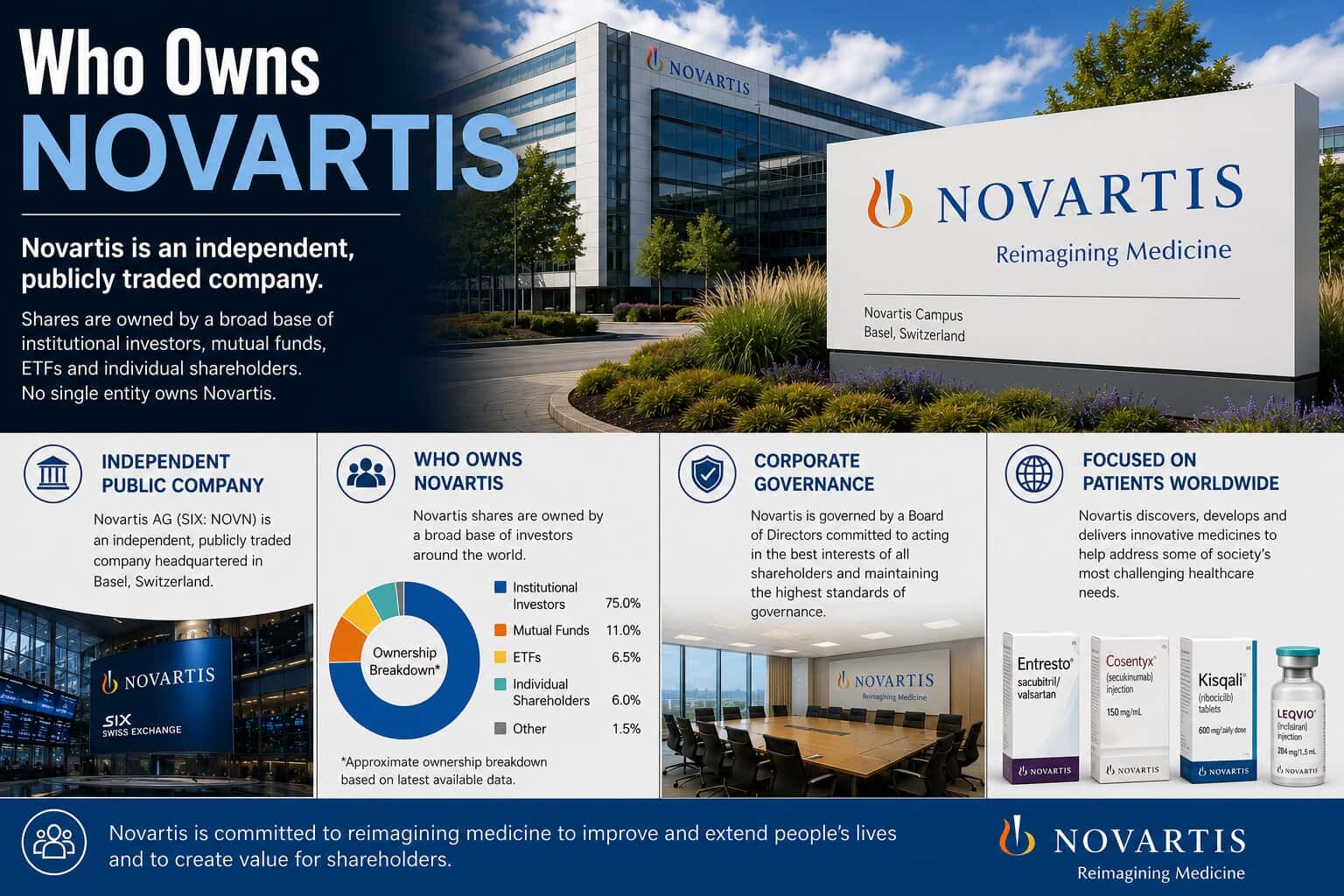
Novartis is a publicly traded Swiss pharmaceutical company with no single controlling owner, listed on the SIX Swiss Exchange under the ticker NOVN and on the New York Stock Exchange as an ADR under NVS, with a market capitalization of approximately 210 billion dollars as of early 2025.
Novartis was formed in 1996 through the merger of Ciba-Geigy and Sandoz, two Swiss chemical and pharmaceutical giants, creating one of the world’s largest pharmaceutical companies at the time of formation.
Novartis is headquartered in Basel, Switzerland, and is led by CEO Vas Narasimhan, who has served since 2018 and has transformed the company from a diversified conglomerate into a focused medicines company through the spinoffs of Alcon eye care and Sandoz generics.
Knowing who owns Novartis helps explain the governance of a company that has systematically divested non-core businesses to concentrate entirely on innovative medicines in cardiovascular, oncology, immunology, and neuroscience.
This article covers who owns Novartis, what the company does, its history, how it compares to a rival, and key facts about the business.
So let’s get started.
Table of Contents
Who Owns Novartis?
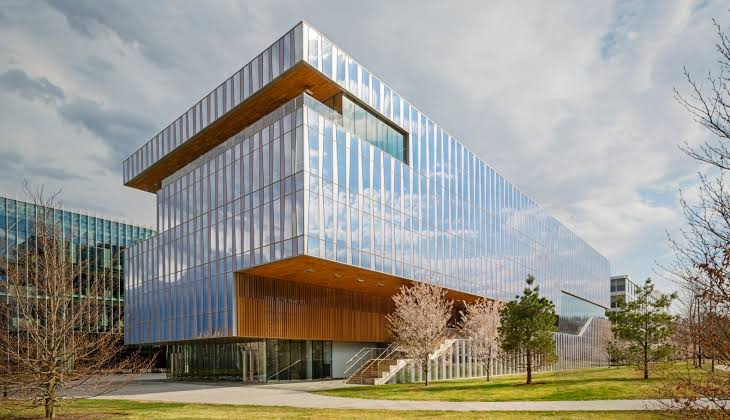
Novartis is publicly traded with no single controlling owner, with ownership distributed among millions of institutional and individual shareholders globally.
Large institutional investors including major index funds and active asset managers hold significant share blocks and collectively exert meaningful influence over governance decisions at annual shareholder meetings.
Novartis operates through its holding company Novartis AG, a publicly traded Swiss holding entity that owns directly or indirectly all companies worldwide that operate as Novartis Group subsidiaries.
CEO Vas Narasimhan, an American physician-scientist, has led Novartis since 2018 and in 2026 joined the board of Anthropic, reflecting his standing as one of the most prominent pharmaceutical executives globally, as confirmed in Novartis’s company profile.
What Does Novartis Do?
Novartis discovers, develops, manufactures, and markets innovative medicines across four core therapeutic areas: cardiovascular, oncology, immunology, and neuroscience.
Its leading products include Cosentyx (secukinumab) for plaque psoriasis, psoriatic arthritis, and ankylosing spondylitis, Entresto (sacubitril and valsartan) for heart failure, and Kisqali (ribociclib) for breast cancer.
COSENTYX, launched in 2015, is one of the world’s best-selling dermatology and rheumatology medicines, an IL-17A inhibitor that targets the underlying inflammatory pathway in multiple immune-mediated diseases.
Novartis also leads in advanced therapy platforms including radioligand therapy, cell and gene therapy, and siRNA therapeutics, positioning it at the frontier of next-generation medicine development, as outlined on Novartis’s official about page.
What Is the History of Novartis?
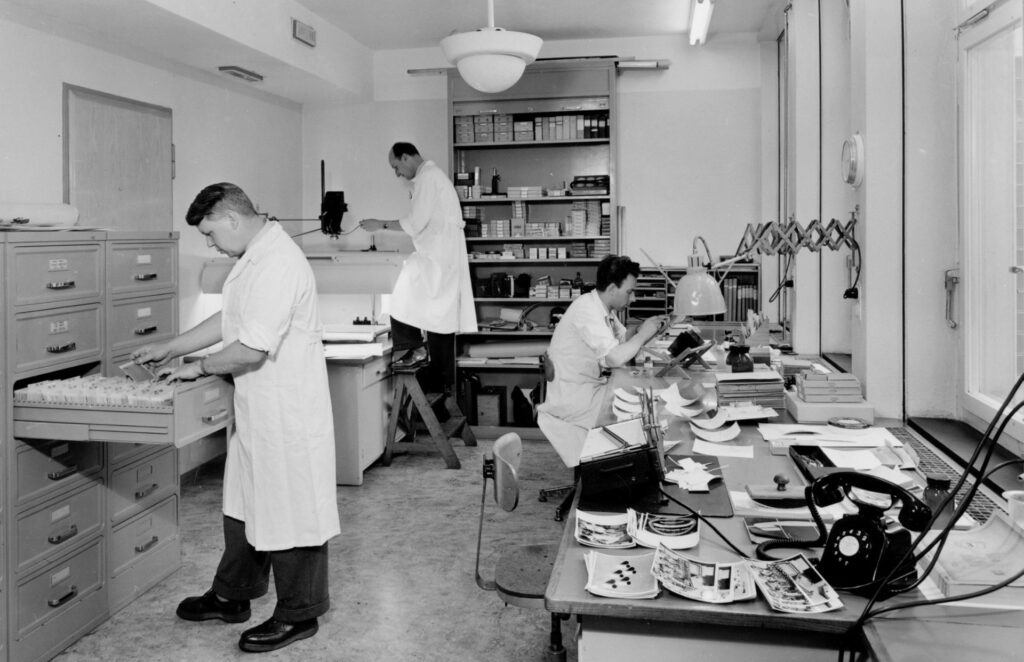
Novartis was formed on March 27, 1996, through the merger of Ciba-Geigy AG and Sandoz AG, two Basel-based Swiss chemical and pharmaceutical companies with histories stretching back to the mid-nineteenth century.
Ciba-Geigy was itself formed in 1970 from the merger of Ciba and Geigy, both founded in the 1850s, while Sandoz was founded in Basel in 1886, giving Novartis a combined industrial heritage of over 170 years.
Under Narasimhan since 2018, Novartis has divested its Alcon eye care division as a separately listed company in 2019, spun off Sandoz generics in 2023, and exited its stake in Roche, transforming into what it calls a pure-play medicines company.
In 2025, Novartis delivered a core operating income margin of 41.2%, two years ahead of its plan, and exceeded its long-term financial and innovation targets, driving Narasimhan’s compensation to 32.4 million Swiss francs for the year.
How Big Is Novartis?
Novartis employs more than 77,000 people in approximately 120 countries and reached over 300 million patients with its medicines in 2025.
Its market capitalization was approximately 210 billion dollars as of January 2025, making Novartis one of the most valuable pharmaceutical companies in the world.
Novartis has more than 30 potential high-value medicines in its pipeline across its four core therapeutic areas, with multiple upcoming launches expected to drive growth through the late 2020s and into the 2030s.
Key growth brands including Kisqali and Kesimpta delivered sales well above expectations in 2025, while the company faces a significant patent expiry cycle beginning in 2026 with the loss of Entresto exclusivity.
Novartis vs Roche: How Do They Compare?
Novartis and Roche are the two largest Swiss pharmaceutical companies, both headquartered in Basel, and have historically had a close relationship, with Novartis having previously held a significant stake in Roche before divesting it.
Roche is primarily a diagnostics and oncology company, with Genentech as its US pharmaceutical subsidiary and Chugai as its Japanese affiliate, making it one of the most integrated diagnostics-pharmaceuticals companies in the world.
Novartis focuses exclusively on innovative medicines after divesting Alcon, Sandoz, and its Roche stake, competing with Roche primarily in oncology where both companies have major cancer medicine portfolios.
Both are among the world’s top 10 pharmaceutical companies by revenue and market capitalization, and together they make Basel, Switzerland, one of the most important pharmaceutical industry centers in the world.
Frequently Asked Questions About Novartis
Who owns Novartis?
Novartis is publicly traded on the SIX Swiss Exchange under the ticker NOVN and on the NYSE as NVS with no single controlling owner. CEO is Vas Narasimhan, who has led the company since 2018.
Where is Novartis headquartered?
Novartis is headquartered in Basel, Switzerland, where both of its predecessor companies, Ciba-Geigy and Sandoz, were also based. Its US pharmaceutical operations are headquartered in East Hanover, New Jersey.
What is Novartis best known for?
Novartis is best known for Cosentyx, one of the world’s leading treatments for plaque psoriasis and inflammatory arthritis, Entresto for heart failure, and Kisqali for breast cancer. It also pioneered Kymriah, the first FDA-approved CAR-T cell therapy.
Is Sandoz part of Novartis?
No. Novartis spun off its Sandoz generics division as a separately listed independent company in 2023. Sandoz Group AG now trades independently on the SIX Swiss Exchange and is no longer part of the Novartis Group.
I am Jack Neel, a mechanical engineer, researcher, and writer. I created this website to share my knowledge about different brands and products with you. I research the manufacturers behind the brands and provide you with the information you need to make smart buying decisions.