
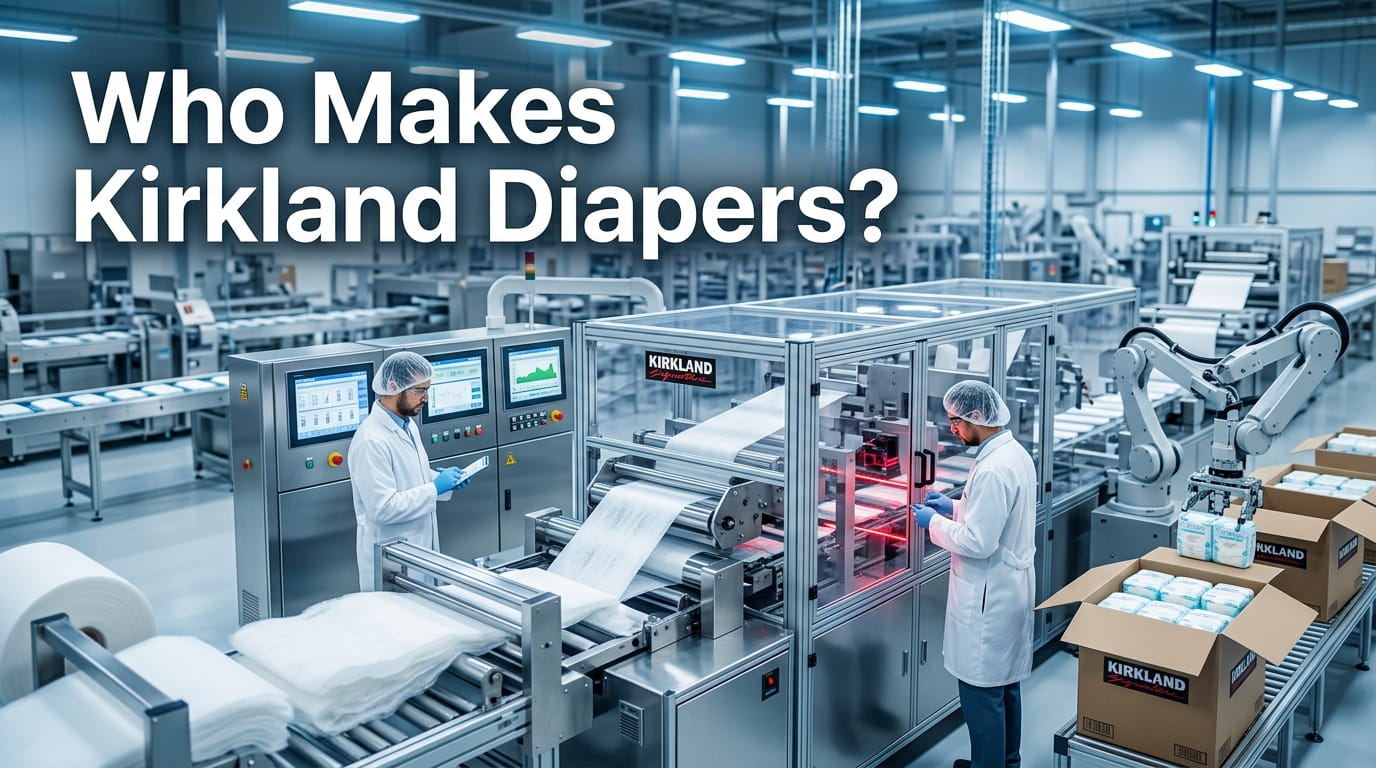
Kirkland Signature diapers are made by First Quality Consumer Products, a large American manufacturer that took over production from Kimberly-Clark starting in January 2025.
For roughly two decades before that change, Kirkland diapers were made by Kimberly-Clark, the same company behind Huggies, making the Kirkland product virtually identical to Huggies in construction and materials.
Kimberly-Clark ended its private label contract with Costco as part of a deliberate strategy to move away from low-margin store brand work and focus on its own premium branded products.
First Quality is the company behind the Cuties diaper brand and operates large domestic manufacturing facilities in Pennsylvania and Georgia.
Costco does not manufacture any products itself; Kirkland Signature is a private label, meaning all products under that name are made by contracted third-party manufacturers.
The manufacturer switch became noticeable to many parents by mid-2025, with widespread reports that the new First Quality diapers were thinner and less absorbent than the previous Kimberly-Clark version.
Table of Contents
Who Makes Kirkland Diapers Now in 2026?

As of January 2025, Kirkland Signature diapers are manufactured by First Quality Consumer Products. First Quality is a family-owned American hygiene products company headquartered in Great Neck, New York, with production plants primarily in Lock Haven, Pennsylvania, and Macon, Georgia.
First Quality already had major scale in the disposable hygiene market before winning the Costco contract.
Its main consumer-facing diaper brand is Cuties, sold at Walmart, Target, and similar mass retailers.
Taking on the Kirkland account required First Quality to expand its production capacity significantly to meet Costco’s volume, which represents one of the largest private label diaper programs in North America.
Before January 2025, Kirkland diapers were made by Kimberly-Clark Corporation, the maker of Huggies and Pull-Ups.
That partnership lasted for roughly two decades and produced a Kirkland diaper that parents widely considered to be essentially the same product as Huggies at a lower cost per unit.
Why Did Costco Change Diaper Manufacturers?
Kimberly-Clark made the call to exit the private label business, not Costco. The company announced it was pulling back from store-brand contracts as part of a broader profitability strategy reported by Bloomberg in late 2024.
The logic was straightforward: making Huggies earns Kimberly-Clark far better margins than making the same diaper under a competitor’s label at a lower price.
By exiting private label work entirely, Kimberly-Clark freed up factory capacity to focus exclusively on higher-margin branded products.
Costco then negotiated a new supply agreement with First Quality, which was positioned to absorb the volume and had the existing infrastructure in disposable hygiene manufacturing to meet Costco’s quality standards.
The transition began in January 2025 and new stock started appearing on warehouse shelves across the U.S. in the months following.
Are the New Kirkland Diapers as Good as the Old Ones?
Parent reviews since the 2025 switch have been largely negative. Across consumer forums and retailer review sections, the most consistent complaint is that the new First Quality-made diapers are noticeably thinner than the Kimberly-Clark version.
Before the switch, Kirkland diapers regularly scored among the top value picks in parent guides precisely because their construction matched Huggies almost exactly. That reputation no longer holds to the same degree.
Natalia Richer, a personal hygiene products expert at Diaper Testing International, noted before the transition that First Quality is technically capable of meeting equivalent absorbent core targets.
However, real-world parent experience since the rollout suggests the actual product arriving on shelves uses a lighter core than the previous version.
Performance concerns are most pronounced in smaller sizes like Size 1 and Size 2, where parents have reported near-leak incidents during heavy use or overnight sessions.
Larger sizes have received slightly more mixed feedback, with some parents finding the fit and absorbency acceptable.
Kirkland Diapers vs. Huggies: Which Should You Buy in 2026?
Until January 2025, the answer was easy: Kirkland diapers were made by Huggies’ own manufacturer, so you were getting the same product at a lower cost. That calculus has changed.
Kimberly-Clark’s Huggies line continues to use the same materials and construction it always has. Post-switch Kirkland diapers from First Quality are a different product built to a different specification.
For parents who used Kirkland diapers heavily during the Kimberly-Clark era, the honest recommendation as of 2025 is to try a smaller box of the new Kirkland product before committing to Costco’s bulk pack sizes.
If the new diapers work for your child’s body shape and usage level, the price-per-diaper advantage is still very real. If not, Huggies now holds a clear quality edge over the updated Kirkland version.
Pampers, made by Procter and Gamble, is the other major premium diaper brand worth comparing. It uses a different absorbent core technology than Huggies and tends to run slightly narrower in the fit, which some parents prefer for slimmer babies.
Who Makes Kirkland Diapers Outside the USA?
Costco operates warehouses in Canada, the UK, Japan, South Korea, Australia, and several other countries. The Kirkland Signature diaper supplier may differ by region depending on which manufacturers Costco contracts locally.
In Canada, Kirkland diapers have historically followed the same supply chain as the United States, meaning Canadian shoppers experienced the same manufacturer transition to First Quality in early 2025.
In other international markets, Costco sources from regional suppliers and the Kirkland diaper product may be made by entirely different manufacturers than those supplying the U.S. market.
What Else Does First Quality Manufacture?
First Quality Consumer Products makes a wide range of disposable hygiene products. Beyond baby diapers under the Cuties brand, the company produces adult incontinence products under the Prevail brand, feminine hygiene items, and training pants.
Prevail is one of the strongest adult incontinence brands in the U.S. market and is sold in pharmacies, grocery chains, and medical supply retailers nationwide. First Quality also operates its own tissue business alongside its hygiene division.
The company does significant private label work across the hygiene category beyond the Costco diapers account, making it one of the most important behind-the-scenes manufacturers in American disposable hygiene. For other Costco private label origins, see Who Makes Kirkland Dog Food and Who Makes Kirkland Golf Balls.
Frequently Asked Questions About Kirkland Diapers
Are Kirkland diapers still made by Huggies?
No. As of January 2025, Kirkland Signature diapers are no longer made by Kimberly-Clark, the company behind Huggies. First Quality Consumer Products, the maker of Cuties diapers, is now the manufacturer.
Are the new Kirkland diapers made in the USA?
Yes. First Quality Consumer Products manufactures the current Kirkland Signature diapers at its U.S. facilities, primarily in Lock Haven, Pennsylvania, and Macon, Georgia. The previous Kimberly-Clark-made version was also produced domestically.
When exactly did Kirkland switch diaper manufacturers?
The official manufacturing transition took effect in January 2025. New First Quality-made Kirkland diapers began appearing on Costco warehouse shelves across the United States in the months following, with most locations fully transitioned to the new product by mid-2025.
Who makes other Kirkland Signature products?
Different Kirkland Signature products are made by different manufacturers under contract with Costco. Some are made by the same companies behind leading national brands, while others come from specialist private label producers. Costco rarely discloses all its supplier relationships publicly, but many have been identified over the years through industry reporting and packaging comparison.

I am Jack Neel, a mechanical engineer, researcher, and writer. I created this website to share my knowledge about different brands and products with you. I research the manufacturers behind the brands and provide you with the information you need to make smart buying decisions.